


 Francais
 Deutsch
 Italiano
Refine Your Search
Naples Italy 1943 stock footage and images
- Showing 1861 to 1866 of 4562 results more
more Hide
Hide
Views from a U.S. Destroyer in Operation Shingle convoy (Allied invasion of Anzio, Italy) during World War II
Operation Shingle invasion convoy during Operation Shingle in World War 2. Opening scene shows view from a U. S. Destroyer showing a transport ship with several Higgins boats in water nearby, and some small invasion boats in distance. View from the Destroyer, close to land, as a lancing craft (Higgins Boat) passes in rough water. Next, Sailors on the Destroyer position a battery of 5 torpedo tubes into firing position on her deck. View from underneath the torpedo tubes, with a line of landing craft seen in distance. Sailors man an anti-aircraft gun on deck. Officer looks through binoculars. Several officers look through binoculars. Two sailors discuss a knife held by one. Warships seen in distant background. Sailors maneuver twin Bofors 40m anti-aircraft auto cannons. Destroyer's guns firing.
Views of destruction and privation in Italy. Views of Corsica and Alta Air Base, there, during World War II.
Camera positions in aircraft P-47. Camera installed behind pilot, under the wing, in the wing, and the wheel well. Pilot's hand at instrument panel. Actor James Stewart reads a passage from a book about the film'Thunderbolt' depicting U.S. Air Forces operations flying P-47 aircraft, during World War II. A ship in a harbor. Ruined buildings at Italian port town. Italian civilians pass on street. Ruined buildings in town. Horse-drawn carts pass along road. Men and women in rubble. Face of an old lady. Refugees on Kimble Bridge. Children in rubble-strewn street. Skeleton of dead bombing victim in rubble. Clouds settled over mountains. A river and waterfall as seen from aircraft. Aerials of town on banks of river. Ruins of Italian towns. Wrecked train. Map highlights Corsica, Mediterranean Sea and Sicily. Island of Corsica. A family with animals being watered at a fountain. Several people posing outside the "Bar Napoleon."Corsican people on street. A graveyard containing German war dead. Man climbs control tower at Alto Air Base in Corsica. Crew at work on airfield. Unfuzed bombs are casually rolled off a moving trailer onto the ground. Man refuels P-47. A soldier sleeps in tent. Men in tents and outside get ready for mission in morning. Airman looks into mirror. Airmen wear uniform and comb hair. Men wash faces and shave. Men brush teeth. Also shows morning activities of a Captain. Aerials of Alto Air Base. Men on look out tower. A Lieutenant smokes pipe. Airmen enter tent and get instructions from officer. Men around chart.
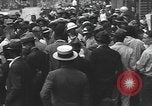
African American citizens in New York City volunteer to serve King Haile Selassie I in potential war with Italy
African American people line up to volunteer for helping King Haile Selassie I of Ethiopia in case of an Italian invasion (Italo-Ethiopian War). People register themselves as Ethiopian volunteers in New York City. A young African American woman registers herself for service as a nurse in Africa.
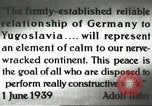
Tripartite Pact signed by Germany, Italy and Japan in Berlin, Germany. Ensuing attacks by Germany and Japan in World War II
This film is a scattering montage of World War 2 scenes from 1939 through 1945. Part of an agreement between Nazi Germany and Yugoslavia is shown in English. It is dated June 1, 1939 and ostensibly signed by Adolf Hitler. Next, German Ju 87, Stuka dive bomber aircraft are shown peeling off from formation, on April 6, 1941, to attack Yugoslavia. Bombs bursting on the ground. Closeup of a Stuka airplane in a dive, making its characteristic whine, and dropping bombs. Bombs exploding just outside some concrete walls. German infantry running along railroad tracks and entering backyard of house in a village. German soldiers observing from overlooking hill; climbing over rubble; and marching along a road toward a village. Animated map showing German invasion areas early in World War II, extending through most of Europe and into Norway, by 1941. Animated map shows further invasions into France, Belgium, low countries, the Balkans, and Eastern front towards the Soviet Union. Map highlights Tokyo, Rome, and Berlin. Delegations walking in hall of Reich Chancellery in Berlin, to sign Tripartite pact, on September 27, 1940. The group is led by by Count Galeazzo Ciano (Italian Foreign Minister, and Mussolini's son-in-law); Joachim von Ribbentrop, Germany's Foreign Minister and Japan’s Ambassador Saburō Kurusu. The diplomats are seen, next, standing near a table as Adolf Hitler enters rendering Nazi salute. He shakes hands with Count Ciano and Ambassador Kurusu. Hitler is seated to watch the proceedings. Von Ribbontrop is seen signing for Germany. Next scenes show German armored units heading East in Operation Barbarossa (June of 1941). A sign identifies the town of Eydtkau (Eydtkuhnen) on the German-Lithuanian border. German armor and artillery moving eastward. German troops destroying international crossing barriers. German troops firing siege guns. Montage with glimpses of German battle scenes showing tanks, guns, rockets in action with attendant explosions, fires, and destruction. Formations of German warplanes in flight, including Junkers Ju-52s that carry troops, including paratroops. View from above of Junkers Ju-87 Stuka dive bombers in formation. Battle of Britain scenes, with view of St. Paul's Cathedral in London, England (which miraculously survived the Blitz). The Tower Bridge in London, seen through a haze following blitzkrieg. German Junkers 87 Stuka dive bombers peeling off from formation to attack. British anti-aircraft searchlights shining beams skyward. Diving bombers illuminated by the lights. Anti-aircraft guns firing. Nighttime scenes showing gunfire flashes, explosions, tracer bullets and fires in London. British fire brigades fighting fires in London buildings as some collapse from the German bombing during the so-called "Blitz." Scene shifts to Pearl Harbor, December 7, 1941, as a Japanese bomb explodes on a U.S. Navy warship. The USS Arizona billowing smoke and listing as it succumbs to Japanese bombing. Another view of the Arizona sinking. Smoke rising from Battleship Row, at Pearl Harbor. Glimpse of postwar Nuremberg trial.
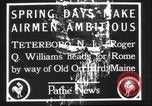
Attempted Atlantic flight by Roger Q Williams and Captain Lewis A Yancey from New Jersey to Rome, Italy, via Maine
Transatlantic flight attempt by Roger Q Williams and Captain Lewis A Yancey in Bellanca monoplane named "the Green Flash. They take off from Teterboro, New Jersey and are seen landing on the beach at Old Orchard, Maine. They refuel and board for their transoceanic leg to Rome. But on takeoff role along the beach, they hit a puddle of seawater that causes them to crash. Views of the damaged airplane.
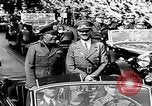
Twentieth Century scenes spanning German annexation of Austria; Italy-Ethiopia conflict; Korean War; and Vietnam War.
Adolf Hitler and Benito Mussolini standing together in an open car during a motorcade in Munich, in 1938. Civilian spectators render Nazi salutes as they pass. Next, British Prime Minister, Neville Chamberlain, arriving for the Munich treaty conference, steps from a British Airways Lockheed Model 14 passenger plane. An honor guard of helmeted and white-gloved German soldiers stands at attention during his welcome. Adolf Hitler climbs stairs of Berghof together with Chamberlain and Hitler's interpretor, Paul Otto Schmidt, on September 15, 1938 for their conference. Crowds of Germans give Nazi salute and cheer as Hitler and Mussolini appear on a balcony. Prime Minister Chamberlain back from the conference, speaks to the crowd at Heston Aerodrome on 30 September 1938, saying, among other thing, "We regard the agreement signed last night, and the Anglo-German naval agreement as symbolic of the desires of our two peoples never to go to war with one another again." Damaged buildings and ruins of city. Mussolini giving an impassioned speech. Italian cavalry carrying out a charge in Ethiopia. Italian troops employing machine guns in the Second Italo-Ethiopian War circa 1936. Italian infantry charging across sand dunes. Ethiopian Emperor Haile Selassie at the League of Nations podium. Nazi Swastika eagle statue. A formation of German troops, during the Anschluss (German annexation of Austria,in 1938). Hitler at a podium. People rendering Nazi salute in annexed city. At this point, the film transitions to 1950 as North Korean troops cross the 39th parallel and start the Korean War. A nighttime artillery barrage. North Korean troops firing a Browning M1917 machine gun and rifles. The feet of American soldiers are jumping out of foxholes as U.S.M26 Pershing tanks fire their guns from tilted positions below hills. A Pershing tank crosses a bridge back into South Korea, where a sign reads:"You are now crossing the 38th parallel, Co.B 728 MP." Scene shifts again, to President Lyndon B. Johnson delivers speech about Vietnam at a news conference on July 28, 1965, in which he states,among other things, "Three times in my lifetime...Americans have gone to far lands to fight for freedom..." as he explains U.S. involvement in Vietnam and the Vietnam War.