


 Francais
 Deutsch
 Italiano
Refine Your Search
Naples Italy 1943 stock footage and images
- Showing 217 to 222 of 4566 results more
more Hide
Hide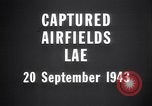
Destruction from Allied bombing at Lae airfield, New Guinea. B-25s fly bombing missions against Japanese targets in Wewak area.
Opening slate gives date as September 20, 1943. Scenes show devastation wrought by Allied bombing of the Japanese airfield at Lae, New Guinea. Most views are from the ground, as Allies occupy the field. Numerous Japanese aircraft are destroyed along with all the buildings and facilities. Next, is shown the view from inside a B-25 bomber, on September 27, 1943, as it flies in a 100 aircraft bombing mission to attack coastal facilities, ships, and airfields in the Wewak area, including the main air base at Wewak and its satellite fields at Boram, Dagua and But. Several B-25s are seen ahead in formation. View of the coastal area below as the camera plane (B-25) comes under fire by Japanese anti-aircraft guns. A pall of smoke hangs over the Wewak area from bombing by B-24s earlier. view from cockpit as the B-25 makes very low strafing and bombing attack against the Japanese satellite airbase at Boram. Another B-25 seen as it flies close to the ground. View to the rear shows small parachutes being released by the B-25, carrying single 100-lb fragmentation bombs and 23-pounders in clusters of three. The fragmentation bombs explode amongst palm trees sheltering Japanese aircraft. view out the back of the camera B-25 shows it continuing to fly, just over the tree tops, at very low altitude. Next, several B-25s are seen rejoined up in formation, ahead. Scene shifts to view from high altitude of bombs striking in the Wewak waterfront area. View from below of three B-25s in formation. Then view from cockpit of a B-25 flying low over the water strafing a ship. (Narrator says they dive low to skip-bomb a ship trying to escape.) Various views of the high hills at the waterfront. View from B-25 strafing Japanese aircraft on the ground at Dagua and Boram airfields. several B-25s in formation headed home. (World War II period).
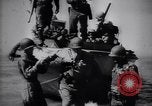
Early life of General George S Patton, and Patton in Africa during World War II.
'The Big Picture' episode narrated by Ronald Reagan depicts the life of U.S. General George S Patton, Jr. Opening scene shows General George S. Patton, Jr. stepping from a landing craft in France, during World War 2. He stands by the side of a road and waves, as elements of his 3rd Army pass in tanks. Patton in a jeep moving with his troops. General Patton pointing with a baton, in North Africa. View of a world globe being circled by a satellite. A baby picture of Patton (called "Georgie"). Patton seen as a boy, fencing, as a cadet at the Virginia Military Institute, and as a cadet at the U.S. Military Academy, West Point. A smiling Patton at West Point. Members of the first football team for soldiers established by Patton. Renault tanks of the 1st Tank Battalion moving with AEF soldiers in World War I. Tank commander George Patton standing in front of a Renault tank. Group picture of American soldiers and tanks, at the Tank School, in Fort Meade, Maryland, after World War I. Closeup of Dwight D. Eisenhower and George S. Patton, in the group. Patton and his wife, Beatrice Banning Ayer, in Old West costumes, for a party, where he displays a pistol in his belt, and in costumes for another party, where they dress as a knight and his lady on horseback. American recruits and draftees being issued uniforms in World War 2. Lieutenant General George S. Patton, Jr. commanding forces for the invasion of North Africa, in November, 1942. U.S. Navy warships fire their guns in advance of an amphibious landing. Landing craft heading toward shore. U.S. troops coming ashore at Casablanca, French Morocco. General Patton accompanied by French officers. Glimpse of U.S. President Franklin D. Roosevelt and British Prime Minister Winston Churchill at their conference in Casablanca in 1943. Patton riding in an armored car with three-star flag displayed. Artillery firing in battle of Tunisia. Lt. Gen. Patton and others observing operations. British General, Sir Harold Alexander, steps from a light airplane to meet with General Patton in North Africa. They converse. General Patton in March 1943 with binoculars observing battle, with Major General Terry Allen on his right, and Brigadier General Theodore Roosevelt Jr. to the right of Allen. They are viewing from a ridge by the village of El Guettar, as allies engage German troops and armor from the 10th Panzer Division. M3 Lee tanks moving in the desert. Knocked out tanks of the German 10th Panzer Division, including German Panzer IV tanks, in the aftermath of the Battle of El Guettar. General Patton coming aboard an American warship, and then standing with an Italian officer and a U.S. Major General. Allied naval bombardment at night. Patton observing though binoculars. Allied warships bombarding Sicily. Allied amphibious forces heading ashore in landing craft. Troops moving ashore. Closeup of troops in a landing craft. Glimpse of Patton in a landing craft. Troops walking across floating dock from a landing ship. U.S. flag flying in sand at beachhead. Landing ships in background. General Patton stepping ashore from small boat, and conversing onshore with a Brigadier General and some troops.

American workers and OSS in World War 2 work to estimate the loss of German military manpower in battle.
Film outlines process of U.S. military and War Department to estimate the German military manpower losses from 1939-1943 during World War II. Scenes of German military forces in battle. German tank on the battlefront smashes down a tree and German soldiers follow, running behind it. Dead bodies of soldiers lay on the battlefield. Airplane falling from sky to ground after being hit. German Soldiers fire rifles during battle. German soldiers carry wounded on litters and German medical staff treat the wounded soldiers. A wounded soldier on a hospital bed. Nurse leans over hospital bed and talks to a wounded soldier. A study made to find out the number of soldiers returning to their jobs after being injured. A man reads a magazine which reads: 'Estimate of non battle causalities'. German soldiers march through Arc de Triomphe in Paris during occupation of Paris by Nazi Germany. Headline of a newspaper reads: 'Germans silent on Russian gain'. Brief scene of Soviet leader Stalin speaking at a microphone. Cavalry soldiers, likely Soviet, crossing a battlefield. Scenes of World War I German troops being reviewed by officers. Civilian or OSS men lean over a German map and discuss among themselves. They study the map. Scene of men and women at a German news stand buying German newspapers in order to obtain obituary information. OSS personnel translate casualty reports from German newspapers to help estimate deaths of German soldiers and determine force strength. An operations room with American staff analyzing German newspapers. View of a Boeing 314 Clipper Flying Boat aicraft taking off from water. The reports from World War I and II, allied forces, chart, graphs and NARS computers used to estimate German Army's manpower loss. African American women workers operate keypunch machines recording battle casualty statistics which yield punch cards for further data analysis. Punch cards being created and being loaded in sorting and reading machines bearing brand "International" (for International Business Machines or IBM). A document entitled "analysis of obituaries." Man in an office studying a map and a document. A woman helps him as she enters numbers into a Remington Rand adding machine. They estimate the officers killed in war and the number of the killed enlisted men, in order to estimate the total battle loss. They compare the data of soldiers missing, killed, wounded, and unfit for duty from 1939 to 1943.
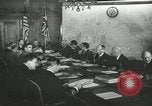
Landing craft, tanks, munitions, and gasoline supplies assembled in England for D-day invasion in World War II
Preparations in year 1943 for the June 1944 invasion of Western Europe by Allied Force during World War 2. Conference at Supreme Headquarters Allied Expeditionary Force in London. U.S. Generals George Marshall, Henry H. Arnold and British Field Marshal Bernard L. Montgomery meet at SHAEF (Supreme Headquarters Allied Expeditionary Force). Montage of war scenes: British Lancaster bombers taking off. British men and women monitors working in a British Command and Intelligence Center, tracking aircraft positions on maps. U.S. B-17 bombers in daylight missions over Germany. Allied pilots and crew members in aircraft. U.S. Army Air Force B-17 aircraft at high altitudes leaving contrails behind. Bombs bursting on German industrial targets. Allied agents being airdropped over France. Allied one-man submarines or solo submarines, torpedo boats and Commandos sampling French beaches and soil conditions in the Normandy region for ability to support 30-ton tanks for the invasion of France. British airman loading reconnaissance camera into a British Spitfire reconnaissance aircraft for photographing the planned invasion region. Woman operating microscope analyzing film. Aerial reconnaissance film images being laid out and attached together to create a large overhead viewing map. Arms and equipment being air dropped to indigenous resistance forces in Nazi-occupied Europe. Mulberry floating harbor segments being designed and built to create invasion ports. Allied landing craft training in Devon, England. Allied aircraft strafing a German ship. Meteorological equipment assessing weather along the invasion coast. Wire netting to pave the beaches. Underwater pipelines to carry gasoline or petrol to France. Allied armored vehicles bearing the White Star. Troops being inoculated or vaccinated. Newly built ship going down the ways at an Allied ship yard that builds Navy warships. View of British intelligence officers with headsets at radio equipment, and personnel monitoring German radio broadcasts. Soviet Embassy in Tehran, Iran, where the Big Three are seen meeting at Tehran Conference to finalize invasion plans. Stalin, Roosevelt, and Churchill sitting on the porch of the Embassy building, in 1943. General Eisenhower and Allied Military leaders planning the D-Day invasion. General Omar Bradley, sitting with a British admiral. General Bernard Law Montgomery Aerial view of formation of U.S. Army Air Force B-17 aircraft, flying through Flak bursts. Pilots in B-17 cockpit .Bombs striking German targets. Polish, Scenes including gun camera footage of Czech, and British in Spitfire aircraft striking German railroads and marshaling yards. B-26 bombers and gunner attacking German Luftwaffe Me-109 aircraft.
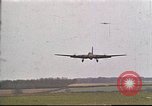
B-17 Flying Fortress bombers of U.S. 8th Army landing in succession on an airfield in England during World War 2.
B-17Fs of the 8th Bomber Command, 1st Bomb Division, 305th Bomb Group, 366th Bomb Squadron, landing at their base, RAF Chelveston, in Northamptonshire, England, during World War II. The first to land displays a dozen yellow bombs, for missions, painted under the pilot's cockpit window, and Squadron code KY, and L, on its fuselage. Its tail number is 42-5053. The second plane to land displays KY and D, on fuselage, and tail number 42-29553. The third, shows the squadron's KY, but other markings are not readable. The fourth to land displays some mission bombs below its cockpit window, the Squadron KY, and J on the fuselage. Its tail number is 41-21624. Bomb Group tail codes and nose art are not seen on any of the aircraft. But, researchers have identified names of three of them: Bloody Tangier Show (42-5053), Arkie II (42-29553),and Madame Betterfly (41-24624), and estimate the film to have been shot between 3/1/1943 and 5/19/1943.
American campaign against Japanese-held islands in the Pacific during World War II
U.S. sea power in the Pacific Theater during World War II. Aerial view of landing craft speeding through the water below. Animated map of Pacific Islands including the Solomons, New Britain, and New Guinea. Shows arrows depicting American amphibious assaults on Russell Islands in February, 1943; on New Guinea, and Rendova in June, on New Georgia in July, on Eastern New Georgia in August, on Choiseul, in October, and Bouganvillle in November, 1943. Aerial view of a Pacific Island airfield. Grumman F4F aircraft with engine running on an aircraft carrier. Bow view of an American Essex class Aircraft Carrier making way in heavy seas. A Douglas Dauntless airplane heading away from a carrier (in background). Map showing locations of American North and South Pacific naval forces and arrows pointing to Tarawa Atoll in the Gilbert Islands, and then to the Marshall Islands (Kwajalein Atoll and Enewetak Atoll). American infantry marching with full field packs, at a port, where they board transport ships. An artillery field piece being loaded on the ship, along with landing vehicles tracked, and army trucks. A convoy of troop ships and supply ships at sea.