


 Francais
 Deutsch
 Italiano
Refine Your Search
Naples Italy 1943 stock footage and images
- Showing 2269 to 2274 of 4562 results more
more Hide
Hide
United States aircraft guns, at aiming point, destroy various Japanese planes.
United States aircraft guns, at aiming point, destroy various Japanese planes at Papua New Guinea . Japanese aircraft being hit.
828th Engineer Aviation Battalion rebuilds airfield at Munda Point, New georgia, solomon islands, in World War II
American Army's 828th Engineer Aviation Battalion (African American) reconstructs airfield, at Munda Point, New Georgia, Solomon Islands, in World War 2. Originally constructed by the Japanese and captured by U.S. Forces, the airfield is unusable and requires rebuilding. African American bugler blows reveille and the Battalion begins a day of work reconstructing the field. Battalion engineers pile into trucks, as their names are called, and head from their bivouac area to the airfield work area. They climb aboard and begin to operate heavy construction equipment, such as graders, tractors, steam shovels, and dump trucks. Surveyers seen using a level in the midst of the field. A machinist steps into a shop contained in a truck, and begins turning a part on a lathe. One engineer steps into a shed containing heavy equipment. Team of men in an excavation pouring concrete. Grading equipment seen smoothing the field surface, and steam rollers packing down the surface. A plane takes off in background. View from above, of Douglas Dauntless SBD aircraft all over the field. A C-47 transport plane in foreground. A B-24 Liberator bomber taking off. Engineers climb aboard a truck at end of work shift. Back at their encampment, the men gather around as mail call is in progress. They enter a mess tent, go through a chow line and eat together at tables. Another tent is seen with sign outside reading: "Munda Cotton Club." Inside, the men relax, playing cards, smoking, playing checkers, and writing letters. Change of scene shows Chaplain leading singing during church service. As a day ends, the bugler blows taps. A sentry stands at ease with rifle. (Note: Sound is very poor and undiscernible in much of the clip.)
Shakedown cruise of Destroyer Escort, USS Frament (DE-677) during World War II
Destroyer Escort,USS Frament (DE 677) is commissioned during World War 2. Lieutenant Commander S. T. McAdam, Jr., in command, reads his orders to crew assembled on deck. Tug boats move the ship away from the pier. DE-677 underway in shakedown cruise.Officers review daily plans for shakedown cruise. General Quarters alarm is sounded and crew mans battle stations. Gun crews at 1.1 inch, 40mm, and 3 inch guns. Crew members positioned to launch depth charges ("ash cans") , torpedoes, and to fire "hedge hogs" (clusters of bombs). Navy aircraft tows a canvas sleeve target for crew to practice fire against. Antiaircraft gun crews shoot down target.
U.S. Army Air forces pilots learn about the Republic P-47 Thunderbolt airplane
From a U.S. Army Air Force Training film, "How to Fly the P-47. Pilot Familiarization." United States pilot seated on table writes a postcard to his mother, "Mrs D.Q. Hopkins. 1024 Clay Avenue, Pelham, New York" Board in the background with 'Daily Assignment of today' written on it. Scene shifts to forward view from cockpit of a Republic P-47 aircraft flying low over the flight line at an Air Base. Momentary glimpse of the pilot and his post card in the office. Back again, to forward view from cockpit of a P-47, but this time it is on final approach to the runway. Scene shifts to ground view of a P-47 landing. It taxis to the ramp and parks. The crew chief stands on the wing as the pilot completes and signs the aircraft's Form 1 (record of any problems). Five pilots walk past the flight line. The pilot, wearing a seat pack parachute, climbs down from the cockpit. The five pilots, seen earlier, approach, and one introduces them to the P-47 pilot (Captain Hopkins). They are Lieutenants assigned to his training flight. He greets them and shakes hands with all. The group ask questions about the P-47. Then they all go to the pilots room. As Captain Hopkins takes off his flight gear he tells them the P-47 is designed to operate at high altitude. He describes the P-47, referencing a large illustration of it on the wall. (World War II; WW II; World War 2; World War Two)
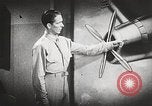
United States Army Air Forces pilots undergo training on characteristics of the P-47 Thunderbolt aircraft
A U.S. Army Air Forces Captain is explaining characteristics of the Republic P-47 thunderbolt airplane, as he points to a large illustration of one on the wall. Among other things, he emphasizes aspects of its engine and propeller. Closeup of instructor pointing to switch, on panel inside the cockpit, that allows pilot to select automatic or manual control of the Curtis Electric constant speed propeller. Instructor points to diagram as he discusses the plane's fuel tanks. The instructor continues describing the aircraft, removing covers to expose parts of the illustration as goes along. The Captain (instructor) and students (Lieutenant pilots) look at a cutaway of the aircraft turbo supercharger. Together, they look at the throttle controls they'll find in the airplane. Instructor demonstrates actions to invoke military power, moving throttle past the sea level stop and invoking supercharger as well as water-injection. He also mentions gear and flap controls as well as armor, and the plane's eight 50-caliber machine guns. Next, the Captain takes one of the Lieutenants with him and leaves to look at an actual airplane on the flight line. (World War II; WW II; World War 2; World War Two)
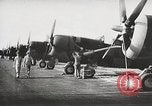
United States Army Air Forces pilot undergoes familiarization training in cockpit of P-47 Thunderbolt aircraft
A U.S. Army Air Forces Captain (instructor) and a Lieutenant, pilot, walk the flight line past parked P-47 Thunderbolt aircraft. They stop at one, and the instructor climbs on its wing root, showing the Lieutenant that the wing flaps have been left down to prevent someone from stepping on them. The Lieutenant climbs into the cockpit as the instructor stands on the wing and points out controls of the aircraft. Included are controls for fuel selection; trim tabs; emergency hydraulic pump; gun heat; wing flaps; landing gear. They look up as a P-47 passes low overhead. Then, the instructor continues clockwise around the cockpit noting the quadrant of turbo, throttle, and mixture controls. He covers switches, warning lights, flight instruments, and engine instruments and other things. Scene shifts to aerial view of a P-47 in flight above clouds, and then to oxygen controls and indicators. Closeup of pilot wearing oxygen mask. More views of cockpit and controls and indicators. Student closes the canopy part way and they discuss its operation. (World War II; WW II; World War 2; World War Two)
CRITICALPAST.COM: About Us | Contact Us | FAQs - How to Order | License Agreement | My Account | My Lightboxes | Shopping Cart | Advanced Search | Featured Collections | Website Terms & Conditions | Privacy Policy ©2026 CriticalPast LLC.
License Agreement |
Terms & Conditions |
Privacy Policy
©2026 CriticalPast LLC.