


 Francais
 Deutsch
 Italiano
Refine Your Search
Naples Italy 1943 stock footage and images
- Showing 235 to 240 of 4566 results more
more Hide
Hide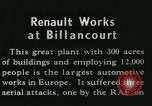
The Renault Works plant at Billancourt after three aerial attacks by the Allied forces during World War II.
Results of air assaults by the British Royal and U.S. Eighth Air Forces over industrial areas in and around German-occupied Paris during Wolrd War II. The Renault Works plant at Billancourt after one aerial attack by the Royal Air Force (March 3, 1943) and two by the U.S. Eighth Air Force (April 4 and September 15, 1943). Workers clear the plant interiors. The damaged plant, collapsed roof, rubble and debris on the floor. Workers clear the debris. Damaged steel structures, pillars and walls. Buildings at the plant. Damaged walls, wrecked equipment and material. Allied officers and workers at the plant.

Four British working men and four American counterparts visit officials concerned with war production, in New York City and Washington DC (WW2)
A British film entitled, "People to People." Four British working men, visiting America, are seen in overcoats on the deck of a ship passing the Statue of Liberty in New York Harbor during World War II. They are accompanied by four American workers who were returning on the same ship, from a similar visit to England. Closeup of the eight men, named by the narrator, who calls them trade unionists on an exchange visit. Brief view of Chiang Kai-Shek, Franklin D. Roosevelt, and Winston Churchill at the Cairo Conference in 1943.Camera pans closeup over Roosevelt and Chiang Kai-Shek. Brief views of Roosevelt, Churchill, and Joseph Stalin at the Tehran Conference in 1943. Closeup of Roosevelt and Churchill, with Anthony Eden standing immediately behind them. Closeup of Stalin and Roosevelt, with U.S. Army Air Force Chief, General Henry H.(Hap) Arnold and British General Alan Brooke, Chief of the Imperial General Staff, conversing behind them. Scene shifts back to the men aboard the ship in New York harbor, with the New York City Manhattan skyline of buildings in the background. Next, the eight men are seen climbing steps to New York City Hall. Inside they are welcomed by New York City Mayor Fiorello LaGuardia. The group is then seen entering a building in Washington, DC, where they sit down at a table with Donald Nelson, Head of the U.S. War Production Board. In the Department of Labor building they meet William Hammatt Davis, Head of the War Labor Board, and also the Secretary of Labor, Frances Perkins. After that they are seen heading into the White House, where they are met by Mrs. Eleanor Roosevelt, who comes out of the White House to greet them on the porch. (Narrator says she later invited them inside for tea.) The men are next seen climbing the Capitol steps. Vice President Henry A. Wallace comes out to greet them and comments about industrial production not only during the war, but in the time of peace to follow.
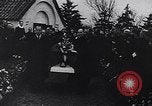
Denmark under German martial law during World War II
Film made by Danes, after increasing tensions between them and German occupation forces that invaded Denmark in 1940, boiled over in August 1943, and the Germans placed Denmark under martial law. It covers the period 1943 and 1944, after which the film was smuggled out of the country. Opening scene shows pallbearers at the funeral of Kaj Harald Leininger Munk (aka Kaj Munk) a Danish playwright and Lutheran pastor, who was assassinated by Nazi Gestapo agents, on 4 January, 1944. Narrator states that Nazi murder leagues assassinated some of Denmark's greatest leaders to intimidate the Danes and quell any rebellions. The coffin of Pastor Munk is lowered into its grave. Memorial stone and flowers are shown. Smoke rising and then a large conflagration are seen, from Danish acts of sabotage. Damaged buildings and more fires, from Danish resistance, are seen. In response, the "Schalburg Corps," a Danish volunteer branch of the Nazi SS, began counter-sabotage (called Shalbotage by the Danes). Film shows fireman on ladders at the building of the Paramount Movie Company, Ltd. where smoke is coming from the windows. (Narrator says film companies that refused every form of collaboration were blown up.) View of severely damaged Nordisk film studio at Helerup. Windows shattered in department stores and in all shops along a street. Illums Bolighus (famous store of Scandinavian design) and many others are wrecked. Camera pans up the side of damaged building with bird painted on its side and the words: "mod lysere Dage.." (Brighter Days). Views of the destroyed Royal Yacht Club pavilion, in Copenhagen harbor. Destruction in Tivoli Gardens. Its concert hall completely destroyed. Fire burning at the Syndicate, Denmark's largest armaments factory, from bombing by saboteurs, in June, 1944. Danes walking in Copenhagen, on a summer evening, flaunting the Nazi curfew from 8PM to 6AM and then lighting bonfires after dark. Abandoned wheel barrows and empty streets are shown when residents of Copenhagen all go home in a general strike. Several German soldiers are seen in otherwise empty street, as the German Commander in Chief declares the city of Copenhagen under siege. A German tank parked in the street amidst pedestrians. Barricades set up by strikers in a street. The American flag flying high over a street. The "Bulldog" a department store in flames. A car serving as an ambulance drives down a street displaying a white flag. A long line of Danes wait at a street corner shop for self-rationed food. Danes drawing fresh water from lakes to be brought to hospitals, where needed. View from above of strikers at a barricade. Narrator states that after 5 days, the Germans gave in and agreed to Danish terms. View of open area in the city, where people stand in silence to commemorate those who lost their lives in the struggle. Danish man looking through chain link fence. More scenes of continued sabotage by Danes.

Famous astrologer, Belle Bart reveals her predictions for the year 1936 in New York, United States.
Belle Bart, famous astrologer at desk in her office, New York, USA. She speaks on her predictions for the Year 1936. She reminds viewers of her predictions for the year 1935. She says that the period of prosperity will extend from 1936-1943. She further says that although war is imminent in the far East, and that some nations will become eclipsed during this period, the general trend through 1943 will be "happiness and prosperity for all."
Scenes of Czechoslovakia beginning in 1918 and gradually moving into the era of World War II
Close-up images of a slide projector as it is turned on and as its Kodak zoom lens moves forward. A picturesque Czech town is seen with numerous historic looking buildings. View of Červená Lhota (Red Village) Castle in South Bohemia. (It has bright red roof tiles, not seen in black and white photos.) A town square and buildings nearby, including one that appears to be a cathedral. A bucolic hillside scene with sheaves of wheat stacked in groups and a village in far background. Farmers moving loaded wagons with teams of oxen. Farming scenes. Local people gathered around a church building, in a rural setting. Closeups of several young girls with their heads covered. A priest conducting mass at a section of the church with altar and backdrop open to the outdoors. Many women are attending and most have their heads covered. Closeup of a woman drinking from a bottle and girls at a marketplace. Girls and a man dressed in traditional costumes. A couple in traditional costumes. Glimpse of bridge over the River Vitava in Prague, Czechoslovakia. Glimpse of isolated church spire in area near city. Pedestrians and horse-drawn carts and wagons moving over the Charles bridge in Prague. Woman with baby in carriage and other pedestrians walking past Statue of Francis Borgia. on the bridge. View from bridge overlooking Wenceslas Square and statue of St Wenceslas, Prague. A tram moves below. Time moves to 1937. Police directing traffic and pedestrians at a busy corner in Prague. People at a flower stall. Glimpse of Adolf Hitler and Hermann Goering. People boarding and riding on trams. Children holding bouquets of flowers. A heavy gun barrel being raised. A backyard with line of wash and children playing in the field. Year is now 1938. German soldiers move a large artillery piece into position on a road. Agreements being signed related to the German annexation of the Sudetenland, portion of Czechoslovakia containing Germans who were incorporated into Czechoslovakia after World War I ). German troops moving into the Sudetenland. Czechs and Germans signing Munich Agreement documents, German forces driving into a city. Hitler meeting with Czech officials. Hitler heading a group including Hermann Goering and other high ranking German officials, as they walk along a road in a Sudetenland city where citizens welcome them enthusiastically. Momentary glimpses of persons being mistreated. Sudden change of scene to persons posing, including some in concentration uniforms. Hitler being overwhelmed by flowers. Empty street scene with flowers discarded on the road. Year advances to 1942. Concentration camp inmates pose behind barbed wire. Year, 1943. A young Jewish woman is seen with Jewish Star of David and word "Juden" displayed on her jacket and the number 671 on a tag around her neck. Year advances to 1943-1944. View of inmates crammed into a concentration camp barracks room.
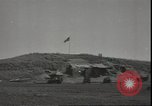
USMC (United States Marine Corps) officers confer at Henderson Field on Guadalcanal during World War II.
American flag flying from a tall flagpole over a hill near Henderson Field on Guadalcanal during World War 2. U.S. Marine officers are seated at a table in a local headquarters tent dug in and sandbagged at the base of the hill, which sits on the edge of the captured Japanese airfield (Henderson Field). One of the officers is looking through binoculars. Nearby, behind them a C-45 transport plane (Beechcraft Model 18) is approached by a fuel truck. Many other aircraft parked aircraft are seen in the distance. Two Marines standing in front of a mound of sandbags discuss something on a clipboard. Several Marines relax in front of a wooden building. Another Marine officer wearing a sidearm joins them with a large map, which they discuss. One of the Marine officers is a Colonel (O-6). Scene shifts to a B-17, tail number 41-2403, taxiing. Next, several B-17s are seen through palm trees, flying overhead. One has its landing gear extended and descends, beyond some trees, to land. Camera moves to a site where pipelines are being repaired by Seabees. A Seabee welder is at work on one. Seabees move new pipe into position on cross ties. (Note: The B-17 Number 41-2403 ditched January 27, 1943, on the way from Guadalcanal to Espiritu Santo, with Brigadier General Nathan Farragut Twining, Commander, 13th Air Force, on board. On 1 February 1943, the U.S. Navy rescued him and 14 others from their life rafts, near New Hebrides Islands.)