


 Francais
 Deutsch
 Italiano
Refine Your Search
Naples Italy 1943 stock footage and images
- Showing 2839 to 2844 of 4562 results more
more Hide
Hide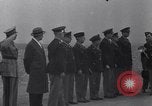
Shah of Iran Mohammad Reza Pahlavi and his wife inspect United States military installations in Tehran during World War II
Shah of Iran Mohammad Reza Pahlavi and his wife, Queen Fawzia, and an entourage of Iranian officers, inspect United States military installations in Tehran. United States Military officials greet the royal couple. Major General Donald H. Connolly (wearing glasses), Commander of the U.S. Army Persian Gulf Command steps forward to greet the Royal couple. Shoulder patch of the Persian Gulf Command (a scimitar and 7-pointed star) is seen on his uniform. General Connally salutes and removes his cap, as he takes the hand of Queen Fawzia. He introduces a Brigadier General to the Royal couple and then all proceed down a path. Large radio antennas are seen dimly in the background. The Shah and Empress emerge from the broadcast facilities of the American Expeditionary Station Tehran, and General Connolly helps Queen Fawzia into a U.S. jeep. An American soldier driver gets into the jeep. The Shah, Queen, and party are escorted by the American officers along a path to the "Service Club", as American soldiers stand to the side. They are seen later, coming out of the Service Club. The party poses for photographs.
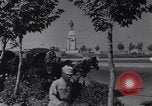
Views of Tehran, when Iran was the "Persian Corridor" for American Lend-Lease aid to the Soviet Union in World War II
Opening scene is of ordinary day in teheran, Iran, during World War 2. A horse and wagon sits quietly in shade at edge of a traffic circle centered on monument topped with a statue of Reza Shah Pahlavi . A U.S. Army truck, displaying a white star, and a jeep, drive by on the nearby roadway. A horse-drawn wagon passes at edge of toad. A military truck drives around the road closest to the statue of Reza Shah Pahlavi . Closeups of the statue. Change of scene shows an official-looking modern building, with a guard at its open gate. A sculpture above the gate depicts a crown flanked by two lions. Several pedestrians pass by casually on the road and sidewalk. The pedestrian women include some in Western dress and ant least one with head modestly covered. View through the open gate shows a circular drive around a garden and a large building behind it. Two military officers walk out the gate. One wears a steel helmet. They pass the guard standing by his booth. Street scenes showing a modern building and light traffic, including another American jeep, a horse-drawn wagon, a car and a bus. Several multistory apartment buildings. View looking down on a horse-drawn cart moving along a tree-lined city street.
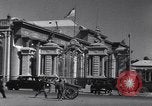
A view of the Royal Palace and street scenes in Tehran, Iran, during World War II
Scenes of Tehran, Iran during World War 2. A view of the Royal Palace of Tehran. The Sepahsalar Mosque (Jomhuri Ave Baharestan Square, Tehran 11369 Iran) and its minarets. Traffic stops for crossing camel caravan. An American soldier in a Jeep, waits for the camel caravan to pass. Camels, trucks, cars, horse drawn carriage, bicycles, and bus, in a traffic circle in Tehran. Veiled women in streets. A commercial shopping district in the city, with streets, wide sidewalks, and numerous shops in buildings. Many pedestrians and shoppers are seen. Many men and women wear modern Western-style clothes. In contrast, the next scene shows camels and merchants in a traditional old-style open-air market.
United States M10 tank destroyers tested over rough terrain (WW2) and promoted by narrator
U.S. Army World War II promotional film presents an overview of the new M10 Tank Destroyer that humorously mimics a new car sales advertisement. A newspaper cutting shows the advertisement of 'Screaming Eagle Hardware Company' that produces the Tank Destroyer. View of United States M-10 tank destroyers in rows in an open field. Crew climbs into Tank Destroyer. The M10 tank destroyer is shown being tested over rough terrain, water, steep drop off, and steep inclines. It is shown operating at 35 miles per hour on flat open terrain. View of crew inside tank destroyer demonstrating operation of its 3 inch gun. Gun of of the tank fired at target on a practice range in the United States. Soldier observes using binoculars. Steam locomotive running on railroad tracks approaching camera position, and then passing with train cars filled with M10 Tank Destroyers. Throughout the clip, narrator describes the features of the tank as if describing a new car, with various humorous lines added.
Pilots discuss participation in Doolittle Raid bombing of Tokyo; scenes from start of raid in World War II.
Car pulls up to curb with Lincoln Memorial in the background, in Washington DC. Captain Ted W. Lawson and Captain Dean Davenport ascend the steps of the Lincoln Memorial, with one of them using a cane to assist, as they talk. They talk about home life and then they recall their flight as pilot and co-pilot on B-25 aircraft in the Tokyo raid in World War 2, one year earlier. Scene changes to open sea and view of the USS Hornet aircraft carrier (CV-8) underway at sea. Aircraft on the flight deck of USS Hornet ready for the operation 'The Doolittle Raid'. Airmen soldiers watch as Lt. Colonel Doolittle ties a Japanese medal onto a bomb. Closeup view of the medal on the bomb. The B-25 aircraft on flight deck ready for the attack on Tokyo. Lawson and Davenport talk about how they suffered engine failure on the return from Tokyo. The crew aboard the ship exercise, running in a group on an open part of the flight deck. Crews starting aircraft on April 18, 1942. The B-25 aircraft of Lt. Colonel Doolittle taking off first from the flight deck. Other B-25 Mitchell bombers taking off from the short flight deck. Planes in flight. Large image of United States flag waving. Still images of pilots captured by the Japanese during the raid. General Henry Arnold ("Hap" Arnold) seated at a desk and speaking, denounces the execution by the Japanese of U.S. pilots and calls on the forces of the US. Army Air Forces to continue their efforts until the enemy are destroyed.

Detroit factory workers visit Camp Atterbury in WW2, and Army officials tour arms plants in Detroit.
Group of United Auto Workers visits Camp Atterbury during World War 2 to get a first hand perspective on what life is like for the soldiers who are receiving the military vehicles and weaponry they build as factory workers in Detroit. The auto workers exit a train car at the camp and run through steps similar to new recruits, including a basic medical check and receiving uniforms from a quartermaster. The auto workers try some of the same training drills as regular soldiers, including an obstacle course, bayonet drills, and crossing a ravine over water on a rope bridge while mock bombing takes place near them. The men clean dishes in a mess hall kitchen and make beds in a barracks. Scene changes to a Detroit factory where officers and soldiers from the Camp tour with the auto workers. They view B-24 liberator aircraft being built, tanks being built as treads are assembled onto vehicles, other vehicles being built. War production workers building and assembling war materiel. Welding and assembly line operations seen. Wide view of factory floor with many newly assembled military tanks and vehicles completed. Newly completed tanks are demonstrated on an open field as officials observe. A war production worker speaks and encourages fellow workers to work hard to support the soldiers.
CRITICALPAST.COM: About Us | Contact Us | FAQs - How to Order | License Agreement | My Account | My Lightboxes | Shopping Cart | Advanced Search | Featured Collections | Website Terms & Conditions | Privacy Policy ©2026 CriticalPast LLC.
License Agreement |
Terms & Conditions |
Privacy Policy
©2026 CriticalPast LLC.