


 Francais
 Deutsch
 Italiano
Refine Your Search
Nevada United States 1936 stock footage and images
- Showing 6199 to 6204 of 27249 results more
more Hide
Hide
U.S. President Richard Nixon addresses people in the United States on withdrawal of remaining U.S. troops from Vietnam.
Television broadcast of U.S. President Richard Nixon's speech from the White House in Washington DC, United States on the withdrawal of remaining U.S. troops from Vietnam on 29th March 1973 during the Vietnam War. The White House. The Seal of the President of the United States. The President talks about that period of the Vietnam War when he joined the office and speaks about the program he initiated to end the war. He says American prisoners are on their way from Vietnam and people of South Vietnam are now free to choose their government. He says North Vietnam is not complying with few provisions of the Peace Agreement. He says that they should honor all those American soldiers who died during the Vietnam War. He refers to the difficult days of the war including the moratorium to end the war which was organized on October 15, 1969 when millions of Americans took day off from work and schools to participate in local demonstrations against the war. Nixon refers to the period of April 1971 when he ordered attacks on Communist bases in Cambodia. He talks about the period of May 1972 when he ordered air strikes in North Vietnam and the period of December 1972 when he ordered more air strikes.
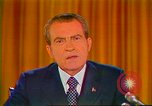
President Richard Nixon address the nation from the White House in Washington DC, United States at the end of the Vietnam War.
Television broadcast of U.S. President Richard Nixon's speech from the White House in Washington DC, United States on withdrawal of the remaining U.S. troops from Vietnam on 29th March 1973 during the Vietnam War. President Nixon speaks about the end of the Vietnam War. He speaks about differences about war which divides a nation. He talks about bringing peace and reducing the burden of armaments. He refers to nations in past which fell at the height of their wealth and strength and assures that it would not happen to the United States. He shares his experience of speaking to an American prisoner who survived in a communist prison during the Vietnam War.
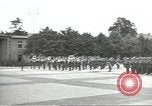
Soviet Union officially transfers control of the American sector of Berlin, to the United States, in a ceremony after end of World War II in Europe
Ceremony in Berlin, Germany, marking official transfer of American Sector of Berlin to U.S. Authorities, following end of World War 2, in Europe. Troops of the U.S. 41st Infantry Regiment, 2nd Armored Division, stand in formation as a U.S Army band plays the American National Anthem (Star Spangled Banner) on the esplanade of the Adolf Hitler Barracks, in Berlin. This is followed by a 48-gun salute fired by "RC" battery of the U.S. 78th Field Artillery Battalion, as all troops assembled render hand salute. Scene shifts to U.S. General Omar Bradley, Commanding General, Twelfth United States Army Group, standing at a microphone. He states that "this ceremony marks the meeting of the United Nations, here, in Berlin and a complete defeat of Germany." He continues with other remarks. Among allied senior officers seen with him are: U.S. Major General Floyd Parks, Commander of the U.S. Sector in Berlin; French Major General Duschesne, Commanding General of French troops in Berlin; and Soviet Major General Nicholei Nicholeiovitch Barinov, Deputy Commander of the Soviet troops in Berlin. Following Bradley's remarks, he, Parks, Duschesne, and Barinov, walk side-by-side across the esplanade, followed by the other military leaders as the Army band plays. Scene shifts to a formation of soldiers from the Soviet 5th Army. Following commands heard, The formation executes a right face,left shoulder arms, and marches off as the band plays.s.
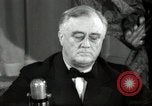
President of United States Franklin Roosevelt delivers a fireside chat in Washington D.C. to the nation.
U.S. President Franklin Roosevelt delivers Fireside Chat speech to the nation on 29th December, 1940 in Washington D.C. during World War II. In portions from his "Great Arsenal of Democracy" speech, Roosevelt talks about lower chances of the United States getting into war by supporting the nations that are defending themselves against attack by the Axis Powers. Roosevelt speaks about supplying equipment required by the nations defending against Axis Powers. He denies any demand for sending an American Expeditionary Force outside the United States. He says that any talk of sending armies to Europe is untrue. He talks about cooperation between the Government, industry and labor. Roosevelt also speaks about immediate expansion of industries essential to defend the nation. He lays stress on aiding Great Britain through lend lease and similar programs, and Roosevelt expresses his belief that the Axis Powers will not win World War II. He says that "we must be the great arsenal of democracy."
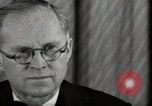
Former Ambassador to the UK, Joseph Kennedy, opposes the entry of United States into World War II in a speech in Washington D.C.
Former U.S. Ambassador to UK, Joseph Kennedy, records a speech in Washington D.C., United States during World War II. He opposes entry of United States into World War II.
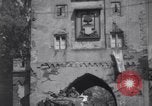
United States Army infantry laden tanks advance along streets of Munich, Germany (WW2)
United States Army infantrymen in Munich, Germany during World War II. U.S. tanks and infantrymen advance along a street and pass through the Karlstor gate (Neuhauser Str., 80331 München, Germany). United States soldiers march on the street past bombed-out buildings. Rubble from Allied bombing raids seen on sides of roads. A column of infantry laden tanks moves along a street.
CRITICALPAST.COM: About Us | Contact Us | FAQs - How to Order | License Agreement | My Account | My Lightboxes | Shopping Cart | Advanced Search | Featured Collections | Website Terms & Conditions | Privacy Policy ©2026 CriticalPast LLC.
License Agreement |
Terms & Conditions |
Privacy Policy
©2026 CriticalPast LLC.