


 Francais
 Deutsch
 Italiano
Refine Your Search
Nevada United States 1936 stock footage and images
- Showing 6319 to 6324 of 27249 results more
more Hide
Hide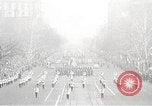
Inauguration ceremony as Dwight David Eisenhower is sworn in as the 34th President of the United States.
Dwight David Eisenhower being inaugurated as the 34th President of the United States. The inauguration ceremony in Washington DC. Band marching on the street. People gather in a large number on the street to watch the ceremony. President Eisenhower seated in a car moving on the street. He waves towards the cheering crowd. People throw confetti from a building. People applauding. various military units marching. Cavalry units passing on the street. Cameramen recording the event. President Eisenhower and Vice President Richard Nixon watching the ceremony.
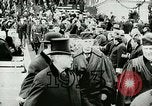
Inaugural address of Thomas Woodrow Wilson after he is named President of the United States in 1913.
Thomas Woodrow Wilson is named President of the United States in 1913. The inaugural address of the President at the U.S. Capitol in Washington DC. Dignitaries and officials arrive in cloaks and hats for the ceremony. Guests include outgoing President William Howard Taft, British ambassador Sir Cecil Spring-Rice, German ambassador to the U.S. Count Von Bernstorff, Speaker of the U.S. House of Representatives Joseph Gurney Cannon, Chief Justice of the U.S. Charles Evans Hughes, U.S. Secretary of State William Jennings Bryan, and Ted Wilson. The President and other attendees take their place on the podium. A large crowd gathered to witness the ceremony. The Chief Justice along with the President. President Wilson addresses the crowd. The band and troops march on the streets.
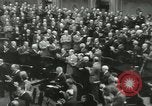
President Harry Truman addresses a joint session of the Congress of United States, about supporting freedom in the world
President Harry Truman welcomed by Congressmen in Washington DC, United States. The President greets the Vice President and the Speaker before his speech to a joint session of the Congress. In his speech he expresses concern about the challenges facing the free peoples of the world. He states that they "look to us for support in maintaining their freedom." This speech is considered the introduction of the "Truman Doctrine."
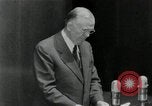
U.S. Secretary of State, George Marshall addresses the General Assembly of the United Nations
In a speech to the General Assembly of the United Nations, U.S. Secretary of State, George Marshall, refers to repeated vetoes by a permanent member of the Security Council. He discusses the post-war state of the world and the many matters yet to be resolved, including the independence of Austria, the Palestine issue, the matter of Korea, still divided along the 38th parallel, and status of nations in Eastern Europe, etc.
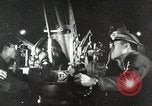
Japanese actions leading to 2nd Sino-Japanese war and attack on United States at Pearl Harbor in World War II
Japanese army officers examining foreign military equipment. A Japanese worker employing electric drill developed in a Western country. The Japanese freighter, Tatsuno Maru, loading scrap iron at a port in the United States. Other Japanese freighters loading coal and oil for shipment back to Japan. View of the Washington Naval Conference in Memorial Continental Hall, Washington, DC, held in 1921-22 and again in 1927 and 1930, to deal with several lingering issues. Glimpse of Japanese people holding flags while gathered near the Imperial Palace in Tokyo. Glimpse of Japanese army troops on parade. Japanese Navy warships at sea. A fleet of Japanese Mitsubishi G3M bombers and Nakajima Ki-27 pursuit planes, parked on an airfield. A loose formation of Ki-27s airborne. Animated map illustrates Japanese fortification of Mariana, Caroline, and Marshall islands in the Pacific. Animated map illustrating China's greater size and population vis-a-vis Japan. Animated map illustrating Japanese occupation of Manchuria in 1931. New York Times newspaper with headline "Japs Seize Manchuria" hovers over fires burning in Manchuria. Other newspaper headlines reporting on Mussolini's invasion of Ethiopia; the Spanish civil war; surrender of Czechoslovakia; invasion of Poland; assaults on France, Belgium, and the Netherlands by Nazi Germany; the London Blitz; and Nazi advances against Russia on the Eastern Front. Fnally, a Boston Hearald extra edition headline reports: "Pearl Harbor Bombed." A still photograph of Japanese Baron Tanaka Giichi (on left) with two other dignitaries, circa 1929. Japanese infantry streaming into Manchuria and then celebrating as they walk into local town. A busy street in a Chinese city. Japanese soldiers in Manchuria escorting local prisoners along a street. Animated map illustrating Japananese warships surrounding harbor of Shanghai, China. View from a Japanese ship bombarding Shanghai. Smoke rising from shell striking on Shanghai waterfront. View from land of severely damaged buildings on a street, and a shell exploding in background, as Chinese defenders move to successfully repel the Japanese forces. New map illustrates subsequent Japanese move, annexing Jehol, from occupied Manchukuo, and Korea. Japanese troops entering a town in Jehol. Sun newspaper headline: "League Censures Japan." Chinese diplomat protesting at League of Nations. Japanese troops exiting railroad trains in Jehol. Aisin Gioro Puyi aka Henry Pu Yi, Kangde Emperor (Kang-te Emperor) of the Japanese puppet state of Manchukuo, is seen saluting Japanese troops on parade. Closeup of Puyi wearing shaded glasses, looking directly into the camera. chiang Kai-shek, with other Chinese officers. Reenactment of barbarian forces riding against China and thwarted by the Great Wall. Many Chinese walking in a long line along the Great Wall. Map tracing the Great Wall across China. Aerial view of the Great Wall from overflying airplane. Japanese troops marching through a city gate; infantry climbing a sheer cliff; and helmeted Japanese soldiers marching past civilians in a city. Map illustrated progress of Chinese unification by year 1937. Japanese officers conferring during occupation. Japanese troops leave a barracks, riding in open trucks. A line of the troop trucks moving along the dirt street of a town. The troops climb from their trucks in the town.
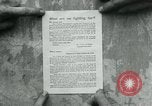
Men hold United States propaganda document in France.
United States propaganda document states 'What are we fighting for?' and 'Why are we still fighting?' The front part of the document. It is turned over. The back side of the document. (World War I; World War 1; WWI; WW1)
CRITICALPAST.COM: About Us | Contact Us | FAQs - How to Order | License Agreement | My Account | My Lightboxes | Shopping Cart | Advanced Search | Featured Collections | Website Terms & Conditions | Privacy Policy ©2026 CriticalPast LLC.
License Agreement |
Terms & Conditions |
Privacy Policy
©2026 CriticalPast LLC.