


 Francais
 Deutsch
 Italiano
Refine Your Search
Nevada United States 1936 stock footage and images
- Showing 6343 to 6348 of 27249 results more
more Hide
Hide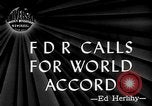
President Roosevelt addresses the Congress during a joint session after the Yalta conference in Washington DC, United States (WW2)
President Franklin D Roosevelt addresses a joint session of the Congress in Washington DC, United States. Roosevelt informs the Congress about the decisions taken at the Yalta Conference in World War II. He states that the two most important purposes of the Conference were to bring peace in Germany and establishment of an international court. He also declares that war against Japan will continue.
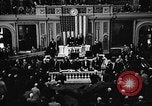
President Roosevelt asks the Congress to reexamine the Law of Neutrality during an address in Washington DC, United States.
President Franklin D Roosevelt addresses the Congress before entering World War II. President Roosevelt during his address urges the Congress to amend the Law of Neutrality to avert the danger of war looming large on America. He says that the primary function of American foreign policy has been to avert war and the government will try to keep out of the war. He states that America has always believed in neutrality and peace but with the outbreak of war in Europe there is a threat to peace and security of United States.
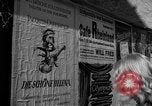
Entertainment for German civilians in United States Zone, Munich, Germany.
Entertainment in the United States Zone in Munich, Germany. German woman read a poster. The poster advertises the performance of operetta “Die schöne Helena” (“The Beautiful Helena”) by Jacques Offenbach at the Bavarian State Theater. Advertising column (known in Germany as Litfaßsäule) on screen indicates huge variety of entertainment to German civilians. Advertisement for “roman einer Tänzerin” (“Novel of a dancer”) with German actor Conrad Veidt. Advertisement in English language of dancing lessons for occupation troops. A crowd outside cinema. A man plays mouth organ and sits on debris. People look at advertisement of a play 'On borrowed time'. Actors perform in theater.

Paul McCracken, an American economist, comments on the economic speech by U.S. President Nixon in the United States.
Discussion and analysis following U.S. President Nixon's speech on the economic crisis from the White House, United States. Reporter Bill Gill sits with Bob Clark, a White House correspondent, and economic advisor Paul McCracken. Both the reporters ask Paul McCracken to make a comment on the proposals of President Nixon dealing with the American economy (a speech later known as the "Nixon shock" speech). Paul McCracken speaks on the advantages of the 90 days wage-price freeze. He tells how to secure cost price level, how to control unemployment and inflation. He states the 90 days wage-price as the strongest economy program and how it will give foundation to more companies. He also speaks on dollar rate and foreign exchange and how to maintain its position, and the closing of the gold window.
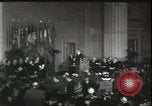
Signing of the NATO treaty in Washington D.C., United States
President Harry S. Truman introduced to foreign ministers of NATO member countries by Secretary of State Dean Acheson in Washington D.C., United States. President delivers a speech on the occasion of signing of NATO (North Atlantic Treaty Organization) treaty. He hopes that members will cooperate in solving common problems and in their efforts of development.
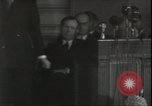
NATO treaty signed in Washington D.C., United States
Representatives of various states sign North Atlantic Treaty Organization treaty (NATO) in Washington DC, United States. Belgian Premier Paul-Henri Spaak, Lester B Person of Canada, Rasmussen of Denmark, Robert Schuman of France, Bjarni Benidiktsson of Italy, Joseph Bech of Luxembourg, Stikker of Netherlands, Halvard M Lange of Norway, Jose Caeiro De Mata of Portugal, Ernest Bevin of England sign the NATO treaty. President Truman shakes hands with Allen W Brakley. Brakley shakes hands with Dean Acheson. Acheson signs the treaty and delivers a concluding speech.
CRITICALPAST.COM: About Us | Contact Us | FAQs - How to Order | License Agreement | My Account | My Lightboxes | Shopping Cart | Advanced Search | Featured Collections | Website Terms & Conditions | Privacy Policy ©2026 CriticalPast LLC.
License Agreement |
Terms & Conditions |
Privacy Policy
©2026 CriticalPast LLC.