


 Francais
 Deutsch
 Italiano
Refine Your Search
Nevada United States 1936 stock footage and images
- Showing 79 to 84 of 27246 results more
more Hide
Hide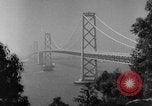
Opening ceremony of San Francisco Oakland Bay Bridge in 1936, San Francisco, California.
View of The San Francisco Oakland Bay Bridge (San Francisco – Oakland Bay Bridge, San Francisco, CA, United States) over San Francisco Bay at the Pacific Ocean. Ceremonies where the bridge was opened to general traffic after completion of construction in 1936. California Governor, Frank Finley Merriam, uses a blowtorch to cut a chain, officially opening the bridge to vehicle traffic. Cars are seen massed, ready to commence the crossing. Cars pass through lane dividers and drive on the bridge. View of the towers and suspension cables from a car passing underneath. Buildings seen from the bridge. Traffic on the bridge. (From a 1961 newsreel recounting events 25 years earlier.)
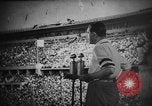
Participants of relay race exchange baton and winning runners receive garland during 1936 Olympics in Berlin, Germany.
Scenes from relay race and award ceremony during 1936 Olympic games in Berlin Germany. The race starts. Participants of relay race run on race track. Runners exchange baton. Spectators cheer participants. Chancellor of Germany, Adolf Hitler, and Minister of Propaganda, Joseph Goebbels among spectators. Garlands of victory are placed on the heads of winning American and British athletes. Spectators applaud. Flags of United States, Britain and Germany are raised.
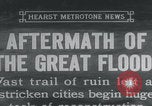
Hartford, Connecticut flood of 1936
Aerial view of The Church of the Good Shepherd and its parish house (155 Wyllys St, Hartford, CT 06106, United States) during the 1936 Hartford flood. Aerial view of The Bulkeley Bridge nearly covered by the Connecticut River. Aerial view of men standing on top of gas storage tanks as they fill them with water to keep them from floating away. Women and children eating at a shelter and picking out clothes. A baby in a bed.
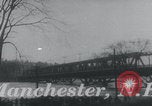
Amoskeag Falls during 1936 Manchester New Hampshire flood.
Amoskeag Falls Bridge over the Merrimack River with raging waters during the Great Flood of 1936 (New England) in Manchester New Hampshire. Remnants of a house is seen going over the falls and floating under the Amoskeag Falls Bridge. Workers stacking sandbags at the Amoskeag Falls Dam power house in an effort to save it. View of Amoskeag Falls Dam powerhouse surrounded by flood water. Two Martin B-10 bombers in flight over an overflowing river. View from a Martin B-10 rear cockpit as United States airmen push food supplies out of bomb bay. Package dropping from a B-10 over Pennsylvania.
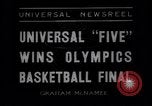
Universal Pictures beats McPherson Globe Refiners in basketball to win Olympics final in New York City
A newsreel titled "Universal five wins Olympics basketball final" shows a game between the company team from Universal Pictures and the McPherson Globe Refiners from Globe Oil and Refining Co. of McPherson, Kansas. The McPherson team is sometimes also referred to as the Oilers, or the Refiners. The teams are seen playing in the Olympics Qualifying basketball final in New York's Madison Square Garden. People cheer the two teams. Universal defeats the McPherson Globe Refiners to win the Olympics final. The win entitled the Universal Pictures team to name 7 players to the Olympic basketball team representing the United States in the 1936 Olympics held in Berlin Germany, and McPherson Globe Refiners was able to name 6 players to the team. These two teams beat out five U.S. college teams to earn the spots in the final and determine the makeup of the U.S. Olympic Basketball team. Players in the game in this video clip include Globe Refiners forward Francis Johnson, Centers Willard Schmidt and Joe Fortenberry, and Universal forward Carl Knowles. Universal beat the Globe Refiners by a score of 44 to 43. According to a Time Magazine article of April 13, 1936, the Globe Oil & Refining team, "...have perfected a technique called dunking with which they score by jumping up above the basket, dropping the ball into it." This may be one of the earliest references to dunking, now a staple technique in basketball. The same Time article further stated of the Oilers, "On the defense, they prevent opponents from scoring by batting the ball out of the basket." Again, the Globe Refiners were demonstrating play that later became standard in modern basketball. The idea for the Globe Refiners was a company promotion scheme, thought up in 1934 by Gene Johnson, the Sales Manager of Globe Oil who had several years experience coaching basketball. The Olympic team also included Washington State Huskey player Ralph Bishop. The USA went on to win the gold, defeating Canada 19-8.
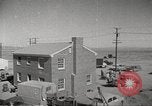
Houses and dummies destroyed due to an atomic bomb test explosion during Operation Cue conducted at Yucca Flat area, Nevada.
Operation Cue conducted at Yucca Flat region in Nevada, United States. The test conducted to examine the effects of atomic bomb explosion on buildings, and the cars parked in front of the building. View of house and cars parked at the site. Following nuclear bomb blast, view as house explodes from the blast wave or shock wave, with fragments flying in the air. View of mannequin dummies inside the house as the blast destroys the house.
CRITICALPAST.COM: About Us | Contact Us | FAQs - How to Order | License Agreement | My Account | My Lightboxes | Shopping Cart | Advanced Search | Featured Collections | Website Terms & Conditions | Privacy Policy ©2026 CriticalPast LLC.
License Agreement |
Terms & Conditions |
Privacy Policy
©2026 CriticalPast LLC.