


 Francais
 Deutsch
 Italiano
Refine Your Search
Nevada United States 1936 stock footage and images
- Showing 907 to 912 of 27248 results more
more Hide
Hide
16 million men register themselves in United States for the WWII draft, and President Roosevelt addresses from White House.
As World War II heats up, 16,500,000 men between ages 21 to 36 register themselves throughout the United States, signing up during the first peacetime conscription in U.S. history. (This was triggered by passage of the Selective Training and Service Act of 1940, also known as the Burke-Wadsworth Act, the genesis of "Selective Service.") Opening scene shows men lining up to register for the draft before the United States entered World War 2. Views of men filing out their registration forms. At 00:22 famous prize fighter, Barney Ross, is being registered. (He jokes that the registrar shaking his hand has too strong a grip.) At 00:34 Hollywood cowboy Gene Autry is seen registering. Close up view of street signs at Chinatown intersection of Bayard Street and Mott Street in New York City. Sign below it notes "School Street. Drive Slowly. Make no unnecessary noise." Line of many registrants of Chinese-American descent waiting in line, and processing paperwork. Scene changes to another area of the city, where a line of mostly African American men wait outside a registration building. Some cheer and wave for the camera. A police officer at the entrance hustles them inside, pulling some of them along. View of the exterior of the White House in Washington DC. United States President Franklin D Roosevelt addresses the nation's men of draft age, telling them that the call up of 800,000 men for training in year one, and less than one million men in each subsequent year, is a program of defensive preparation only. Roosevelt says to the registrants that "Democracy is your cause. The cause of youth." ( Note: clip is silent except for President Roosevelt speaking at the end.)
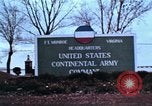
Activities of United States Continental Army Command; U.S. Strike Command; and North American Air Defense Command
Opening scene shows sign at Fort Monroe, Virginia, Headquarters of the United States Continental Army Command. U.S. Army soldiers come pouring out of their barracks and assemble in formation as non-commissioned officers inspect their personal gear. Inspectors look over closely parked armored vehicles.Troops rush to board CH-47 Helicopter transports. Sign identifying Headquarters United states Strike Command. Views of Exercise Delawar, a United States-Iran joint armed forces combat readiness operation conducted in April 1964 in Iran. (Delawar is a Persian word meaning courageous.) Paratroopers lined up and inspecting their gear as they ready to board through rear door of a transport aircraft.View of Pilot and Copilot in cockpit. Paratroopers jumping from the aircraft. Formation of U.S. Air Force C-130 aircraft dropping paratroopers, with chutes clearly visible as they descend. View of troopers exiting rear cargo door of C-130 aircraft. Ground view of paratroopers landing on Iranian desert. Some set up field artillery pieces, others deploy on foot, and some ride in trucks pulling artillery pieces. Change of scene to North American Air Defense Command (NORAD) Combat Operations Center. Inside, General John Koehler Gerhart, Commander of NORAD, sits at a deck in a control room with several other officers. Next, officers and non-commissioned officers, e.g. a Master Sergeant, who regularly work in the center are seen at their stations. Army Air Defense personnel run from their ready room to man batteries of Nike-Hercules missiles. An air defense radar site, part of the early warning system. Missiles of the Nike-Hercules battery being raised to firing positions.
Isolationist versus interventionist sentiments of people in the United States regarding America entering World War 2
Americans express their views about United States entering into World War II after the Pearl Harbor attack. Anti-war isolationist and interventionist views are presented. Senator Gerald P. Nye advocates in favor of an arms embargo. Urging against American involvement in war, Senator Burton K. Wheeler cautions that war mongers and interventioners or intervention advocates control most of the avenues of propaganda. Wendell Willkie speaks advocating unity of purpose in America and importance of assisting the threatened democracies of Europe with war materiel and supplies. Next, Senator Joshua B. Lee of Oklahoma strongly urges support for lend-lease and "setting in motion an industrial blitzkrieg (of war materiel) that will make it possible for England to blast Hitlarism from the face of the earth." View of Congress meeting in the U.S. Capitol chamber. Anti-war college aged students protests against involvement in war and picket at the White House in Washington D.C.,United States. Adjacent to them are other protestors picketing against the peace advocates, with signs like "Americans are against subversive organizations picketing the White House" and "We Americans protest Communists picketing the White House. A women's organization advocating peace or protectionism or isolationism is seen wearing all black. They pull down black veils over their faces in a show of unity against war and the possible loss of American boys to war. An outdoor rally of a fascist organization meeting in America. Also scenes from a German American Bund meeting in 1939 at Madison Square Garden in New York City. Speaker at the meeting is Fritz Julius Kuhn who watches as a protestor leaps on the stage and is subdued by guards. Scenes shown from various other protests in the United States during the same era, including labor strikes and lockouts, and a group holding a rally in favor of equal rights or civil rights, with a woman holding a sign "Did Lincoln Free the Slaves?"
Ammunition being produced at an arsenal in the United States during World War I.
War preparations in the United States during World War I. A horse drawn cart moves along a road near shipyard, with lumber everywhere. Machines inside an arsenal in the United States as men work on them to produce ammunition. United States flag hangs against a building as workers gather at a rally outside it. Men salute to the flag.
Models of houses on display as architects discuss the future trends in housing in United States.
' Tomorrow housing' about the housing trends in United States in years to come. An intersection of highways in the United States with flyovers and vehicles moving over them. Models of modern and futuristic buildings and roads of the future, seen just after the end of World War 2 during expansion of home ownership in America. Newspaper articles and headlines about the growing need to develop new houses. A woman steps away from a bank teller window after making a deposit. A sign in the bank reads 'Save for your future home'. A United States Navy sailor discusses about future houses with women. Architects look at a model of future houses and discuss. A sailor and his family look at models of various suburban house designs.
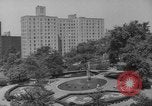
A new planned housing community with various amenities like drug store, theater, laundromat in United States.
Improvement in housing facilities in post war era in United States. A planned housing community in the United States with various facilities like children's parks, baseball fields, a Liggett's drug store, a movie theater and a laundromat laundry facility. The theater marquee advertises Allan Ladd and Loretta Young, "And Now Tomorrow", and "Our hearts were young and gay" with Gail Russell and Diana Lynn. Woman loading clothes into an early model laundromat washing machine. Children play about in the area around the houses and run down from a pedestrian bridge that crosses a road. Ice cream man pushes an ice cream cart with an Eskimo Pie advertisement on the cart. The man rings a bell as children run to the ice cream cart. A woman inside a well ventilated and well lit up house. Men and a woman conduct research about improving housing facilities in United States.
CRITICALPAST.COM: About Us | Contact Us | FAQs - How to Order | License Agreement | My Account | My Lightboxes | Shopping Cart | Advanced Search | Featured Collections | Website Terms & Conditions | Privacy Policy ©2026 CriticalPast LLC.
License Agreement |
Terms & Conditions |
Privacy Policy
©2026 CriticalPast LLC.