


 Francais
 Deutsch
 Italiano
Refine Your Search
Nevada United States 1936 stock footage and images
- Showing 9577 to 9582 of 27248 results more
more Hide
Hide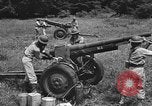
The procedure of decontaminating vehicles and persons in the United States (WW2)
A U.S. Army training film about decontamination procedures during World War II. A thick coat of contaminated solution is swabbed off with kerosene or gasoline. Then a solution of a non corrosive substance is applied. After it evaporates, the vehicle is washed with soap and water and is left to dry. The vehicle is then covered with a layer of oil. Machine guns and artillery are cleaned in the same way. Clothes and rags used for cleaning are then burned or buried. The land is covered with chlorinate lime. Men shuffle their shoes in the lime mixture. They then remove their shoes and clothes with the help of each other. The clothes are spread in air. They remove their socks and underwear and wash themselves in a stream. Then they wear fresh uniforms.
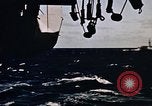
An LCVP, APs and transporters underway in the United States.
Activities aboard the USS Bayfield (APA 33) prior to the invasion of Iwo Jima. Sea as seen from the USS Bayfield. Rigging on a life raft. A Landing Craft Vehicle Personnel (LCVP) is rigged out over the side in the foreground. A convoy of APs underway. An LCVP in right foreground. Three transporters underway. A 5 inch open gun mount 38 in the foreground.
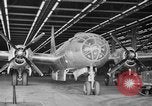
New B-29 plane towed out of a plant and takes off in the United States during World War II.
U.S. Army Air Forces film about B-29 aircraft construction. A completed B-29 bomber towed out of the construction factory during World War 2. Wheels of the bomber. Workers in plant weld, bolt and do other work to complete another B-29 plane. Women and men war production workers seen working in the plant look up and smile on hearing one of the new B-29 aircraft in flight overhead. Aerial views of B-29 in flight. Wing area and tactical gear of the plane. Close-up view of revolutionary flap design that constitutes one fifth of the wing area. Flaps shown moving on the aircraft. Close-up view of landing gear descending. B-29 aircraft lands. View of guns mounted on plane. Pilots shake hands with crew member. B-29 flight crew in briefing to receive information about bombing objective over Japan. Laborers assisting with loading and unloading the aircraft. B-29 taking off and again seen in flight.

Dr. Ad Hoi Tailor works at a radar and an animation shows the operation and the use of the radar in the United States.
Operation and the uses of the radar. A radar with 'XAF installed 1938' written on it. Allied civilian scientist Dr. Ad Hoi Tailor, Chief of Electronic Science Development and his assistant Mr. Lio Se Young at work. A diagram shows the operation of the radar. A dot of voltage barrier at a florescent screen. An animation shows how a radar traces an enemy plane. Radar equipped planes detect enemy fleet. A light mover in the radar. (World War II period).
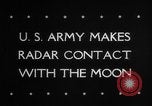
Radar for establishing contact with the moon reflects rays back on the earth from the moon in United States.
U.S. Army radar equipment used to contact the moon. Steel structure of a radar. Men work at controls. Moon in the background of the radar. Animation shows distance of moon and earth being 238000 miles. Radar beam reaches to the earth in 2.4 seconds. Radar rays go to moon and comes back to earth after reflecting. Readings of radar shows signals. Picture of the surface of the moon. Narrator says, "no longer beyond men's dreaming is the possibility of reusable airplane-like space ships to commute between the two planets (the earth and the moon)" as animation shows an aircraft space ship flying from the earth to the moon (foreshadowing the NASA Space Shuttle program).
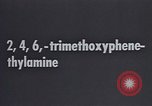
The reactions of a cat under the influence of 2,4,6-Trimethoxylphenethylamine at Aero Medical Laboratory in the United States.
Drug testing on an animal. Specifically, effect of mescaline analogues on the behavior of cats. A laboratory technician puts a cat in an observation case. A test conducted at Aero Medical Laboratory shows the reaction of the cat while under the influence of 2,4,6-Trimethoxylphenethylamine. The psychoactive drug brings about temporary changes in the normal activities of the cat. The cat does not react at all when the technician pokes it and is quiet and placid.
CRITICALPAST.COM: About Us | Contact Us | FAQs - How to Order | License Agreement | My Account | My Lightboxes | Shopping Cart | Advanced Search | Featured Collections | Website Terms & Conditions | Privacy Policy ©2026 CriticalPast LLC.
License Agreement |
Terms & Conditions |
Privacy Policy
©2026 CriticalPast LLC.