


 Francais
 Deutsch
 Italiano
Refine Your Search
Nevada United States 1936 stock footage and images
- Showing 9691 to 9696 of 27248 results more
more Hide
Hide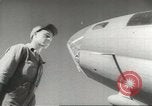
A USAAF officer trains a new B-17 pilot in cockpit inspection and start up procedures in the United States.
A U.S. Army Air Forces (USAAF) training film titled 'How to fly the B-17. Part I. Ground Operations.' about inspections and safety precautions by a pilot prior to take off. A USAAF officer trains a new pilot beginning his career as a USAAF B-17 Flying Fortress pilot. The instructing officer, trainee pilot and aircraft engineer in the cockpit, prepare for take off. The fire guard gives the all clear. The pilot is instructed to check and adjust the: master and ignition switches, batteries and inverter power, volts on the inverter. The pilot reaches out of the cockpit window and gives the hand signal for external power (source of electric power). The ground crew man turns on the portable generator and links the power cable to the aircraft. Further cockpit check includes turning on or inspection of: parking brakes, hydraulics check, booster pumps, pressure carborator filters, fuel quantity in the tanks. the pilot is instructed to give the signal to start engine number 1 and adjust the throttle. Check: the starter switch, hand timer, other start and mesh controls, oil pressure, RPM. The pilot gives the signal to start engine number 2. Adjustment of the vacuum selector switch, flight indicator check. The officer instructs the pilot to repeat all inspection procedures for engine number 2 as conducted for engine number 1. (World War II period).
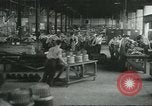
Workers returning to oil heater plants, rolling mills, Douglas Aircraft Plant, and Atlas brewing company in the United States
Renewed manufacturing activity throughout the nation recalls thousands of workers as the American industry forges onward and shows some signs of improvement during the great depression. Bloomington, Illinois: Workers manufacture oil heaters. They work on various machines and equipment. Middleton, Ohio: 2400 men at work in one of the big rolling mill companies. The workers arrive at the steel mill. Steel processing. Santa Monica, California: Men and women report for work at the Douglas Aircraft Plant. They work on a tight schedule for the new type Army torpedo and bombing planes. Men work on various parts of the aircraft. Chicago, Illinois: The Atlas Brewing Company, a huge brewery and bottling works where the production has been speeded to almost 30,000 bottles of beer an hour to meet a surge of demand following the passing of the Volstead Act allowing 3.2 beer (3.2% alchohol), near the end of prohibition in America. Beer Bottles move on conveyor belts. The bottles are filled, packed in crates and readied for transportation.

U.S. citizens invited to send vacation photographs taken abroad to OSS in the United States during World War 2
Public service announcement to be shown to American citizens going to move theaters during World War II. U.S. OSS (Office of Strategic Services, precursor to Central Intelligence Agency or CIA) headed by Colonel William Joseph Donovan asks the public to send in vacation photographs taken abroad. Narrator explains that photos of overseas ports, docks, railroads, and places of strategic importance in cities can be useful for the U.S. war effort (for intelligence and targeting purposes). Women workers remove pictures from mail sacks, view them for useful information, and sort them. Men examine images by magnifying glasses. Closeups of example photos are shown. Colonel L. E. Norris takes a look at photographs at his desk and holds up a card with his name and address. Narrator invites viewers to send photographs to Colonel Norris as a civilian contribution to the war effort and says, "it's one way you can help win the war."
The United States demobilizes following World War II
Opening illustrated slate shows reduction of Amercan Armed forces personnel from more than 12 million in 1945 to only a little over 1 and a half million in 1947. U.S. Navy submarines are seen docked in storage. Men work spraying protective coatings over guns on Navy ships as they are placed in storage in the "Mothball Fleet." A lone sailor is seen on the deck of a ship with vast number of mothballed Navy destroyers in the background. A B-24 Liberator bomber being dismantled and a B-17 parked with engines removed, seen through stack of propellers in foreground. Airman sets a demolition charge. Views of several bomber aircraft being blown up as junk. Stacks of junked and scrapped American war materiel rusting. View inside a mill where molten metal is being processed (ostensibly recycled from junked war materiel). Narrator speaks of beating guns into plow shares. Several views of molten metal being poured into and from ladles. Views inside post-war factories returning to peace-time production, where industrial heavy equipment, railroad wheels, kitchen appliances, home appliances, rubber tires, and new 1946 Ford automobiles are assembled (looking exactly like the 1942 models).
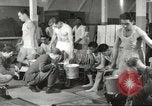
American Army recruits try on their uniforms in the United States
US Army recruits in World War 2 hold buckets of sand and stand barefoot on one leg at a time as doctor checks for flat feet and shoe sizing. A Lieutenant checks the fit of a new uniform jacket on a soldier. A group of newly recruited soldiers try on uniforms. A group of soldiers buttons their new Army overcoats
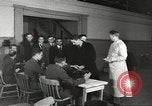
American Army recruits get their throats checked by a doctor and receive their uniforms in the United States
American Army recruits in civilian clothes get physical examination and receive uniforms during World War II. U.S. Army recruits enter a room and check-in. A doctor wearing a white gown uses a tongue depressor and checks the throat of each man. The recruits are seen receiving their new uniforms.
CRITICALPAST.COM: About Us | Contact Us | FAQs - How to Order | License Agreement | My Account | My Lightboxes | Shopping Cart | Advanced Search | Featured Collections | Website Terms & Conditions | Privacy Policy ©2026 CriticalPast LLC.
License Agreement |
Terms & Conditions |
Privacy Policy
©2026 CriticalPast LLC.