


 Francais
 Deutsch
 Italiano
Refine Your Search
Nevada United States 1936 stock footage and images
- Showing 11053 to 11058 of 27248 results more
more Hide
Hide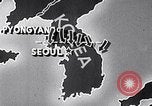
Attack by North Korea and U.S. attempt in United Nations' Security Council meeting to protect South Korea.
Start of Korean War. South Korea is attacked by Communist North Korea. Map shows division of Korea and capital of North and South Korea as Pyongyang and Seoul. Animated arrows shows attack of North Korea to South Korea. Troops of Korean Republican Army in the South mobilizing in citiies and heading to the front. South Korean soldiers fire rifles and artillery from trenches and hills. Smoke is seen among mountain ranges during battle. Soldier looks through binoculars. Next scene is in the United States, in Lake Success, New York, where guards at the United Nations simultaneously raise flags of many nations at the United Nations. South Korean ambassador Chang Myon is seen at an Emergency meeting of the Security Council of the UN. Secretary of UN, Trygve Lie states the situation is a as threat to world peace and calls for acceptance of the U.S. demand to reestablish peace. All 9 members present raise their hands in acceptance. Next scene is back in South Korea. Scenes of displaced civilian refugees including women and children. Many are gathered together. Man helps old woman to walk. Two Korean refugee boys stand side by side as one child eats bread. Next scene is again at the United Nations. Empty seat of representative of the Soviet Union is shown. U.S. Ambassador to the UN, Warren Austin, speaks and asks that the UN members vote to to assist South Korea, repel the armed attack by North Korea, and bring peace. Camera shows Security Council delegates voting, as 7 out of 8 representatives raise their hands in acceptance.
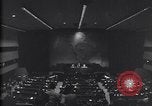
View of United Nations Assembly after announcements made on Palestine problem during British and Israeli negotiations
View of United Nations Assembly after announcements made by United States Ambassador to United Nations, Warren Austin. In front of the United Nations Headquarters is a display of flags representing each member state. Other dignitaries and Warren Austin can be seen discussing. Russian delegation seated with Andrei Gromyko.
U.S. 712th Preventive Medicine unit soldiers dance with Thai girls in a bar at Korat Royal Thai Air Base in Thailand.
United States 712th Preventive Medicine Unit soldiers at Korat Royal Thai Air Base in Thailand. A neon sign in the dark reads 'Castle'. United states 712th Preventive Medicine Unit soldiers dance with Thai girls at a bar or night club. The orchestra plays as people dance. Soldiers drink at a table. A drummer hits at the drum and a Thai man sings as soldiers and girls dance.
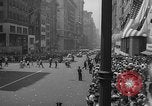
Jeeps, tanks, half tracks, other mechanized equipment, and many U.S. military units march in War Parade on 5th Ave in New York (WW2)
War Parade on Fifth Avenue, in New York City, United States during World War II . An open car driven by an Army soldier, escorted by motorcycle police, and carrying Army and Navy officers. United States flags raised on the buildings. A huge crowd gathered on the sidewalks. Mechanized equipment on parade. Band in the parade. Jeeps, tanks, and half-tracks loaded with soldiers. A Curtis Aircraft float with a real P-40 airplane on it. A display of a Wright Cyclone 9 aircraft engine rated at 1200 horsepower, the type used on Flying Fortresses, with sign reading: "US Army Air Forces at War:" Infantry units march with massed colors in the parade. Military units participate with countless Soldiers, Sailors, Marines, and Airmen marching.
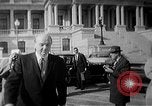
U.S. President Kennedy addresses American people about the buildup of arms in Cuba by Soviets.
Events held in the United States during the Cuban Missile Crisis of October, 1962, during the Cold War, when the United States and the Soviet Union confronted each other with nuclear destruction. Top advisors of U.S. President John Kennedy arrive at the White House. Americans buy newspapers. President Kennedy makes a TV announcement about the crisis and what has been happening. He states that a strict quarantine on all offensive military equipment under shipment to Cuba is being initiated to halt offensive buildup of nuclear arms. He says that all ships of any kind bound for Cuba from whatever nation and port , if found to contain cargoes of offensive weapons, will be turned back. This quarantine will be extended, if needed, to other types of cargo and carriers. He further states that it shall be the policy of the United States to regard any nuclear missile launched from Cuba against any nation in the Western Hemisphere as an attack on the United States, requiring a full retaliatory response upon the Soviet Union. Exteriors of the White House. An electronic billboard flashing news. Americans being interviewed by newsmen along a street.
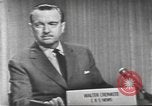
Candidates Nixon and Kennedy debate over prestige of the U.S. overseas prior to the presidential elections in the U.S.
The fourth presidential election debate held between Democratic nominee Senator John F. Kennedy and Republican nominee U.S. Vice President Richard Nixon in New York, United States on 21st October 1960. ABC News correspondent Quincy Howe allows CBS News correspondent Walter Cronkite to ask a question to Vice President Nixon. Mr. Cronkite asks Vice President Nixon if the Eisenhower Administration was suppressing a report by the United States Information Agency that shows a decline in United States prestige overseas as pointed by Senator Kennedy. Vice President Nixon replies and talks about Sputnik space program launched by the Soviet Union (compared to NASA efforts during the Space Race). He further compares the United States and the Soviet Union in terms of education and science. He speaks about UN General Assembly votes called on the Soviet Union to end its Hungarian intervention in 1956 and relates to American prestige. Senator Kennedy says that he did not make most of the statements that Vice President Nixon said he has made and he refers to the first one about Sputnik Program launched by the Soviet Union. Senator Kennedy refers to slums in the United States and talks about support housing legislation which the Eisenhower's Administration has opposed and also speaks about scientists and engineers United States has produced in comparison to the Soviet Union. He further says they were the first in other areas of science but in space, which is the new science, they are not the first
CRITICALPAST.COM: About Us | Contact Us | FAQs - How to Order | License Agreement | My Account | My Lightboxes | Shopping Cart | Advanced Search | Featured Collections | Website Terms & Conditions | Privacy Policy ©2026 CriticalPast LLC.
License Agreement |
Terms & Conditions |
Privacy Policy
©2026 CriticalPast LLC.