


 Francais
 Deutsch
 Italiano
Refine Your Search
Nevada United States 1936 stock footage and images
- Showing 11083 to 11088 of 27248 results more
more Hide
Hide
President Johnson delivers a speech and people express grief after the assassination of Martin Luther King Jr. in the U.S.
From production "April Aftermath", showing mourning and grief throughout the United States after the assassination of Martin Luther King, Jr. on April 4, 1968. The flag of the United States is lowered at half mast. People watch on television President Johnson's speech about the assassination of Martin Luther King Jr. (leader in the American Civil Rights Movement). Families are seen at home gathered around the television to watch the speech. Views of several families of husband and wife and children gathered in their living rooms viewing television sets to watch the address. Most are white families. One family is an African American family watching television. President Lyndon B. Johnson delivers a speech. The Seal of the President of the United States on a dais. President Johnson declares April 7 as a national day of mourning for the civil rights leader. Mourning ceremonies are conducted in all churches and pilgrims of the United States. Television broadcast the faces of leaders and the news about the assassination and people expressing grief. A large crowd of civilians gather at a condolence meet. People in a line enter a building to express their grief. They come outside the building. A large crowd of civilians gather and attend the condolence ceremony. They express grief.

A train moving on the Union Pacific Railroad depicts the First Transcontinental Railroad Line of the U.S. started in 1869.
A train moving on the Union Pacific Railroad in the United States. A herd of cattle advances across the Americn plain. Close up view of Long Horn cattle. A train pulled by a black steam locomotive moving on the Union Pacific Railroad depicts the First Transcontinental Railroad Line of the United States opened for through traffic on May 10, 1869. The locomotive engine of the train as it emits black smoke. Mountain and western United States landscape views. A windmill in operation. Distribution of water and farmlands in the Western United States. A herd of cattle crossing a river.

Space shuttle blasting off from Cape Canaveral, Korean War aerial dogfight, KC-10 airplane, Airforce
“Coming Attractions: Air Force Now” sequence. A view of Cape Canaveral with a United States NASA space shuttle launching in the background. An aircraft exploding in the sky during the Korean War. A United States air Force ground crewmember directs an aircraft with marshalling lights. A United States KC-10 airplane taxiing. A United States Air Force soldier, wearing a red OMS hat, drives as his comrades sitting behind him in a truck at night.
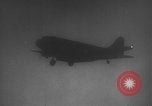
Ships and airplanes navigate in fog, submarine depth charged by destroyer (WW2)
Douglas C-47 Skytrain flying in fog. A radar mobile station with rotating radar dish. C-47 lands on airfield under low visibility conditions. A fighter landing on aircraft carrier deck of a United States Navy aircraft carrier. Large U.S. battleship at sea. Sailor wearing deck-communications helmet. Close up of interior ship siren sounding. United States sailors wake up and jump out of bunks while siren sounds. A radar dish rotating onboard a ship. Hands actuating fire control triggers on a battleship. Multiple U.S. naval ships firing guns night and day. Battleship hit by guns. Battleships firing artillery on enemy ships and shorelines of islands. Submarine underwater. A U-boat submarine periscope seen above water surface. A United States Navy crew operates radar gunnery control system in destroyer, tracking a nearby submarine. Navy captain with sailor at the helm on destroyer. Destroyer shoots depth charges into water. Depth charge flying in air and then detonating in the ocean shortly after its release. Explosions under water destroying the U-boat submarine. Consolidated PBY Catalina flying above a naval flotilla. United States ships navigate through fog. (World War II period)
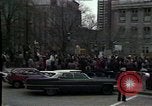
Public meeting against nuclear power station at State Capitol building in Harrisburg, Pennsylvania.
Events following accident at Three Mile Island (TMI) Nuclear power plant in Pennsylvania. People gather near the Pennsylvania State Capitol (501 N 3rd St, Harrisburg, PA 17120, United States) in Harrisburg, Pennsylvania. People hold placards ad signs such as, "RIP TMI"; "No Nukes"; "Evacuate Met Ed”; "TMI is not healthy for children or other living things." Traffic on road. Dome of the Pennsylvania State Capitol building. Statue over the dome. People stand at the stairs to listen to the speaker at the public meeting speaking out against nuclear power. Protestor holding sign, "Nuclear power is rotten to the core."
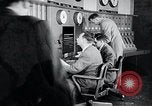
USIA operations like radio broadcast, press edition and Director Streibert explains mission to a committee in U.S.
United States Information Agency (USIA) radio operators operate radio studio controls and set frequencies for transmission and receiving. USIA staff work on gathering additional facts, with newsroom reporters and editors in a press room typing and working on stories, a woman editing motion pictures, typing, printing at USIA. Exterior view of headquarters building of United States Information Service or USIS. People enter and exit the building of USIS. Members of a Citizens Committee and Director Streibert enter into a room. Map of world in room. Citizens seated on sofa. Director Streibert explains U.S.I.A. mission to a citizens' committee and talks about America's history and involvement in the world. One Citizen Committee member smokes a pipe. The Director shows a chart of how "communist propaganda is spread by a vast worldwide machine." Director Streibert explains (via anti-communist propaganda, or reverse propaganda...during Cold War) its mechanism and control exerted via the presidium of the Soviet communist party. View of Soviet Union leaders watching a military parade in Red Square, Moscow, Russia. Khrushchev is among the leaders. Next scenes show Communist rallies and speakers in Korea and then in China. At the Chinese rally, a scene of unrest unfolds as a group filling a large truck enters a rally, jumps down, and inflames the crowd. Communist leader Khrushchev with other Soviet officials debarks an airplane and meets leaders in India. He waves at a welcoming crowd during a visit. View of piles of Motion picture canisters ,magazines, pamphlets and books distributed as propaganda by Soviet Union. High production quality of paper shown. Industrial equipment and industrial farming equipment is displayed in a large exhibit hall for visiting foreign governments and dignitaries to view and consider investment. The Director states that long term Communist goals are world domination, and short term goals include the encouragement of neutralism, dividing and confusing American allies, and isolation of the United States. Director Streibert explains how the USIS works together with the Department of State to communicate American information. He ends the explanation by giving the USIA campaign pamphlets "Atoms for Peace" and "Atomic Power for Peace" ( The Eisenhower plan) to citizens of committee as example of a communication.
CRITICALPAST.COM: About Us | Contact Us | FAQs - How to Order | License Agreement | My Account | My Lightboxes | Shopping Cart | Advanced Search | Featured Collections | Website Terms & Conditions | Privacy Policy ©2026 CriticalPast LLC.
License Agreement |
Terms & Conditions |
Privacy Policy
©2026 CriticalPast LLC.