


 Francais
 Deutsch
 Italiano
Refine Your Search
Nevada United States 1936 stock footage and images
- Showing 11239 to 11244 of 27248 results more
more Hide
Hide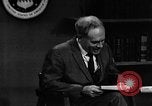
During an interview in the US, Lt. Gen. Ira Eaker talks about the Question Mark flight and refueling of aircraft in flight.
An interview of United States Air Force Lieutenant General Ira Eaker conducted by Dr. Maurer in the United States. General Eaker talks about the 'Question Mark' flight and its major significance. He says that they were having a few ideas in their minds. One was to call the attention of the people in the country towards aviation. The second was that they realized that there were no possibilities of getting aircraft overseas in time or in condition for early mission to combat. He further states that when they returned from the Question Mark flight, they realized they have made various discoveries. They came to know more about aircraft and their maintenance. Technical discoveries and extension of the range of aircraft by refueling them in flight. He talks about refueling the aircraft.

Industrial machines manufacture various consumer and packaged goods and products; Marina City in Chicago USA
Industrial factory production in the late 1960s United States. Factory machine prints sheets of can labels. Canned goods emerge from a large machine. Glass bottles and toilet paper rolls move along conveyor belt inside a factory. A machine producing and releasing a newly created yellow plastic bottle into a pile of yellow plastic bottles. Packaged food machine manufactures crust and pies for packs of Sara Lee frozen pies. View of the Marina City building (300 N State St, Chicago, IL 60654, United States) in downtown Chicago, Illinois USA.
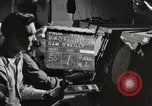
Air Force Lieutenant scans radar scope and gives information on phone for Air Defense.
United States Air Force Lieutenant sits in front of radar scope unit. Air Force personnel in the background perform other duties with radar scope. Lieutenant scans scope and gives information on phone for United States air defense.
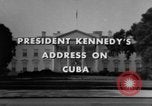
President John F. Kennedy addresses the nation about the missiles in Cuba from his office in the White House, Washington DC.
U.S. President John F. Kennedy addresses the nation during Cuban Missile Crisis. Exterior of the White House. President Kennedy in his office. He speaks about the series of offensive missiles found in Cuba and the range of these missiles. He names the cities that could be covered by medium range missiles and intermediate range missiles and thus are a danger to the western hemisphere. He also talks about Jet bombers capable of nuclear bombing. He refers to the constitution and the charter of the United States. He also discusses his talk with Soviet officials and their refusal to remove the weapons. President Kennedy condemns the nuclear weapons and expresses his concern about the Communist buildup in Cuba as it is dangerous to the United States. He talks about Americans policy to be patient and restrained. He warns that any nuclear attack from Cuba would be regarded as Soviet attack. He talks about an emergency meeting of the UN Security Council for withdrawal of all offensive arms from Cuba under supervision of the United Nations. Kennedy addresses Cuban people and says that they had been betrayed by their leaders. He asks all citizens to be patient
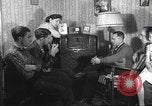
American citizens gather around living room console radios and portable radios in other locations, listening to news.
Multiple scenes of groups of people in the United States gathered around radios, listening. Timing is conclusion of labor strike by Coal Miners in the United States. On December 7, 1946, United Mine Workers President John L. Lewis called an end to a walkout of 400,000 coal miners that he had called on November 20, 1946. First scene shows a family seated in a living room listening to the news on a large console radio. The men, young and old, share cigarettes and pipes and smoke while listening intently. Next scene is a bar or tavern and shows a group of men, presumably coal miners, gathered around a portable radio on the bar to listen to the news. Two large American flags hang in the bar. Several men are drinking beer. Next scene shows four men playing cards at a table while they listen to a portable radio on the table. Wall calendar page for December 1946 is on the wall behind them. Next scene shows three men gathered around a wood burning pot belly stove that is heating a room, as they listen to a portable radio. Final scene shows a man and a woman huddled close to a living room console radio as they listen.
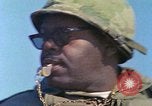
In the U.S. MPs at circulation control points provide river crossing support during war.
A training film in the United States details the role of Combat Military Police of the United States Army in supporting river crossing during war. An MAB (Military Assault Bridge) is emplaced and an armored vehicle rolls over the bridge. MPs direct the traffic. Other roles of MPs showing MPs involved in intelligence reporting on a battlefield, evacuation and control of prisoners. They move forward with equipment gaining advance in enemy area. Additional units of MPs cross the bridge. The MPs direct traffic at circulation control points such as road junctions. MPs with rifles provide security. One MP maintains radio communication. The MPs exchange information at a road junction.
CRITICALPAST.COM: About Us | Contact Us | FAQs - How to Order | License Agreement | My Account | My Lightboxes | Shopping Cart | Advanced Search | Featured Collections | Website Terms & Conditions | Privacy Policy ©2026 CriticalPast LLC.
License Agreement |
Terms & Conditions |
Privacy Policy
©2026 CriticalPast LLC.