


 Francais
 Deutsch
 Italiano
Refine Your Search
Nevada United States 1936 stock footage and images
- Showing 11275 to 11280 of 27248 results more
more Hide
Hide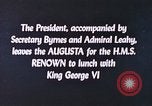
U.S. President Truman leaves USS Augusta and goes aboard HMS Renown to meet King George VI in England during World War II.
United States President Harry Truman meets King George VI on British battle cruiser HMS Renown in England. President Truman accompanied by United States Secretary of State James F. Byrnes and U.S. Navy Fleet Admiral William Daniel Leahy disembarks from USS Augusta. HMS Renown at sea. President Truman goes to the British cruiser to meet King George VI and returns back to USS Augusta. Dignitaries and sailors on the ship deck. United Kingdom and American flags on the mast of battleships. A band playing on the ship deck.

U.S. propaganda film during WW2, "Know Your Ally: Britain" showing war battle scenes and scenes of life in England
'Know Your Ally: Britain' - An Allied propaganda film to solidify Anglo-American solidarity within the ranks as well as to counter Nazi German propaganda aimed at weakening the alliance during World War II. Scenes in the United States of a college football game as a player makes a touchdown and a crowd erupts in loud cheering. Football team at blocking and tackling practice on a practice field. A World War 2 tank fires. British and American soldiers fire artillery and infantry forces running on a battlefield. Explosions occur and smoke rises. Views of soldiers of China, Russia, Britain and the United States. Allied troops march. Idaho, United States and Britain on a map showing population. Vehicular traffic and pedestrians on a road including cars and double-decker buses and pedestrians showing congested space in Britain. People talk to their neighbors. British policemen seen. British citizens emerge from underground transit system. Groups of British men, women and children in crowds are seen. Image of British Bobby police officer with hand up and narrator relates that British police do not carry a gun. Newspaper headlines about a strike, a catastrophe in Britain. Animated map of the Great Britain shows that it is surrounded by sea. Ships at sea. An old man and a boy sitting on a stoop with a model of a tall masted sailing ship. Brief views of cities in different parts of the world, including Sydney Australia; an unidentified South African port; an aerial view of the city of Wellington, New Zealand; parliament and government buildings in Ottawa, Canada; a large passenger ferry boat passing by with the skyscrapers of Manhattan New York City in the background.
FBI Director J Edgar Hoover talks about youth criminal activity, Bureau statistics, and flaws in the parole system.
First Director of the Federal Bureau of Investigation (FBI) of United States, John Edgar Hoover delivers a speech in Washington DC. He talks about raids against the underworld by the Bureau. He states the use of training, hard work, courses and cooperation with local law enforcement agencies as the means to successful crime solving. He states statistics of FBI Agents and shoot to kill incidences. The attendees applaud. He lays emphasis on the Bureau's methods and youth criminal statistics. He talks about the need to eradicate flaws in the parole system that turn criminals loose.

Britain, France, and Israel attack Egypt following nationalization of the Suez Canal.
Egyptian nationalization of the Suez Canal leads to war as Israel attacks Egypt, and France and Britain embark troops for transport to a joint staging area at the island of Cyprus. View of commercial ships in the Suez canal. Egyptian President Gamal Abdel Nasser. in discussion with officials. French troops embarking a transport ship in the port of Marseille, France. Brief glimpse of their destination port at Cyprus. British troops boarding airliners to take them to Cyprus where they will reinforce the existing British garrison. British and French carriers and warships assembling in the Eastern Mediterranean sea. A flight of four British Hawker Hunter jet fighter-bombers are seen flying in formation. Closeup of one inflight, with rockets mounted beneath its wings. Closeup of a rocket under its right wing. Scene shifts to another Hawker Hunter armed differently. It displays four outer wing rocket rails on each wing, carrying three rockets each. Auxiliary fuel tanks are installed on pylons under each wing. View of the White House in Washington DC. Inside, United States President Dwight D. Eisenhower and Secretary of State, John Foster Dulles discuss the Suez situation. Next, speaking at a press conference, President Eisenhower states , "the United States was not consulted in any way about any phase of these actions, nor were we informed about them in advance." He asserts America's intent not to become involved and to bring the matter before the UN General Assembly where their is no threat of a veto. He states his intent to "keep in contact with Congressional leaders of both parties," and expresses hope that the United Nations can bring an end to this "tormenting problem." View of the United Nations General Assembly building in New York City. Inside U.S. Secretary of State, Dulles, is seen seated next to America's UN ambassador Henry Cabot Lodge, Jr. Glimpse of the General assembly with all delegates seated.
Nixon and Kennedy comment on the Cold War and Communist prestige during a presidential election debate in Washington DC.
The second Kennedy-Nixon Presidential Debate in Washington DC, United States. Edward P. Morgan of ABC News asks Republican candidate U.S. Vice President Richard M. Nixon to comment on whether the United States was doing well in the Cold War. Nixon states that they were not doing as well as they should have in the Cold War because of the presence of the Communists on the international scene. He says that the Communist prestige in the world is lower than the American prestige. He comments on cost cuttings on programs like mutual security and defense by the Democratic Congresses. Democratic candidate Senator John F Kennedy disagrees with Nixon's statement that the Congress has not provided funds for national defense. He also disagrees on the question of U.S. position in the United Nations. He mentions that various reports of Congressional committees indicate that the relative strength of the U.S. compared to that of the Soviet Union and the Chinese Communists together has deteriorated in the past years. Alvin Spivak of United Press International asks Kennedy how the losing prestige can be regained, and programs accomplished without damaging economy. Kennedy talks about the breaking off of the sugar quota with Cuba, passing of an authorization, and the development of the Inter-American Bank. He states that the U.S. has looked at the needs of Latin America. He states that instead of concentrating aid on surplus military equipment in Laos, the aid should have been concentrated in long-term loans. He concludes that Americans should identify themselves not only with the anti-Communist fight but also with the fight against poverty and hunger. Nixon presents his views and states that along with the necessity for economic assistance, the need for technical assistance should also be developed. Americans should not only think in terms of fighting Communism but also in terms of the interests of these countries. He concludes and mentions American ideals of independence, right of freedom and right of progress.
Preparations for allied invasion of Normandy France during World War II.
'Normandy: Air borne invasion of fortress Europe ' Allied invasion of Normandy. Lieutenant General William S Knudsen introduces the film to be presented, expressing thanks to makers of the glider aircraft used in the invasion, who are the intended audience of the film. Field Order no1, 9th Troop commander Carrier. A man puts a Top Secret seal on the order. The Captain of United States 82nd Air Borne Division briefs men about the terrain with the help of a mosaic. A map of Europe shows principle cities of the continent. Map and narrator describe German Atlantic Wall coastal defenses on European continent. A giant concrete coastal gun emplacement. A large German railroad coastal gun moved out of a concrete shelter. Various concrete structures, sandbag structures of coastal guns. A concrete base gun turret revolves. Huge coastal guns protrude from concrete gun emplacements. Huge steel and concrete tank barriers stretched across. Large concrete and steel structures built along the coast to prevent assault craft from landing. Combined Chiefs of staff of the United Nations at a meeting. George Marshall and Henry Arnold at the head of the table during the meeting. A map shows invasion area near Le Harve. Troop Carrier units departing for Allied invasion on Sicily, Africa on 10 July, 1943. The United States C-47 aircraft take off towing gliders from an airfield in Africa. Troops transported from British 1st Air Borne division and United States 82nd Air Borne division. Dust rises as aircraft take off from a desert field. Demolished gliders on field and beside water. Multiple views of demolished gliders. C-47 in flight and paratroopers jump from the plane in New Guinea. Instructor trains paratroopers in United States. Discussion and demonstration of improvements in glider equipment and usage after Sicily Invasion and prior to D-Day Normandy invasion. Two men attach link nose chain to glider. Parachute extended and held open by men. Pilot of a glider talks to the pilot of the plane towing the glider over intercom.
CRITICALPAST.COM: About Us | Contact Us | FAQs - How to Order | License Agreement | My Account | My Lightboxes | Shopping Cart | Advanced Search | Featured Collections | Website Terms & Conditions | Privacy Policy ©2026 CriticalPast LLC.
License Agreement |
Terms & Conditions |
Privacy Policy
©2026 CriticalPast LLC.