


 Francais
 Deutsch
 Italiano
Refine Your Search
Nevada United States 1936 stock footage and images
- Showing 11971 to 11976 of 27248 results more
more Hide
Hide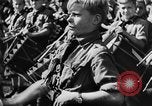
Fascism growth despite pre-World War 2 disarmament efforts including Washington Disarmament Conference, Nine-power treaty.
The background of World War II. German Hitler Youth children march with rifles, flags and a band beneath a camp entrance named Nordmark Lager 1935. Flag with Nazi symbol. Japanese flag and Japanese youth march in military exercises, followed by teenage Japanese forces. Italian fascist troops in uniform march in Torino Italy led by a band. Views of various German and Nazi forces parade and goose step in various cities. Units include brownshirts, goosestepping Storm Troopers, Wehrmacht. Civilians give a salute. Mostly sad looking men women and children watch the parades. The world globe. U.S. Capitol Building in Washington DC. French, Japanese and United States dignitaries attend the Washington Disarmament Conference or Washington Naval Conference at Memorial Continental Hall in Washington DC in 1921. View of the Washington Naval Treaty naval fleet reduction treaty book with signatures on it. Officials sign the Nine-Power Treaty that guarantees the integrity of China (per the John Hay "Open Door Policy"). Japanese delegation is shown at signing ceremony for the Nine-Power Treaty. Next scene shows 1928 signing ceremony in Paris of the Kellogg-Briand Pact renouncing war as a means of settling international disputes. French Foreign Minister Aristide Briand is seen speaking, and American Secretary of State Frank Kellogg is also seen at the treaty signing which was signed by 47 nations including Germany and Japan. In a 1930 scene, U.S. Secretary of State, Henry Stimson hands the London Naval Treaty to President Herbert Hoover. Scene of a U.S. Navy ship being blown up and scrapped in accordance with the treaty terms. View of American citizens in small town parades with floats marching as anti-war and isolationist groups.
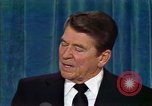
President Ronald Reagan gives a speech about U.S. Foreign Policy in Washington DC.
United States President Ronald Reagan's address on U.S. Foreign Policy at the National Press Club in Washington DC. President Reagan proposes mutual United States-Soviet reduction of nuclear weapons in Europe. He also talks about the elimination of the risk of surprise nuclear attacks. President Reagan states that talks with the Soviets on Arms Reduction Program are of utmost importance. The officials stand and applaud after the President's speech. President Ronald Reagan exits the room.
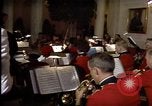
Indian Prime Minister, Indira Gandhi attend the formal dinner as an orchestra conducted by Zubin Mehta plays at the dinner.
Prime Minister (PM) of India, Indira Gandhi visits United States for better understanding and friendship between the two countries. Orchestra plays musical instrument at the formal state dinner hosted by U.S. President Ronald Reagan at the White House. President Reagan speaks about seeking clear understanding between the two countries. He raises his glass to PM Gandhi. PM Gandhi extends thanks for the invitation, hospitality and delightful evening given by President Reagan and first lady of U.S. She raises a toast towards President and speaks to other member of government to join them. A concert on the South Lawn given by the New York Phiharmonic Orchestra conducted by Zubin Mehta. President Reagan thanks Zubin Mehta for the beautiful musical evening. Zubin Mehta, First lady of the United States and PM Indira Gandhi stand beside President Reagan.
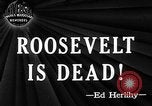
Life and death of U.S. President Franklin Roosevelt.
U.S. President Franklin Roosevelt passes away. Past events showing the President working for the nation. The President addresses the people. An aerial view of the Capitol building. The President stands in a balcony of the building for the inaugural ceremony. A large crowd gathers in front of the building to hear him. The President in car outside a building, he waves. The President with other dignitaries in a hall. The President at work in his office. He waves towards a large crowd lined up on the streets to greet him. He is seated in a car with his wife. People gather outside a building. The President with his family outside the building. He meets British Prime Minister Winston Churchill to discuss about World War II. He addresses the people and declares the state of war between Japan and the United States. The President seated in a jeep reviews troops. Churchill seated with the President. Other officials stand in the background. President Roosevelt seated with U.S. Vice President Truman. He studies a map with other officials. He addresses the people at the inaugural ceremony and takes the oath as the President. Exterior of a building. The President confers with other dignitaries at Livadia Palace near Yalta. He addresses the people about the war against Japan. The United States flag lowered on the flag pole.
Delegates from 51 nations meet for Convention on International Civil Aviation in Chicago.
Scenes from the first International Civil Aviation Conference (ICAO) in the city of Chicago, Illinois. At the invitation of the United States, delegates from 51 nations arrive to begin drafting and concluding the Convention on International Civil Aviation (Chicago Convention), including discussion on freedom of aircraft traffic in the world's aviation routes. Opening scene shows the Stevens Hotel at 720 S. Michigan Avenue, Chicago, United States, with automobile traffic driving past it on the street. Delegates from 51 nations are seen entering the hotel Grand ballroom, being monitored by U.S. Army Military police, as they enter. View from inside the ballroom as delegates enter. Some are seen standing around a globe of the world, discussing the transfer of military air routes back to civilian operations, in the future after the end of World War 2. View from a balcony of the delegates gathered below. Closeups of delegates from: Belgium; a military aviator in uniform, representing Haiti; delegates from Iraq, India, Australia, and Norway. Assistant Secretary of State, Adolf A. Berle Jr., Head of the U.S. delegation, delivers a brief welcoming speech, on behalf of President Roosevelt, from a podium behind which flags of participating nations are displayed. He speaks of the importance of freedom of air space, noting that closed air space can lead to war. He says that the air which God gave to everyone, should not become the means of domination over anyone.
Syngman Rhee, General Hodge, General Shitkov, and other officials meet at Duck Soo Kong in Seoul, after World War II.
Early North Korean Propaganda film depicts post-World War 2 events in Korea. including the partition of North and South at the 38th parallel. Korean village and country side.Seagulls fly at seaside. Duck Soo Kong building in Nam Dai Moon in Seoul. Officers stand around a table as General Hodge ( United States), General Shitkov (Russia), Syngman Rhee of South Korea meet. Rhee addresses the meeting, Koreans enter YMCA building in Seoul. Shows Japanese flag and states that Syngman Rhee has traded one Imperial overlord for United States. Animated map of Korea shows division at 38th parallel and depicts Southern part being covered by the entangling web of American interference. Len Han Sa building in Seoul and the city as a whole. South Korean police depicted treating a man badly and taking his food away to highlight Syngman Rhee's strongman tactics.
CRITICALPAST.COM: About Us | Contact Us | FAQs - How to Order | License Agreement | My Account | My Lightboxes | Shopping Cart | Advanced Search | Featured Collections | Website Terms & Conditions | Privacy Policy ©2026 CriticalPast LLC.
License Agreement |
Terms & Conditions |
Privacy Policy
©2026 CriticalPast LLC.