


 Francais
 Deutsch
 Italiano
Refine Your Search
Nevada United States 1936 stock footage and images
- Showing 12055 to 12060 of 27248 results more
more Hide
Hide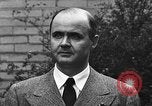
Ambassadors from Netherlands and Belgium speak about the German attack on their territories during World War II.
Ambassadors from Netherlands and Belgium in the United States. Official from Netherlands speaks about the German attack. He states that Germany has violated all norms. Netherlands is resisting the attack in its full power. Belgium ambassador talks about the German attack and the strategies to defend Belgium made by King Albert I of Belgium.
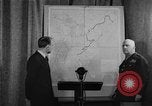
General Hugh Drum and James M. Landis, Civil Defense Chief, announce Proclamation restricting movements of civilians in U.S.
World War II restrictions on movements of civilians in the Eastern United States, are referenced by U.S. Army Lieutenant General Hugh Aloysius Drum, Commander of the Eastern Defense Command, and Mr. James M. Landis, Director of the U.S. Office of Civil Defense. They look at a large map showing the U.S. Eastern states and coast, from Maine to Florida. General Drum discusses Public Proclamation number 4 issued by the War Department, and urges citizens to read it. (It is posted in U.S. Post Offices and describes restrictions on the movements of citizens near war plants and beaches.) General Drum speaks of a uniform system of controls needed for U.S. Civil Defense. James M. Landis, Director of the Office of Civilian Defense, adds his comments about the importance of Civil Defense measures.
America's actions as World War II breaks out in Europe and Japan attacks China in Asia
Americans in bed listen to radio announcing beginning of World War 2 in Europe. French troops deploying to Maginot Line fortresses and firing their heavy guns. German heavy artillery firing. A rail gun firing. Pollsters gather American opinions about the war.Congress convenes in Special session. President Roosevelt requests changes in Neutrality Act. Senator Gerald P. Nye of North Dakota argues against and Senator Elbert D. Thomas (Utah) argues for changes in neutrality. Pollsters seek American's opinions. U.S. Congress ends arms embargo. The ship SS American Farmer (United States Lines) underway in the ocean. Animated map of Asia and views of Japanese forces bombarding China. Chinese civilians fleeing bombardment. Japanese soldiers executing two Chinese men. Dead Chinese civilians. American housewife being asked opinion about Chinese-Japanese conflict. Japanese ships load U.S. scrap iron, as some Americans protest. Dean Acheson, Assistant Secretary of State explaining U.S. law and decision to stop all exports to Japan in Summer 1941.
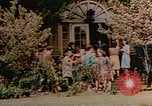
Idyllic scenes of American natural resources, lifestyle, and industry in the late 1940s
American teenagers walking in and out of a school or other institution. Movie set view of a immigrant family ostensibly on a ship deck looking outward. A view from the ground of the Empire State Building in New York City. People working on a farm and a red farm barn visible. Wide view of a river with forest on either side. Two people in a canoe paddling on a lake toward log cabin structures. Wide view of High Falls waterfall on Genesee River at Genesee Gorge in Rochester, New York, panning upward to show Williams, Hoyt and Company shoe factory building and buildings of downtown Rochester in more distant background. View looking upward at the Statue of Liberty. Scene with arms of people stretching out across a map of the United States and interlocking hands to represent unity across the nation. People walk towards the horizon.
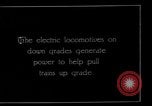
Views of electric locomotives and trains operating through rugged country in the U.S.
A film about electrified railroads in the United States. Slate states: "The electric locomotives on downgrade generate power to help pull trains upgrade." An electrified locomotive is seen moving down a railway track pulling many open rail cars loaded with raw materials. Slate reads: "Another striking example of regeneration is found on the Chicago Milwaukee and St. Paul Rocky Mountain electrification." An electric train is seen running through mountainous area. Slate reads: " This eletrification is operated entirely from water power." View from rear of an electric train as it runs alongside a river. View from locomotive cab and of engineer at the simple controls, as train transits a tunnel.
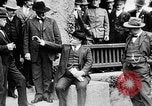
Scenes of Theodore Roosevelt campaigning for President as Bull Moose Party candidate in 1912
Theodore Roosevelt, Bull Moose Party candidate for President of the United States, is seen seated on a low concrete wall in front of the porch of a house. He appears relaxed and is surrounded by men who listen as he speaks, informally. Closeup of Roosevelt. Next, a motorcade carrying him drives along a wide street in what appears to be a town in an American western state. A woman, in western garb, on horseback, and carrying a bouquet of flowers, leads the motorcade. The cars are decorated with American flags. Roosevelt rides in the back of the lead car, which is followed by several others. Scene shifts to huge gathering of people surrounding a speaker's stand, where Theodore Roosevelt is about to speak. Two women in western clothes, on horseback, ride through the crowd to the speaker's stand and each presents Roosevelt with a bouquet of flowers. He thanks them and holds the bouquets aloft, before handing them to another man in the speaker's box. Next, Roosevelt, in closeup, is seen standing, in an open car, parked in front of a house, speaking directly into the camera (unseen). People are gathered around his as he speaks. Roosevelt gestures with his right hand and forefinger as he speaks.
CRITICALPAST.COM: About Us | Contact Us | FAQs - How to Order | License Agreement | My Account | My Lightboxes | Shopping Cart | Advanced Search | Featured Collections | Website Terms & Conditions | Privacy Policy ©2026 CriticalPast LLC.
License Agreement |
Terms & Conditions |
Privacy Policy
©2026 CriticalPast LLC.