


 Francais
 Deutsch
 Italiano
Refine Your Search
Nevada United States 1936 stock footage and images
- Showing 13033 to 13038 of 27248 results more
more Hide
Hide
General Eisenhower delivers brief remarks upon his appointment as Supreme Commander, Allied Forces, in World War II
U.S. General Dwight D. Eisenhower is besieged by correspondents and photographers in London, upon his appointment as Supreme Commander Allied Expeditionary Forces during World War 2. He us seen pointing at a wall map of Europe. Then, with flags of Great Britain and the United States behind him, he makes remarks from his desk. He expresses pleasure at the Joint nature of the allied command, and the effectiveness of the U.K. and U.S. forces. He extols the advances made on the Eastern front by Soviet forces. Finally, he expressed confidence in the ultimate victory of the United Nations.
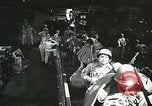
Views of London, England, when it is filled with Allied military personnel during World War II. Various organizations supporting the Allied military in the city.
American troops are seen boarding a transport ship in the opening scene, heading for the war front in Europe during World War 2. Closeup of the ship leaving the dock in the United States. Closeup of soldiers on deck looking back as they depart. Glimpse of upper deck of the ship completely filled with soldier passengers. Soldiers in their multi-bunk rooms aboard ship. Soldiers on ship's deck wearing life preservers. An impromptu band of soldier musicians entertains the troops. Others pass the time in card games,and sharing letters from home. Next, soldiers are seen watching as the troop ship arrives in Liverpool, England. A British army band plays to welcome them. View from the ship of American soldiers descending a gangplank to the Liverpool dock, where U.S. army trucks and an ambulance awaited them. Sailors, and a Women's Army Corp (WAC) Sergeant, feed pigeons on dock. One sailor poses with a small English girl. Film shifts to scenes of wartime London which occupy the remainder of the film. Several U.S. Army officers walk along a London sidewalk A British woman army sergeant and a local policeman. An English Bobbie (police officer with tall helmet) poses for the camera with several sailors and an American WAC Sergeant. U.S. soldiers and Military police (MPs) posing in front of a shop with U.S. Marine Corps logo on the window. Street scene with U.S. soldier walking past a sign reading: "USA cars, No Entry." More street scenes showing various British military and police in the city. A sign reading, "American Red Cross Services for Women." Another sign reading, "A uniformed Red Cross woman. Sign identifying the "Yugoslav Relief Society" headquarters. Canadian soldiers near the headquarters of the "RCAF Overseas." A Norwegian sailor with cap reading,"Norske Marine." Street sign pointing toward :"Canadian Red Cross and Maple Leaf Club." Headquarters of the "Newfoundland Caribou Club." Uniformed women from a Canadian province. Three Canadian soldiers lighting cigarettes. A local park in the background. Sign above "Merchant Navy Comforts Club." Sign reading: "St. Columbia Catholic Services Club." An Australian soldier walking on the sidewalk. Two uniformed women consulting a guide book with two American MPs. A Scottish soldier wearing a kilt accompanying a woman. Brief glimpses of various Allied soldiers from the British Commonwealth. British soldier wearing a busby hat. "Lion Services Club" sign with lion image. "Armoured Royal Corps Club" sign. "New Zealand Forces Club.""United Nations' Forces' Club."
Police disperse mob from Grosvenor Square as the crowd demonstrate at U.S. Embassy in London, England.
Demonstrations at United States Embassy (24 Grosvenor Square, London W1A 1AE, United Kingdom) in Mayfair, London, England, protesting American involvement in the Vietnam War. The police are moving in on the crowd. Bare tree in the foreground, the crowd of anti-war and peace activist demonstrators in Grosvenor Square. Police carry off demonstrators to the buses to be taken away. Large banners are being carried by the demonstrators in Grosvenor Square. A bus pulling out with demonstrators to the Police Station. The police and photographers, police have the demonstrators in tow. The buses and police wagons. The police pushing in on the crowded demonstrators along with the Mounted Police. A large mob jammed in the square. Police are lining the sidewalk. A demonstrator being carried off by the police. Police along the sidewalk with officials. Street is littered with newspapers after the mob dispersed. Police are seen walking through the park. Police running with a stretcher. Police carry a man on the stretcher toward the ambulance at the curb. Man being carried around to the back of the ambulance, being put into ambulance and taken to the hospital.
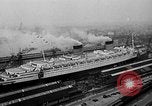
Vyacheslav Molotov, Senator Tom Connally and UN dignitaries on first post war voyage of luxury liner Queen Elizabeth.
The first post war (World War II) voyage of luxury ocean liner Queen Elizabeth on October 16, 1946. The luxury liner ship "Queen Elizabeth" docked in a harbor in Southampton England. Soviet Foreign Minister Vyacheslav Mikhailovich Molotov, United States Senator Tom Connally and other dignitaries board the ship. Smoke comes out of stacks. A sailor operates the helm. People standing on the dock sing and cheer together as the Queen Elizabeth departs on her voyage. The Queen Elizabeth underway in the Atlantic Ocean. The Queen Elizabeth arrives in New York harbor in the early morning and enters New York harbor at day break where she is greeted by fire boats shooting streams of water aloft in salute. Manhattan, New York City skyline barely visible in early morning mist. United Nations dignitaries disembark from the ship. Molotov is greeted by Soviet representative to the UN Andrei Andreyevich Gromyko. Molotov addresses the gathering.
African-American WACS pass in review before Major Charity Adams and General John C H Lee during World War II.
During World War 2, African American women soldiers of the Women's Army Corps (WACS) stand in formation at a parade ground in Birmingham, England, United Kingdom, during a formal military review on February 15, 1945. The women are from the 6888th Central Postal Directory Battalion, nicknamed “Six Triple Eight, which had just arrived in Birmingham. The WACS' commanding officer, Major Charity Adams, stands beside General John C.H. Lee. The African-American female soldiers of the WACS march in a column, eight deep, passing by General John CH Lee and Major Charity Adams, who salute the soldiers. Other male officers stand on the review stand behind officers Lee and Adams. Note: Major Charity Adams (Charity Edna Adams; later Charity Adams Earley) was the first African-American woman officer in the WACS, and, at the end of the war, then Lieutenant Colonel Adams was the highest ranking African-American woman in the United States military.

Scenes from 1929 Geneva Convention; surrender of 20,000 Germans to U.S. General Macon by German Major General Elster near Loire
A U.S. Army Signal Corps training film on Rules for controlling German prisoners of war in World War 2. International conference 1929 in Geneva, Switzerland. Various officers and dignitaries in the conference where the Geneva Convention was agreed-upon by many nations. Image of Field Manual 27-10 states the Rules of Land Warfare based on the Geneva Conventions and describes standard procedures for handling Prisoners of War. Scene of 20,000 Prisoners of War who surrender under Nazi Major General Eric Elster at Loire, France September 16, 1944 to the United States 3rd Army, 83rd Division, under General Macon. General Elster salutes General Macon, then approaches the microphones in the middle of a roadway and delivers a surrender speech. General Macon then replies accepting the surrender on behalf of General Simpson. General Macon states that the men will be treated according to the rules made during the conference in Geneva.
CRITICALPAST.COM: About Us | Contact Us | FAQs - How to Order | License Agreement | My Account | My Lightboxes | Shopping Cart | Advanced Search | Featured Collections | Website Terms & Conditions | Privacy Policy ©2026 CriticalPast LLC.
License Agreement |
Terms & Conditions |
Privacy Policy
©2026 CriticalPast LLC.