


 Francais
 Deutsch
 Italiano
Refine Your Search
Nevada United States 1936 stock footage and images
- Showing 13477 to 13482 of 27248 results more
more Hide
Hide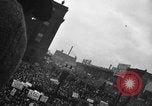
U.S. President Franklin Roosevelt addresses large crowd during 1940 Presidential campaign
Thousands of people gathered in streets of a town to hear President Franklin D. Roosevelt speak during the 1940 Presidential campaign in the United States. Numerous signs carried in the crowd display CIO and AFL letters representing unions.One reads: "Labor wants Roosevelt." One refers to New York truck drivers who support Roosevelt. The President addresses the crowd from a balcony overlooking the street corner. He is surrounded by photograpers and newsmen, and others.
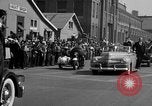
President Franklin Roosevelt visits an aircraft manufacturing plant during World War 2
Events related to the visit of President Franklin Roosevelt to a World War II warplane production plant in the United States. President Roosevelt's motorcade moves on road. Crowd gathered along streets wave as the convoy passes by. The motorcade drives through a huge warehouse. Stacked supplies in the warehouse. President in his open Lincoln car drives past a B-24 parked inside the plant. A group of sailors salutes the President as he passes. President talks to an officer in car.
View of a relocation center developed for rehabilitation of Japanese Americans during World War II.
Life of Japanese-Americans living at relocation centers (internment camps) in the United States during World War II. Officers inspect Japanese- American personnel standing at attention. Cars and trucks pass on a road. Trucks parked in garages in the background. Pumpkin grows in a farm at the relocation center.
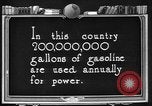
Busy city street with 1920's era automobiles; also Kerosene and by-products obtained from distillation of crude petroleum in US
Slate indicates that 200 million gallons of gasoline are used annually in the United States for power (in 1925). View of a busy city street, possibly New York City, circa 1925 with motor vehicle traffic, pedestrians and many tall buildings. Many early automobiles seen. A worker tests flash point of kerosene. Lighted candle in stuck block of paraffin (wax) showing wax or parrafin as a byproduct of petroleum. Slate indicates that petroleum provides motor fuel, common light, a lubricant for machinery and other important by-products.
Men carry out experiments to check the quality of petroleum products in the U.S.
Quality of petroleum products is checked and scientific research for further improvement is carried out in the United States. A man carries out an experiment to check the quality of a petroleum product. He heats the product on a Bunsen burner using a pair of tongs. Then he lights a lamp using the petroleum product. Another researcher looks through a tube at a screen and makes some adjustments. He makes a note on a container and pours in the container. Scientific glass apparatus in a box on a stand. A man looks at them. He makes a note on a paper and takes a look at a paper in his hand.
Water flows over the Niagara Falls and a globe with nine circular parallel lines along the equator rotates in the U.S.
The total consumption of petroleum of the U.S. and the world outside of the United States for the year 1918 is compared. Animation is used for this. Per capita consumption is also compared. Water flows over the Niagara Falls. A globe with nine circular parallel lines along the equator rotates. The 9 circular lines denote that if the per capita consumption of petroleum had increased as rapidly abroad as in the U.S. the world's petroleum requirement in 1922 would have been 10 times the actual requirement and if this volume had been loaded into tank cars of the capacity of 10,000 gallons each it would have made a solid train extending around the world at the equator 9 times.
CRITICALPAST.COM: About Us | Contact Us | FAQs - How to Order | License Agreement | My Account | My Lightboxes | Shopping Cart | Advanced Search | Featured Collections | Website Terms & Conditions | Privacy Policy ©2026 CriticalPast LLC.
License Agreement |
Terms & Conditions |
Privacy Policy
©2026 CriticalPast LLC.