


 Francais
 Deutsch
 Italiano
Refine Your Search
Nevada United States 1936 stock footage and images
- Showing 13771 to 13776 of 27248 results more
more Hide
Hide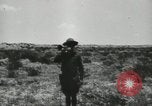
American soldiers train at firing range between World Wars. National Guard and Reserves considered "Citizen Soldiers."
Lifestyle of American soldiers between the World Wars. Soldier sounds bugle on a field in the United States. Soldiers leave their tents. Soldiers loaded on covered wagons pulled by mules. Army vehicles operating during training. Soldiers on firing range. National Guard and Army Reserve personnel referred to as "Civilian soldiers." They eat in their camp. They enjoy ice cream cones. They play Army band instruments while some of them dance and a soldier plays the saxophone.
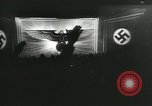
U.S. President Franklin D Roosevelt signs Selective Service Training Act of 1940. American men are drafted for military service
German Chancellor Adolf Hitler addresses officials in Germany. German military aircraft in flight . Bombs falling on targets. German troops march through streets. U.S. President Franklin Delano Roosevelt, at a desk in his office, signs the Selective Service Training Act of 1940. Officials mix serial numbers in a glass container. President Roosevelt announces the serial numbers of the men drafted into the U.S. Army. A large crowd of civilians gathered on the streets await the announcement. Selected men are shown in all places and in all walks of life, in the United States, including an African American man. The men undergo a medical and physical checkup at the induction center to begin service as new military recruits. Those inducted receive basic training and begin tours of duty in the U.S. Army. (World War II period). Background music during recruitment scenes is a chorus singing "This is the Army Mr Jones" by Irving Berlin.
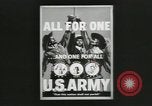
The three U.S. Army components are : the Army Reserves, the Regular Army and the Army National Guard.
Components of the U.S. Army. A poster in the United States reads 'All for One,One for all U.S. Army'. The three army components are : the Army Reserve, the Regular Army and the Army National Guard. A poster reads ' Serve in the Army Reserve'. Men of the Army Reserve join the Active Army during a summer training in field exercises. A large group of U.S. Army soldiers marching on a field. Soldier works on a typewriter. Other soldiers learn to load and fire artillery.
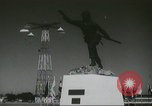
Sketches of U.S. Army Infantrymen fighting in every conflict from the Revolution to the Korean War.
Sketches of U.S. Army Infantry in the United States. 'Follow Me' statue at the U.S. Army Infantry School at Fort Benning, Georgia. The sketches depict infantrymen in various conflicts in American history, from Washington in the Revolution to combat in Korea. An infantryman holds the American flag. U.S. Army Infantry during the invasion of Africa. They fight in the Korea War.
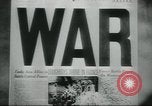
New U.S. infantrymen learn to fire rifles, make trenches and advance on a battlefield, in preparation for going to war in France
Training of U.S. Army infantrymen in the United States. A newspaper headline reads ' infantrymen arrive in France'. The infantrymen are taught to advance on a battlefield. Recruits in New York's Rainbow Division are seen marching in the mud, at Camp Mills, Long Island, They undergo physical training at the camp. They learn to fire rifles and dig trenches. They inhabit a tent city at the camp. Scenes of Rainbow Division soldiers on a chow line at Camp Mills. After basic training, the soldiers board ships and trains for France. Loved ones give them a sendoff. Upon arrival in France, they are given a warm welcome.They resume training in France, until they are ordered to the Front. Scenes of U.S. infantry in trenches wearing gas masks and firing rifles. Tanks advancing across the trenches. View of the 7th Regiment World War I memorial statue in Central Park, New York City.
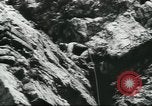
U.S. Army Special Forces soldiers learn mountaineering and jungle surviving techniques during their training in the U.S.
U.S. Army Special Forces soldiers undergo a training in the United States. U.S. Army Special Forces soldiers learn mountaineering techniques. They learn to fire in a jungle. A camouflaged trap with embedded bamboo sharp needles sticks and covered with hay. The soldiers kill a reptile, cook it and eat it in a jungle. They make their shelter with palm leaves. The soldiers are path finders and know their area orientation in the jungle. The soldiers climb down a rope from a mountain. They study about machines in a classroom. The use a dog sledge and a skiing board to move in a snow covered area.
CRITICALPAST.COM: About Us | Contact Us | FAQs - How to Order | License Agreement | My Account | My Lightboxes | Shopping Cart | Advanced Search | Featured Collections | Website Terms & Conditions | Privacy Policy ©2026 CriticalPast LLC.
License Agreement |
Terms & Conditions |
Privacy Policy
©2026 CriticalPast LLC.