


 Francais
 Deutsch
 Italiano
Refine Your Search
Nevada United States 1936 stock footage and images
- Showing 14005 to 14010 of 27248 results more
more Hide
Hide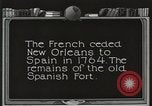
Ruins of the Old Spanish Fort and two men sit with legs in the stockade in New Orleans, Louisiana.
Scenes from the city of New Orleans in Louisiana, United States. Ruins of the old Spanish Fort at the Bayou St. John on Lake Ponchartrain, also sometimes called Fort St. Jean or Fort St. John, or Fort San Juan del Bayou. Tourists walking in the old fort area, and view of an old cannon in the fort grounds. Exterior view of the city arsenal at 615 St. Peter Street directly behind the Oabildo. The arsenal is on the site of a former Spanish prison. It was war designated in 1915 to be the relic department of the Louisiana State Museum, and dedicated as a "Battle Abbey." View inside the arsenal, where two African American men are seated on the ground with their legs in the stockades or stocks to demonstrate their operation.

Eisenhower is greeted by a crowd after his recovery and Paul Dudley White addresses a press conference in Washington DC.
U.S. President Dwight David Eisenhower in Washington DC after his recovery from his 1955 heart attack. The President followed by officials waves to people. The President enters a car. Paul Dudley White, American physician and cardiologist, addresses a press conference stating that the condition of the President is fit for another 5 to 10 years. The President and the First Lady of the United States Mamie Doud Eisenhower disembark from an aircraft at an airport. A crowd waves to the president. The car is driven on a road with the crowd gathered on either side to greet the President.

Dwight D Eisenhower addresses a presidential press conference in Washington DC.
U.S. President Dwight David Eisenhower addresses people in Washington DC, United States. The President addresses a press conference. The President says that he will quit the office if his health declines. He also states that Vice president Richard Milhous Nixon will make his own decision. The newsmen move out of the conference hall after the conference.

After a surgery President Dwight David Eisenhower addresses a press conference in Washington DC.
U.S. President Dwight David Eisenhower after a surgery after he suffered an intestinal ailment in Washington DC, United States. The President enters a conference hall with officials. The President addresses a press conference after his recovery from the surgery. The President states that he can continue working in the office if elected by the voters.
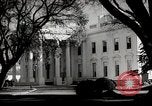
U.S. Government officials at White House and Pentagon during the Cuban Missile Crisis; President Kennedy informs America.
Activities during Cuban Missile Crisis in the United States. U.S. Government officials arriving at the White House in Washington DC to address the Cuban missile crisis. CIA Director John McCone and Vice President Lyndon Johnson seen arriving at the White House. President John F. Kennedy addresses the American people on October 22, 1962, announcing discovery of Soviet missiles in Cuba and imposing a U.S. naval "quarantine" on Cuba. Animation showing areas of naval quarantine. The U.S. Capitol in a night time view. Night view of the State Department Building and the Pentagon in Arlington, Virginia. Interior views in the Pentagon show offices and signs for Office of Secretary of Air Force; Office of U.S. Air Force Chief of Staff; Office of Chief of Naval Operations; Office of the Joint Chiefs of Staff; and Office of the Secretary of Defense. View in a meeting room of Robert McNamara, the Secretary of Defense, standing at a microphone.
John Foster Dulles accompanied by Harold Edward Stassen as they meet Muhammad Naguib in Cairo, Egypt.
The U.S. Secretary of State John Foster Dulles visit Cairo in Egypt during his world tour to trouble spots. John Foster Dulles accompanied by the Director of the United States Foreign Operations Administration Harold Edward Stassen arrives in Cairo and meets the Commander-in-Chief of Egyptian Army Muhammad Naguib. John Foster Dulles talks to Muhammad Naguib. They walk up the stairs. Both men seated as they discuss on Suez canal issue.
CRITICALPAST.COM: About Us | Contact Us | FAQs - How to Order | License Agreement | My Account | My Lightboxes | Shopping Cart | Advanced Search | Featured Collections | Website Terms & Conditions | Privacy Policy ©2026 CriticalPast LLC.
License Agreement |
Terms & Conditions |
Privacy Policy
©2026 CriticalPast LLC.