


 Francais
 Deutsch
 Italiano
Refine Your Search
Nevada United States 1936 stock footage and images
- Showing 15091 to 15096 of 27248 results more
more Hide
Hide
Japanese Self Defense Force training. Combined Arms School at Camp Fuji.
Japanese ground self defense force under training provided by United States and Japanese government jointly in Japan.Combined Arms School at Camp Fuji. Bayonet drill practice using wooden rifles. Firing recoiless rifles. Firing 155mm howitzers. Firing guns on Sherman tanks. Japanese mechanics repairing and maintaining 155mm howitzers. Japanese drills with semaphore flags. Japanese play volleyball at Camp Fuji. American military advisors work with general staff of Japanese self defense force in "paper war," including Command, Control and Communications exercises in the field, where. Japanese operate military communications facilities. Japanese Defense Forces in chow line and dining hall tent, during field exercises.

Imperial Japanese Army (IJA) soldiers commit war atrocities and murder during World War II
Atrocities committed by Imperial Japanese Army (IJA) soldiers in China and other parts of Asia during World War II. War workers in offices, factories, and mills shift their attention to the narrator. Smoke rises from factory smokestacks and chimneys. American workers manufacture war materiel in factories. Factory workers shovel coal to the furnace. Japanese soldiers abuse elderly Chinese women. A Japanese soldier toss an infant before striking with a bayonet midair. A Chinese woman watches with shock. IJA troops drag and bury Chinese civilians alive. IJA troops burn cities and shoot victims at close range. Soldiers place the remains of dead Chinese men, women, and children in truck. Japanese soldiers torture and kill Chinese civilians and are depicted killing American Prisoners of War (POW). Aerial views of San Francisco, Chicago, Pittsburgh, and New York. A dead Japanese soldier with flies covering his face. A newly built M4 Sherman tank moves inside a factory. Body of a Japanese soldier wearing round glasses. Dead Japanese soldiers seen with repeating American wartime propaganda message that every piece of wartime production "kills a Jap." Tanks, trucks, planes, shells, guns, and artillery are manufactured in United States factories and plants during World War II. Americans urged to take war jobs to help win World War 2.
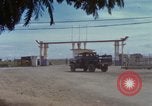
VNAF and USAF Air police on duty at main gate of Bien Hoa Air Base in Vietnam.
Vietnam Air Force and United States Air Force Air police stand for duty at main gate of Bien Hoa Air Base in Vietnam. Air Force van enters into the main gate. Horse cart and bicycles pass on a road. Jeeps driven out from the main gate. VNAF and USAF AP on duty at the main gate. (Vietnam War period).
Colonel Catledge dives into swimming pool at Officers' Club in Bien Hoa Air Base, Vietnam.
Routine activities of United States Air Force Colonel Richard C Catledge, Commander of the 3rd Tactical Fighter Wing at Bien Hoa Air Base in the Republic of Vietnam. Richard C Catledge speaks that he won the first Air Force Diving Championship. View of Colonel Catledge diving into swimming pool at the Officers' Club. He swims and comes out from swimming pool. (Vietnam War period).
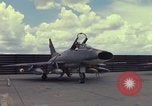
Colonel Richard C Catledge enters into ready room and talks to pilots at Bien Hoa Air Base in Vietnam.
United States Air Force Colonel Richard C Catledge visits the alert facility at Bien Hoa Air Base in Vietnam. F-100 parked on the ground at Air Base. Colonel Catledge walks past camouflaged F-100D. He salutes a security guard and enters ready room. Sign of 'F-100 Alert Facility Air Crew'. Colonel Catledge enters into the ready room and talks with pilots of 3rd Tactical Fighter Wing. Colonel Catledge seated at desk speaks. A pilot writes down on notepad and another pilot reads newspaper. (Vietnam War period).
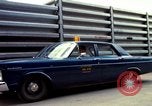
U.S. Air Force Colonel Richard C Catledge enters maintenance shop and talks to NCOIC at Bien Hoa Air Base in Vietnam.
United States Air Force Colonel Richard C Catledge visits maintenance shop at Bien Hoa Air Base in Vietnam. Colonel Catledge leaves staff car and enters the maintenance shop. He salutes the Non-Commissioned Officer in Charge (NCOIC) and walks to a group of airmen at work. Airmen work on jet engine. Colonel Catledge talks to NCOIC. Airman cleans the jet engine. (Vietnam War period).
CRITICALPAST.COM: About Us | Contact Us | FAQs - How to Order | License Agreement | My Account | My Lightboxes | Shopping Cart | Advanced Search | Featured Collections | Website Terms & Conditions | Privacy Policy ©2026 CriticalPast LLC.
License Agreement |
Terms & Conditions |
Privacy Policy
©2026 CriticalPast LLC.