


 Francais
 Deutsch
 Italiano
Refine Your Search
Nevada United States 1936 stock footage and images
- Showing 1531 to 1536 of 27246 results more
more Hide
Hide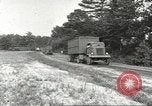
American Army Quartermaster vans in United States
American Army stakes and platform van rolls on a road in United States. Soldiers enter one of the vans with a shoe repair unit. A shoe repaired. Men hand over their clothes to a man operating a washing machine van. Soldiers take showers in a truck parked in a wooded area. (World War II period).
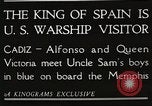
King Alfonso XIII of Spain and Queen Victoria aboard U.S. cruiser Memphis in the United States.
A visit of King Alfonso XIII of Spain and Queen Victoria on U.S. cruiser Memphis in the United States. U.S. Ambassador Hammond, Mrs. Haamond, U.S. Navy Captain R. D. White and U.S. Navy Vice Admiral Roger Welles pose on the deck of U.S. cruiser Memphis. King Alfonso talks to two U.S. sailors of Spanish descent. The sailors salute a boat going away from the ship. King George V of the United Kingdom aboard a U.S. ship.
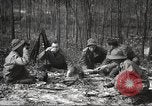
K ration developed under U.S. Army Colonel Roland for U.S. Army soldiers in the United States.
Nutritious food for U.S. Army soldiers in the United States. A group of U.S. soldiers seated among a few trees and having food. The soldiers having pre-cooked meat, which is an emergency ration developed in a laboratory. Nutritionists and army officers tasting food in a laboratory. Different cans with labels 'breakfast', 'dinner' and 'supper'. Three K ration packets developed for the army. 'U. S. Army Field Ration K, Supper Unit' written on one of the packets. A few soldiers seated on an army tank having food. One of the men puts contents of a packet in a mug. Commandos having K ration. Soldiers smoking cigarettes. Colonel Roland, who developed the K ration, speaking. He says that the K ration has been developed to provide soldiers with food under emergency situations and is suitable for all climatic conditions. The items used in K ration are tested. Several recipes are tested for soybean biscuits. Colonel Roland seated with other officers at a table and tasting different soybean biscuits. (World War II period).
Cattle being loaded onto a ship in the United States to be transported to Europe by the UNRRA during World War II.
Livestock being shipped to Europe during World War II. The UNRRA (United Nations Relief and Rehabilitation Administration) ships livestock to Europe to improve the breed of cattle. Cattle being loaded onto a ship at a port in the United States.
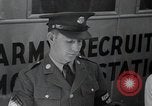
Men get inducted and trained for war in the United States along with the UN army preparations during World War 2
Draftees are trained for army in the United States during World War II. A U.S. officer recruits men for army. Men including farmers, fishermen, clerks and factory workers walk in lines. Men run on ground with wooden guns as they undergo training. Men drive trucks. Men learn to load guns. The draftees are inducted and trained. Men from different United Nations member countries including America, Russia, China, German, Czech Republic, Greece, India, Dutch, Philippines and French get trained and prepared for war.
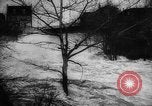
WPA workers help rescue people from the flooded area and Harry Hopkins visit the flooded area in the United States.
WPA (Works Progress Administration) units carry out relief projects in flooded areas in the United States in the Great Depression. The floods in a town. The water entering the town. The fields flooded with water. Damage due to floods. Aerial view of the flooded area. Houses submerged in water. The water on streets. Several views of damaged buildings and submerged houses in water. The workers of the WPA help the people to rescue. They take the people stucked in their houses aboard a boat. Several views of the workers helping the people to rescue. The WPA workers on the snow area. The victims are provided woolen clothes by the workers. Red Cross nurses in a hospital. They treat the wounded. The workers carry wooden planks on their shoulder. The WPA workers fill sand bags. The workers lay sand bags near a river. Director of WPA Harry Hopkins inspects flooded areas. The workers remove the wreckage. The wreckage on the ground. The workers remove the wreckage.
CRITICALPAST.COM: About Us | Contact Us | FAQs - How to Order | License Agreement | My Account | My Lightboxes | Shopping Cart | Advanced Search | Featured Collections | Website Terms & Conditions | Privacy Policy ©2026 CriticalPast LLC.
License Agreement |
Terms & Conditions |
Privacy Policy
©2026 CriticalPast LLC.