


 Francais
 Deutsch
 Italiano
Refine Your Search
Nevada United States 1936 stock footage and images
- Showing 15445 to 15450 of 27248 results more
more Hide
Hide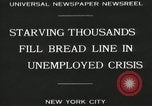
Unemployed men in bread lines receive tickets for food from charitable institutions during Great Depression
Unemployed men during depression seek work and assistance in New York City, United States. Men line up in a bread line to receive tickets for food. Clergy and an assistant, in front of a church, hand out food tickets to the men. Close up views of the men in the bread line, and close up view of their legs and feet and shoes shuffling forward in line. New York City policemen maintain an orderly procession. Men sit by shed in vacant lot looking at newspapers for employment opportunities.
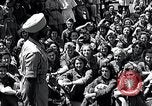
Women's Army Auxiliary Corps (WAAC) training and and contribution to war efforts in different parts of the world (WW2)
The role of Women's Army Auxiliary Corps (WAAC) in the United States Army during World War II. In January 1943, the first posting of WAAC enlisted personnel overseas, was to Algiers. Women disembark a ship. WAAC women walk with orphan children into a convent. A WAAC woman washes utensils; others dry clothes. WAAC women arrive in Scotland and get trained. Women visit India. Women at the Taj Mahal in Agra. Women visit New Delhi. Women on camels in Cairo. Women disembark a ship in Europe. Two women adjust a tent. Woman washes her hair and clothes using her helmet. Women inside a tent. Woman checks injured soldiers. Nurses in hospital as they look after soldiers. Women march. A woman pays homage to the female soldiers who sacrificed their life in war. Soldiers carry another injured soldier on stretcher. Officers check injured women in hospital. Women in uniform march.
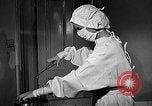
Army nurses treat injured soldiers while doctors perform surgery and women work in the communication department in Korea
The film 'The Big Picture' depicts the role of women in the U.S. Army in Korea. An Army nurse removes a dressing from sterilizer, with tongs, and gives it to surgeon, during operation. A team of doctors perform surgery. Physician works on soldiers. The leg of the soldiers dipped in a water tub. Nurse wipes the legs of soldier using a towel. A nurse teaches physical therapy exercises to recovering soldiers. Nurses treat soldiers in a medical van. Women work in the communication department. Woman works on typewriter. Yokohama, Japan: A quonset hut reads 'WAC Detachment Yokohama command 8064th army unit'. U.S. army women come out of the building. The local women stand. Woman arranges paper on a table. The Eiffel tower. Women work in office. Women eat on snow. A woman with a soldier as she examines a gun. A nurse helps an injured soldier. U.S. Army General Matthew Bunker Ridgway states that he is proud to have women in the army and needs many more to contribute. Captain Carl Zimmerman concludes the program.
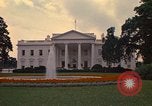
Front entrance of the White House, Washington, DC
Front view of the White House, official office and residence of the president of the United States at 1600 Pennsylvania Avenue N.W. in Washington, DC. Beautiful flowers blooming around fountain on the front lawn. Guard post seen in left distance, with people entering past it. American flag flying from pole on roof of the White House. Flag pole is topped with a gold eagle.
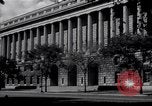
Washington DC scenes. IRS Service Building. Washington Monument. Washington Channel.
Several views of Washington DC. Views of the Internal Revenue Service Building, at 10th Street and Pennsylvania Avenue. The Washington monument can be seen from various viewpoints. The Washington Channel, as viewed from Hain's Point, looking toward Maine Avenue. Boats in the harbor. View of the Washington Monument (2 15th St NW, Washington, DC 20024, United States) as seen from inside the Lincoln Memorial, across the reflecting pool.
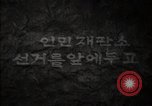
Post-World War 2 Soviet propaganda film (1948) depicting the rule of law at work in the USSR and mistreatment of people in America.
Soviet newsreel with opening slate in Korean, accompanied by Korean narration. Scene transitions to open pages of books written in cyrillic text, entitled "Constitution Basic Law Soviet Union." Camera pans to various sections of the Law Book. A man, seeming to be the senior judge, sits at a table flanked by a bemedaled woman and another man. Another woman sits at the end of the table. The senior judge is speaking as the camera backs away to reveal a room filled with people seated at the proceedings. Camera pans to cyrillic sign on a door, reading "People's Court, or People's Judgment." Next, a woman approaches the Judge (in his office, or chambers) and presents some documents that she discusses with him. Scene changes showing a poster of a woman holding a petition. Writing on the poster reads,"People's Court." Scene shifts to another courtroom where a man stands at a podium on a stage shared with a panel of people. A mural in the background depicts Joseph Stalin. Closeup of the speaker reveals he is the same judge seen in earlier scenes. As he speaks, the camera pans the serious looking audience that applauds when he finishes speaking. Next, a city street scene shows a tram moving. Then a woman is seen working at a desk inside a modern apartment. She is seen, next, speaking before a group comprising a cross-section of people, including a Soviet military officer. The woman lecturer holds a magazine depicting drawings of violence, including lynchings, and mistreatment against African American citizens in the United States.
CRITICALPAST.COM: About Us | Contact Us | FAQs - How to Order | License Agreement | My Account | My Lightboxes | Shopping Cart | Advanced Search | Featured Collections | Website Terms & Conditions | Privacy Policy ©2026 CriticalPast LLC.
License Agreement |
Terms & Conditions |
Privacy Policy
©2026 CriticalPast LLC.