


 Francais
 Deutsch
 Italiano
Refine Your Search
Nevada United States 1936 stock footage and images
- Showing 16567 to 16572 of 27248 results more
more Hide
Hide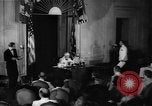
President Franklin D Roosevelt delivers fireside speech about the threat of war in Europe becoming a World War
President Franklin D Roosevelt delivers a fireside speech from inside the White House in Washington DC, United States. During the speech he expresses concern over the national emergency and the need to defend the freedom of American republics. He expresses concern over the European War turning into a World War (World War II) and the increasing threat to countries in the American hemisphere. He condemns Adolf Hitler's policies and stresses upon the need to check Nazi German expansion to the west. He says that the only way to stop Adolf Hitler is to prevent him from gaining control of the seas. Toward this end he stresses the need to speed up the ship building program.
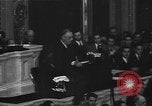
President Franklin D Roosevelt delivers the Rearmament speech during World War II in Washington DC.
President Franklin D Roosevelt during the Rearmament speech before the Congress in Washington DC, United States emphasizes upon the need to increase airplane production to 50,000 planes a year. He also emphasizes upon the need to increase production of tanks, antiaircraft guns and ammunition. He urges the Congress to allow appropriating a sum of 896 million American dollars for the purpose of increasing armament production.
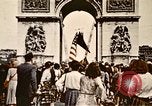
Allied countries flags fly at Arc de Triomphe in Paris, France during VE Day (World War II)
Victory in Europe Day festivities in Paris, France after World War II. A crowd gathered in front of the Arc de Triomphe (Pl. Charles de Gaulle, 75008 Paris, France). Large flags of United States, Soviet Union, and France are displayed under the Arch.
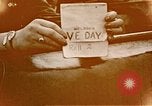
People celebrate the end of WWII in Europe, on Victory in Europe Day, Paris, France.
Victory in Europe Day (VE Day) celebrations, in Paris, France- marking the end of World War II in Europe. United States Boeing B-17 Flying Fortress bomber aircraft flies over Arc de Triomphe (Pl. Charles de Gaulle, 75008 Paris, France). People gather in large numbers to celebrate the end of World War 2, in Europe. A group of people at Arc de Triomphe waves a French flag. People gathered in large numbers. Allied flags carried by people. A man reads a newspaper with a headline that reads 'Victory'.
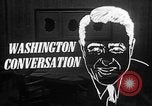
R. Sargent Shriver interviewed in Washington DC about his student life.
An episode of the television show Washington Conversation. Robert Sargent Shriver talks to the interviewer, they occupy their seat and the interview begins. Interviewer Paul Niven asks him about his student life and the tours to Europe. Shriver talks about his experience during his tours to Germany, France and other European countries. He tells how he learnt to appreciate different cultures through such tours. He also tells about how he got the scholarship to go to Europe. He answers questions about his days in the United States Navy and how after the World War II he took to Journalism instead of Law.
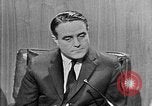
Sargent Shriver interviewed in Washington DC about his student life.
Robert Sargent interviewed in Washington DC, United States. On being asked by the interviewer, Paul Niven, about his first meeting with Joseph Kennedy, he talks about how he met Kennedy at a party, who wanted him to publish his dead son Joe's diaries in a newspaper.
CRITICALPAST.COM: About Us | Contact Us | FAQs - How to Order | License Agreement | My Account | My Lightboxes | Shopping Cart | Advanced Search | Featured Collections | Website Terms & Conditions | Privacy Policy ©2026 CriticalPast LLC.
License Agreement |
Terms & Conditions |
Privacy Policy
©2026 CriticalPast LLC.