


 Francais
 Deutsch
 Italiano

Refine Your Search
Nevada United States 1936 stock footage and images
- Showing 163 to 168 of 35683 results more
 Hide
Color Sound
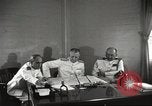
Admiral Kimmel and staff in a meeting, and U.S. Navy ships docked at Pearl Harbor, Hawaii
Admiral Husband E. Kimmel, U.S. Navy, Commander in Chief, U.S. Fleet and Pacific Fleet, (center), confers with his Chief of Staff, Captain William W. Smith, (right), and his Operations Officer and Assistant Chief of Staff, Captain Walter S. DeLany (left), at Pearl Harbor, in 1941. Closeup view of Admiral Kimmel. View of two U.S. Navy submarines and several ships docked at Pearl Harbor, and crew men working on some of the ships. USS Indianapolis (CA-35) is seen at dock. Dock crane removing a 5 inch gun from USS San Francisco (CA-38) in the beginning stages of a refit. She would still be getting refitted when the attack on Dec. 7th occurred. Covered Lighter barge YF-240 is also seen. This is the barge that was next to USS Nevada during the attack. This was filmed before the December attack on Pearl Harbor by the Empire of Japan. (World War II period).
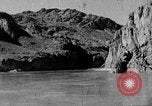
Boulder City built to house employees engaged in Boulder dam excavation and construction.
Documents the excavation and construction of the Boulder Dam (Later named Hoover Dam). Boat in a river at the Black Canyon. A man points to the map of United States. Water floods in agricultural district. River in a deep valley between cliffs. Map points out Black Canyon of the Colorado River, on the border between Arizona and Nevada. Deserts of South West. Excavating mountains by truck. Cargo train runs on track. Men work in factories. Industrial equipment. Engineers and surveyors at construction site. Small town (Boulder City) built to house employees. Various buildings of town. Building housing the officers of Pacific administration. Traffic on street and gardens outside houses. White cottages in town. Cooks prepare food in kitchen. Men served in large dining hall. Passenger trucks loaded with workers, moves for dam site. Workers leave trucks at dam site.
Meeting of the Eighteen-Nation Disarmament Committee at the U.N Palace of Nations, Geneva Switzerland, in 1967
As film starts, the loud sound of jet airplanes is accompanied by views upward of clocks and the control tower at Geneva, Switzerland airport. The flag of the Canton of Geneva and that of Switzerland are displayed in tall flag poles. A jet passenger plane begins its takeoff roll in the background. An observation deck atop the airport building is filled with visitors. A Swissair Boeing 707 passenger plane is taxiing to the ramp after landing. Snow covered mountains fill the background. Narrator says "tomorrow, the 4 year old, 18 Nation Disarmament Conference, co-chaired by the Soviet Union and the United States, will once again, convene." Photographers ready cameras as a mobile stairway moves to the aircraft doorway. Closeups of spectators on the observation deck, including families with children. The American delegate, William C. Foster, Director, United States arms control and disarmament agency, is seen walking away from the airplane, across the airport ramp, accompanied by persons greeting him. Inside a building, Foster is mobbed by surrounding reporters and photographers. An interviewer asks him what is the most important item on the agenda for the United States. He replies: "The achievement of a Non-proliferation Treaty." Newsmen continue to press him about prospects of success in negotiations with the Russians. Scene shifts to the shore of Lake Geneva and the original League of Nations, Palace of Nations building there. Camera pans over the building to a tablet in its wall, memorializing U.S. President Woodrow Wilson, Founder of the League of Nations. View from a high hill overlooking the lake, shows the second home of the League of Nations built in 1936, adjacent to the original building. (It is now the European Headquarters of the United Nations.) Camera pans across the building and its grounds, where a flag and a large sculptured globe of the world are seen. Scene shifts to a parkway with several cars on it. The camera focuses on the shaded building of the Soviet Mission, just off the parkway. In downtown Geneva, the camera focuses on a large building of glass and aluminum, which houses the United States Mission, where the United States Disarmament delegation is headquartered. William C. Foster is seen at a large conference with the delegation staff. Closeup of him and staff members as they consider the best ways to approach the negotiations. Various closeups of Mr. Foster as he works over texts at his desk. He is heard saying: "The important thing is to get complete control of a possible exchange of nuclear weapons on a grand scale." Brief view of Lake Geneva at night. Next, the camera pans downward from the ceiling to the council chamber floor where delegate seats are arranged around a huge table in readiness for the next days activities. It is the next day, and an American flag flutters on the fender of a car carrying William Foster to the Council chamber for the day's session. Closeup of him in the back of the car. The camera also captures scenes outdoors as the car drives along the scenic lake front drive to the Palace of Nations. A daytime view from overlooking hill of the Palace of Nations and Lake Geneva. In the outer hall of the Palace of Nations building, some 200 reporters mill about discussing world events of the day. William Foster's car arrives at a curb and a white-capped officer greets him as he steps from the car. Other delegates, including a woman, are also seen arriving and entering the building. Inside the building, delegates are seen socializing (with many languages heard). Closeup glimpse of Mr. Foster among the group.
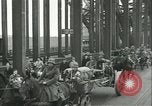
German and Japanese forces capture towns; Allied workers make ammunitions in factories (WW2)
German forces during remilitarization of the Rhineland: German Army supply wagons and German soldiers cross Hohenzollern Bridge in Cologne, Germany, to reoccupy Cologne and the Rhineland on March 7, 1936. Change of scene to Japan in late 1930s. Emperor Hirohito of Japan inspects troops on his white horse, Shirayuki. Japanese soldiers bow in front of the Imperial Palace in Tokyo. Japanese men holding banners. Japanese soldiers and cavalry advance. Japanese soldiers stand in formation and march on a street. Japanese Navy officers view a map or chart and discuss their plans and strategies for attack. Japanese soldiers fire artillery and other weapons in battle. Japanese war production worker in munitions plant making shells. Change of scene to American workers in war production factories in the United States making shells, bullets, and various munitions during World War 2. Elevated view of large American tank factory floor with many Army tanks being assembled. War production workers building Army trucks and new trucks being driven off of assembly line. Rows of U.S. Army tanks and artillery on the ground. U.S. Army soldiers board a troop transport ship. A submarine is spotted by a sailor. A hand presses a button to launch torpedoes to attack a ship. View through periscope as torpedo moves just below water surface toward target. View in open water of torpedo moving through water. Torpedo strikes a ship and explosion rocks ship. Formation of torpedo aircraft and dive bombers in flight over an area. Ships on fire with black clouds of smoke rising above. British navy sailors firing anti aircraft guns from a British ship. Sailors and officers aboard ships watch enemy airplanes through binoculars. U.S. Navy sailor manning a machine gun aboard ship watches the skies overhead.
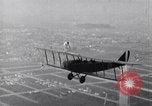
The good times of the 1920's turn into the difficult times of the depression in 1930s America
Documentary depicts the end of the 1920s good times in the U.S. ("Roaring 20s"), leading into the Great Depression. Mildred Unger, age 10, performs a wing walker charleston dance while out on the wing of a JN-4 "Jenny" airplane in flight over Los Angeles in 1926. Four girls dancing on the top of a building higher than those around it, in Boston, Massachusetts. Amusement park patrons riding a roller coaster. People out driving through a park in their automobiles. Patrons enjoying themselves at the Steeplechase amusement park in Coney Island, New York. A crane piling old cars in a heap at a junk yard. But following the Wall Street crash (stock market crash) of 1929, conditions change in America. Group of men, women, and children standing together, looking sad and dejected, poor and desperate, due to conditions of the Great Depression affecting families. Still photo of group of people receiving food assistance or food relief in a bread line in a city. A man, woman, and baby, in a tent (probably migrant workers). The famous 1936 photo, "Migrant Mother" by Dorothea Lange, of migrant worker, Florence Owens Thompson, with two of her children in California. Men receiving food from a city soup kitchen. Dejected unemployed men.
Captured heavy machine gun, light machine gun and Japanese infantry rifles.
Japanese weapons demonstrated to United States Troops. Japanese soldiers in action. Captured heavy machine gun Model 92 shown and its parts explained. A telescope demonstrated to troops. Its elevation and depression explained. Officers describe Japanese guns to troops. Japanese light machine gun model 1936 explained with its mechanism. Japanese infantry rifles 1905 and other models explained. (World War II period).
CRITICALPAST.COM: About Us | Contact Us | FAQs - How to Order | License Agreement | My Account | My Lightboxes | Shopping Cart | Advanced Search | Featured Collections | Website Terms & Conditions | Privacy Policy ©2026 CriticalPast LLC.
License Agreement |
Terms & Conditions |
Privacy Policy
©2026 CriticalPast LLC.