


 Francais
 Deutsch
 Italiano
Refine Your Search
Nevada United States 1936 stock footage and images
- Showing 17377 to 17382 of 27248 results more
more Hide
Hide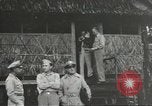
U.S. Army Chief of Staff, George C. Marshall, visits 6th Army Headquarters during World War II
George C. Marshall, U.S. Army Chief of Staff, stands on the top step of a wood and woven palm building, headquarters of the U.S. 6th Army, on Goodenough Island, New Guinea, during World War 2. Lieutenant General George C. Kenney, Commander of Allied Air Forces and the U.S. Fifth Air Force, stands with two other officers on the ground in front of the hut. General Douglas MacArthur Supreme Commander of Allied Forces in the Southwest Pacific Area (SWPA) joins Marshall and poses, standing to his left. General Marshall leaves the building to enter a car. Next, he is seen standing on the ramp of an airfield. MacArthur is also seen briefly, standing next to Marshall. General Marshall converses with Lieutenant General Walter Kreuger, Commander of the Sixth United States Army in the South West Pacific Area, and with General Kenney. General MacArthur and General Kenney, followed by other officers, walk back from a B-17 bomber (General Marshall's airplane) after saying goodbye to General Marshall. General Kreuger remains at the door of Marshall's B-17, bidding Marshall farewell. The B-17 is next seen taking off from the runway.
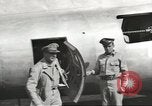
General Douglas MacArthur visits elements of the 6th Army in New Guinea, during World War II
General Douglas MacArthur (Supreme Commander of Allied Forces in the Southwest Pacific Area) steps from a B-17 bomber at the airfield on Goodenough Island, New Guinea, during World War 2. He converses with Lieutenant General Walter Kreuger, Commander of the Sixth United States Army in the South West Pacific Area. Next they are seen sitting in a spruced up patrol boat underway in waters not far from the island (seen in background). A line of Landing Vehicles Tracked (LVT-1s) filled with soldiers, is seen moving across a field. On continues past an audience of sailors and soldiers, and enters the waters off the island. It continues, kicking up a wake as it moves through the water. A line of LVT-1s filled with troops, waits to also enter the water.
A 57 mm anti tank gun being fired by 38th Division soldiers in Luzon., Philippines during World War 2
United States 38th Division soldiers in Luzon, Philippines during World War II. A 57 mm anti tank gun being loaded and fired by men of 38th Division. A soldier loads shell into the gun and fires.
American prisoners narrate their experiences of the Bataan Death March after being released from a prison in the Philippines.
United States prisoners after being released from a Japanese prison camp in the Philippines during World War II. American soldiers after being released from the Japanese prison camp. The soldiers loaded in carts. Trucks outside a building. A crippled soldier. The soldiers lying in beds. Two American prisoners introduce themselves and share their experiences about their life at the Japanese prison camp. The first soldier talks about the Bataan Death March to San Fernando from where the prisoners were taken to a prison camp. He says that the captured soldiers were made to march to San Fernando for 3 days and 3 nights and that the prisoners were not provided any food or water. He says that nearly 150 men out of 800 lost their lives during the march. Sergeant Daniel Smith narrates how the Japanese tortured the American soldiers at the prison camp.
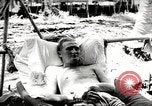
U.S. Army soldier shares his experiences after being released from a prison in the Philippines during World War II.
United States prisoners after being released from a Japanese prison camp in the Philippines during World War II. U.S. Army Private First Class Pat Parker lying in a bed as he shares his experiences at the Japanese prison camp. He says that at the prison camp his weight reduced from 183 pounds to just 75 pounds. He also narrates how the Japanese used to torture the prisoners. He says that he was hanged by toes and water was sprayed on him. He says that he was hanged without food and water.
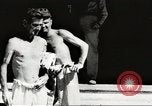
Allied prisoners shares his experiences after being released from the Cabanatuan prison camp in the Philippines.
United States prisoners and British prisoners after being released from a Japanese prison camp at Cabanatuan in the Philippines during World War II. 511 Allied prisoners after being liberated from the Japanese prison camp. Soldiers get off a truck. Liberated soldiers share their experiences of the life at Japanese prison camps. British Sergeant Robert Fell speaks and says that he was taken prisoner in Singapore. He says that a number of prisoners lost their lives due to diphtheria, cholera and other diseases. He was taken to Thailand and brought back to Singapore from where the prisoners went aboard a Japanese ship. Majority of the prisoners lost their lives after the Japanese ship was sunk due to American air attack near Luzon. Then he was taken to the Cabanatuan prison camp. Another liberated prisoner Sergeant Samuel Goldy expresses gladness on being released by the Americans after 3 years of imprisonment.
CRITICALPAST.COM: About Us | Contact Us | FAQs - How to Order | License Agreement | My Account | My Lightboxes | Shopping Cart | Advanced Search | Featured Collections | Website Terms & Conditions | Privacy Policy ©2026 CriticalPast LLC.
License Agreement |
Terms & Conditions |
Privacy Policy
©2026 CriticalPast LLC.