


 Francais
 Deutsch
 Italiano

Refine Your Search
Nevada United States 1936 stock footage and images
- Showing 18907 to 18912 of 35683 results more
 Hide
Color Sound

U.S. First Lady, Eleanor Roosevelt travels across the country during 1933
First Lady Eleanor Roosevelt waving and moving through a crowd of women, in March, 1933. She stands with son, James, at entrance to an American Airlines aircraft. Eleanor Roosevelt waving goodbye to a crowd, as she boards a railroad train on a trip across the country. She is seen attending an outdoor picnic event. Wearing a miners hat, she rides, with labor union representatives and members, on a train into a coal mine, where she inspects its interior and conditions. Eleanor Roosevelt visiting a facility for the aged, and speaking publicly about their problems. She is seen engaged in country dancing during one of her visits. Upon her return from the cross country trip, she remarks about enjoying and learning much from it, as she walks from Union station, in Washington, DC, to a waiting automobile. She pauses to pose for a photographer, and then enters the back seat of the car.

U.S. Army training film entitled: "Barrage Balloon, Low Altitude, Cable Armament."
Behind opening slate, is a closeup of Barrage Balloon with cables attached. Next, a formation of German Ju-87, Stuka dive bombers peels off and begins diving attack against Allied target in Europe during World War 2. Closeup of bombs dropping. A formation of German Heinkel He-111 bombers in flight. A German Dornier Do-215 long range bomber in flight (notable features: twin tail and tail wheel). A German Messerschmitt Bf-109 rolling over to attack a ground target. Low flying German warplanes attacking bases and supply depots. German planes strafing an Allied air base. A fire raging from bombing somewhere in England. Scene shifts to a formation of American barrage balloons creating a maze of wire cables to prevent low flying enemy aircraft from striking important ground targets.
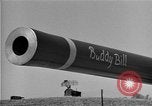
United States advanced air defense systems in the Cold War
The barrel of a 120mm M1 anti-aircraft gun is seen with a white ring and the name "Buddy Bill" painted on it. Another shown is named "Bashful-Baby." A soldier is in the process of painting a name on his gun barrel. View of the M51 Skysweeper anti-aircraft gun. Closeup of the radar dish atop the gun. View of the numerous controls of the gun. A Skysweeper gun set up in a desert setting, test site. An officer approaches the gun crew and gives an order. A gun crew member lowers the gun barrel, while two others retrieve shells for it. Hand of operator seen adjusting settings on gun controls. An aircraft (drone) is seen in flight overhead. The gun begins to automatically track it. A gunner presses a firing switch and the gun begins to fire shells. Black flak clouds form as shells explode in the air. several rounds are fired, the drone is struck and fall, burning, from the sky. Change of scene shows a Nike surface to air missile in a launch position. A soldier stands near a sign at a test site, reading "Launch Area." Soldiers slide a Nike missile across a set of rails, hook it up to a launch stand, turn on various control switches, and quickly leave the area. Aerial view of several Nike missiles laid horizontal on similar rails. Closeup on the ground of a Nike missile being raised to an uptight firing position. A rotating radar antenna. An Army technician at a battery of controls in a Nike operation center. Soldiers at a plotting table in th operation center. One wears a headset and announces countdown to firing. A visiting Allied military officer observes the activities. A clock on the wall records the countdown. A field grade Army officer with a headset stands near the soldier during the countdown. A hand actuates the firing switch and the Nike missile is seen launching. Men track it with elaborate camera equipment. The Army controller then announces time to intercept, as a dial in the control room shows the countdown progressing. . View of a B-17 target drone aircraft in flight at high altitude. As intercept is announced, the Nike strikes the B-17 which explodes and falls. Views of Nike test launch. View of the B-17 drone leaving contrails as it flies at high altitude, and then exploding and burning after being struck by the Nike missile. Pieces of the aircraft fall off as it burns, including two of its engines. Army Master Sergeant Stuart Queen, host of the "Big Picture" television program, wraps up the presentation.
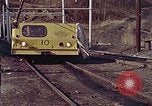
Glimpses of industrial and commercial activities in the United States
Miners arriving above ground on a rail car. Open coal cars filled with coal. A steel furnace. A commuter railroad train. A man operating a tracked crane at a city construction site. Workers and equipment at a road and tunnel project. Home builders starting on foundation of a new house in the suburbs, with view of a new suburban neighborhood being built in background. Views of various construction activities: a mobile home; a high rise building; a residential house. Factory workers on an automobile assembly line are seen assembling engine, transmission and other parts to chassis. Salesman showing a car to prospective woman customer a a new car dealership. Bushel baskets of vegetables, fruits, and assorted produce at a sidewalk market. Several shoppers seen on Connecticut Avenue, in Washington, DC. Businesses seen include: The Camalier & Buckley shop, Raleigh's haberdashery and the Mayflower hotel (in the background). New automobiles stored in a yard, including many station wagons, and a sedan car being offloaded from a truck. Man doing major bodywork repairs on a car. Doormen in red uniforms assist patrons in taxis at a hotel or apartment building.

An early model aircraft with rotor attachment between each wing at an airfield in the United States.
The history of aviation. An early model aircraft with rotor attachment between each wing is parked at an airfield. The airplane does not successfully take off.

Oscar Hammerstein introduces the song "You've Got to be Taught" during Brotherhood Week in the United States.
Oscar Hammerstein introduces the song "You've Got to be Taught" from his show "South Pacific" during The National Conference of Christians and Jews Brotherhood Week. Richard Rodgers plays "You've Got to be Taught" on the piano while William Tabbert sings as the character Lt. Joseph Cable from "South Pacific." The lyrics address racism and prejudice, and how they are taught rather than innate.
CRITICALPAST.COM: About Us | Contact Us | FAQs - How to Order | License Agreement | My Account | My Lightboxes | Shopping Cart | Advanced Search | Featured Collections | Website Terms & Conditions | Privacy Policy ©2026 CriticalPast LLC.
License Agreement |
Terms & Conditions |
Privacy Policy
©2026 CriticalPast LLC.