


 Francais
 Deutsch
 Italiano

Refine Your Search
Nevada United States 1936 stock footage and images
- Showing 18955 to 18960 of 35683 results more
 Hide
Color Sound
U.S. Army pre-World War II bayonet training film on the horizontal butt stroke attack sequence.
Slow motion and full speed demonstration and description of the first move in the horizontal butt stroke bayonet attack sequence. American soldiers demonstrate attack while narrator discusses their mistakes. Slow motion and full speed demonstration and description of the second and third moves in the horizontal butt stroke attack sequence. Soldier performing demonstration has a very animated and determined look on his face. Normal speed description and demonstration of non-verbal commands used by the instructor to signal soldiers to perform certain moves in the sequence while practicing. Group practicing full sequence of attacks. M1903 Springfield rifle with bayonet attached used by soldiers.
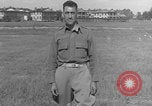
U.S. Army training film on non-verbal commands signaling different moves when training soldiers with a bayonet.
Soldier demonstrates each non-verbal command used to signal trainees when teaching bayonet skills. Each command (often a hand gesture or movement) signifies a different move with the bayonet. Narrator lists each move while the soldier demonstrates the commands associated with said moves. Performed in a large field with some sort of residential or barracks-type buildings in the background. Pre World War 2.

U.S. Army pre-World War II training film on the main bayonet attack sequence.
Slow motion demonstration of the main bayonet attack sequence. Guard position, long thrust attack, withdrawal, short thrust attack, withdrawal, jab attack, back to guard position. Narrator says the names of each movement of the sequence as the soldier demonstrating reaches them.

Telemetry scientists of the Mercury-Atlas 6 in Mexico and the United States anticipate the countdown of John Glenn’s launch on the “Friendship 7”
View of a full moon. View of rotating white satellite dish at night-time. Station staff working on Kauai Hawaii tracking station, one of the telemetry stations for the Mercury-Atlas 6 network. A Filipino telemetry communicator turns his head to speak to a colleague as they monitor the Friendship 7’s journey. View of a full moon in blue. View of the at Guaymas, Mexico tracking station at dawn. View of door with notice in English and Spanish saying, “Keep the doors closed critical air conditioning”, “Favor de cerrar la Puerta debemos mantener temperature constante” and “aviso- notice”. A portly Mexican scientist enters the computer room where his colleagues are working on telemetry for Friendship 7. The portly Mexican scientist gives his American colleague a reassuring tap on the shoulders. “M-A-O-T-N, status green, preceding with free-pass calibrations…” the American telemetry communicator radios. View of moon with blue hue. View of the Mercury-Atlas 6 telemetry station in Port Arguello, California. Two telemetry communicators on their computer working as they wait out the long countdown for Friendship 7’s take-off. A telemetry communicator opens a thermous, puts on a pair of headphones, and speaks. Three telemetry communicators in a computer room working. View of the Mercury-Atlas 6 telemetry station in Corpus Christi, Texas. Telemetry communicator, wearing headphones, speaking, says "roger, all systems, would you please commence pre-flight calibrations at this time since the countdown is progressing normally...." Two telemetry communicators on their desks, preparing for preflight calibration.

Franklin Roosevelt (FDR) visits Springfield, Illinois and Atlanta, Georgia during his campaign to run as President of the United States
Train carrying New York Governor and Presidential Candidate Franklin Roosevelt (FDR) arrives to a huge crowd of supporters in Springfield, Illinois. Franklin Roosevelt waves at the crowd from train caboose. Train carrying Franklin Roosevelt journeys towards Atlanta, Georgia. Crowds outside the Atlanta, Georgia State Capitol (Georgia State Capitol Building, 206 Washington St SW, Atlanta, GA 30334) showing support for Franklin Roosevelt. Franklin Roosevelt laughs and smiles with supporters as he sits in a convertible car. Franklin Roosevelt gives a speech under a floral arch to his Atlanta, Georgia supporters. With such a warm welcome, Roosevelt notes to those gathered that “insofar as carrying on a campaign in Georgia to get votes, my visit to this state has not been exactly necessary!”
Scrap metal used in steel production to manufacture war materiel in the United States (WW2)
Naval artillery firing from warships during World War 2. Artillery fire during nighttime. A thick smoke from a battered ship after a naval battle. Smokestacks of a factory. View of a steel plant. Carts of scrap metal being brought to a steel plant. A horizontal charging machine empties boxes of metal and scrap into the furnace. Molten metal inside factory foundry ladles. Molten metal pours from ladle. A war production worker in steel factory. Coal burning in foundry furnace. A worker operates a machine to lift mold from newly cast blooms. Hot slabs of steel roll and take shape on factory assembly line. War Production Board headquarters in Washington DC. Chairman of the War Production Board, Donald Nelson, speaks about the importance of steel production to meet increasing war demands. “We must have a continuing flow of scrap in order to keep steel production at the level needed to meet our war requirements”, says Donald Nelson.
CRITICALPAST.COM: About Us | Contact Us | FAQs - How to Order | License Agreement | My Account | My Lightboxes | Shopping Cart | Advanced Search | Featured Collections | Website Terms & Conditions | Privacy Policy ©2026 CriticalPast LLC.
License Agreement |
Terms & Conditions |
Privacy Policy
©2026 CriticalPast LLC.