


 Francais
 Deutsch
 Italiano

Refine Your Search
Nevada United States 1936 stock footage and images
- Showing 19915 to 19920 of 35683 results more
 Hide
Color Sound
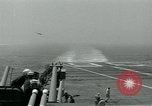
British Royal Navy aircraft operating aboard the United States aircraft carrier Antietam in Atlantic Ocean.
British Royal Navy de Havilland Vampire jet aircraft makes an arrested landing on the American Aircraft Carrier, USS Antietam (CVA-36). Sailors clear the arresting gear and surround the aircraft momentarily. Next, the aircraft is seen ready for takeoff. The aircraft tilts forward as the pilot applies power, holding the brakes. Upon signal from Carrier Yellow Shirt crew member, the pilot releases his brakes and commences his takeoff roll. Brief view of British Naval officers conversing on the deck of the USS Antietam.

U.S. cameraman and a journalist travel in Russia and record observations during famine, following World War I
Views of Russian during famine following World War 1. Journalist Arthur Ransome (smoking a pipe) and cameraman George Ercole (smoking a cigar) pose at a railroad yard on the Latvian-Russian border. They talk with Latvian and Russian guards and then board a train and depart to record observations in famine-stricken Russia. Views of near-deserted village abandoned by inhabitants seeking food elsewhere. Refugees camping outdoors, on the banks of the Volga River. They share their meager food supplies. Refugee encampments near towns. A cemetery full of white crosses set up near a refugee camp. Refugee peasants housed in railroad freight cars. Large group of starving Russian children.

First Director of Peace Corps, Sargent Shriver interviewed in Washington DC, United States.
A Television series 'Your man in Washington'. Reporters Len O' Connor and Art Barriault interview the First Director of Peace Corps, Robert Sargent Shriver. During the interview Shriver explains how the idea for Peace Corps was put forward by President Kennedy during his election campaign. He says that Peace Corps consists of 1000 people and it serves in 13 countries across the globe. He also expresses hope that Congress will sanction a bigger chunk of money for the expansion of the Peace Corps.

Robert Sargent Shriver interviewed in Washington DC, United States.
Len O' Connor of WNBQ interviews the First Director of Peace Corps, Robert Sargent Shriver. On being asked does he think there are too many Kennedy's in the public office, he disagrees. Shriver instead says that there is a dearth of qualified people capable of holding public offices and if people are qualified enough their surnames should not be an issue.

Robert Sargent Shriver interviewed about the Peace Corps activities in Washington DC, United States.
Reporters Len 0' Connor and Art Barriault interview the First Director of Peace Corps, Robert Sargent Shriver. On being asked whether the Peace Corps run into opposition with the government he clarifies that Peace Corps go to countries where the government invites them. Shriver reveals that the demand for Peace Corp volunteers has been on an increase. He also talks about the Peace Corps in Brazil, Dominican Republic, Chile, Venezuela and other American Republics. He states how the Peace Corps volunteers in Columbia lived in a simple manner but they still managed to keep their morale high.

Robert Sargent Shriver interviewed about the African volunteers in Peace Corps, Washington DC, United States.
Reporters Len O' Connor and Art Barriault interview the First Director of Peace Corps, Robert Sargent Shriver. Shriver states that the African are enthusiastic about joining the Peace Corps and register in large numbers to join the Corps. About the working styles of the Peace Corps he says that they try to anticipate a difficulty and overcome it well in time. He also quotes an example of a Nigerian girl and how in spite of the incident the number of Peace Corps volunteers in Nigeria is increasing.
CRITICALPAST.COM: About Us | Contact Us | FAQs - How to Order | License Agreement | My Account | My Lightboxes | Shopping Cart | Advanced Search | Featured Collections | Website Terms & Conditions | Privacy Policy ©2026 CriticalPast LLC.
License Agreement |
Terms & Conditions |
Privacy Policy
©2026 CriticalPast LLC.