


 Francais
 Deutsch
 Italiano

Refine Your Search
Nevada United States 1936 stock footage and images
- Showing 20467 to 20472 of 35683 results more
 Hide
Color Sound
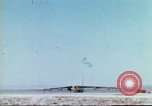
First unpowered drop flight of X-15 aircraft, piloted by Scott Crossfield at Edwards Air Force Base in California.
U.S. Air Force X-15A aircraft first unpowered drop flight and landing in California, United States on June 8, 1959. United States Air Force Boeing NB-52A aircraft with X-15 under its wing, taxis and takes off from Edwards Air Force Base, California. American X-15 aircraft in captive-carry position, mated to pylon under wing of Boeing NB-52A aircraft. The aircraft taxis and takes off from the runway. Chase planes U.S. Air Force F-104A flies along NB-52A aircraft. X-15 releases from NB-52A aircraft in mid flight. Radar dish antenna records course of the flight. Pilot seated in the cockpit of F-104A aircraft. Technicians look at plotting boards and flight monitors. Pilot Albert Scott Crossfield converses with ground crew members. X-15 piloted by Crossfield lands at Rogers Dry Lake in California.

The F-84G Thunderjet being tested on inflated pads at the Edwards Air Force Base in California.
The accidents and the unusual occurrences at the Air Force flight test center at the Edwards Air Force Base in California, United States. The inflated pads being tested for arrester hook landings. The United States Air Force (USAF) aircraft F-84G Thunderjet makes a zero length launch. The United States Air Force (USAF) aircraft F-84G Thunderjet makes approach to the pad and overshooting to belly landing. The F-84G Thunderjet makes a pass with no hookup. The United States Air Force(USAF) aircraft F-84G Thunderjet makes belly lading on pads. Aerial view of the F-84G Thunderjet nose during approach and landing on pads.

General John J. Pershing at open air rally and parades in California two years after end of World War 1.
U.S. Army officer General John J. Pershing on a western tour in the United States. General Pershing with other officials exits Ferry Terminal on arrival in San Francisco on January 25, 1920. A close up of General Pershing talking to officials including Mayor James Rolph Jr. and Raphael Weill, a well known San Francisco business and civic leader. U.S. Army troops parade on the streets and hold the flag of the United States in San Francisco, California. General Pershing at a podium and about to speak at open air rally. Crowd on the field. General Pershing in a car and receiving applause of crowd during Los Angeles parade on January 26, 1920. People stand on either side of the street in downtown Los Angeles.
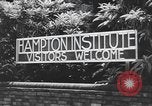
African American students gain knowledge of agriculture, chemistry and radio operation at Hampton Institute in Virginia (WW2)
African American colleges in the United States during World War II. College curricula adjusts to war needs as they prepare students for various military and civilian occupations including war factory production and war manufacturing. A sign reads ' Hampton Institute visitors welcome' at Hampton Institute, presently known as Hampton University (100 E Queen St, Hampton, VA 23669), in Hampton, Virginia. Exteriors of buildings on the campus. An educator welcomes students from other countries for taking up a course at the institute. Students in a class take lessons in radio operation and construction. Students in a chemistry laboratory learn to develop new war material. Science students train to become laboratory technicians. An African American student conducts a test on bacteria in food caused by handling. Hampton Institute provides laboratory facilities for training of nurses. Students in a ground school class. The students work on machines as they weld metal pieces. A farm management course for girls by the Agriculture Department of the Institute. Girls operate a tractor as they plant corn in a field. Dairy farming lessons being conducted as girls watch a man as he milks a cow. Students conduct research on food and the importance of soybean over meat. Students broadcast programs related to research results, improved diet and raising better crop. They take up lessons in surveying and topography. Cadets of institute regiment march. A sign reads ' U.S. motor transport shops'. The students learn to work on motor parts. U.S. Army trucks being repaired at the shop. Engineering Department of the institute trains men for the U.S. Navy. The cadets march. A clock tower in the background.

Major General Curtis LeMay flies non stop to Buenos Aires from Honolulu,Hawaii.
U.S. Joint Strategic Target Planning staff at SAC (Strategic Air Command) headquarters in Nebraska, United States. Chairman Joint Chief of Staff General Lyman Lemnitzer, USAF Chief of Staff General Curtis LeMay, Chief of Naval Operations Admiral George W Anderson, Jr., U.S. Marine Corps Commandant David M Shoup alight from a U.S. Air Forces VC-135 aircraft at Offutt Air Force Base. The officers being greeted by Commander of SAC General Thomas S Power and Vice Commander Lieutenant General John P McConell. The officers talk and shake hands. The officers leave the air force base in staff cars as SAC elite guards salute.

Establishment of Vandenberg Air Force Base, California, and its first launch of a ballistic missile.
Restrospective of the 1954 search for a suitable site for U.S. Air Force testing of ballistic missiles. Coastal area with ocean in the background. Officials look over charts, maps, photographs as they select the site for Vandenberg Air Force Base. In January, 1958, view of building with a sign that reads ' Headquarters, First Missile Division, Strategic Air Command, Vandenberg Air Force Base' Entrance of the headquarters as Major General David Wade walks out. U.S. Air Force officers and airmen attend missile training classes. Airmen work on assembly of Thor missiles . U.S. Air Force officers and airmen operate missile launch consoles in a launch control center. November, 1958, Thor intermediate range missile on a trailer being delivered to Vandenberg Air Force Base. Trailer backs up to the launch pad. December, 16, 1958, the Thor missile on launch pad venting gases. U.S. Air Forces officers at a launch console. The Thor missile is launched. RAF airmen watch missile in flight.
CRITICALPAST.COM: About Us | Contact Us | FAQs - How to Order | License Agreement | My Account | My Lightboxes | Shopping Cart | Advanced Search | Featured Collections | Website Terms & Conditions | Privacy Policy ©2026 CriticalPast LLC.
License Agreement |
Terms & Conditions |
Privacy Policy
©2026 CriticalPast LLC.