


 Francais
 Deutsch
 Italiano

Refine Your Search
Nevada United States 1936 stock footage and images
- Showing 20659 to 20664 of 35682 results more
 Hide
Color Sound
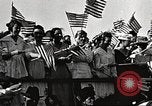
American Expeditionary Forces arriving in France, during World War I
A large group of French women stand on a pier, waving American flags, as a troop ship arrives at a port in France, during World War 1. American Expeditionary Forces (AEF), soldiers of the U.S.1st Infantry Division, crowd her deck. The troops are seen leaving the ship by gangplank, and crowding the pier. They then assemble and march off. They proceed through dense crowds on both sides of their line of march. U.S. troops marching along a French city street are approached by French women expressing their appreciation. A French policeman walks with a bicycle, alongside the troops. French policemen march along, behind the Americans. Scene shifts to American soldiers playing musical instruments as others dance with women at an outdoor waterfront cafe, as they wait for transport. Allied officers are seen standing in front of a collection of canvas covered shelters, with a sign above, reading: "Camp Franco-Americain." (This is where arriving American troops undergo training by the French.) (World War I; World War 1; WWI; WW1)

Animated map depicts the area covered by the Soviet Union and its major physio-graphical features.
Animated map of the Soviet Union. Animated map depicts the distance between United States and Europe. A map of the Soviet Union. The map locates the White Sea, the Volga River, the Caucasus Mountains and Siberia. The east west expanse of the Soviet Union is depicted as 4662 miles. Animated map depicts the area covered by the Soviet Union which is equivalent to the areas of Canada, the United States and Europe put together. A map locates the Caucasians Mountains on the map of the Soviet Union.
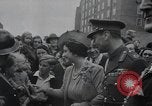
British PM Churchill assess bomb damage in London,and war industries in US,and damage in Soviet Union and China during WWII.
A film about the industrial activities in various countries during World War II. London: Prime Minister of the United Kingdom Sir Winston Leonard Spencer-Churchill with other officers inspects bomb damage in London. The bombed out buildings in London. Soviet Union: Destruction in Soviet Union. The Soviet people walk to new areas to rebuild industries. China: The Chinese men walk past a factory. A man rows a boat in a river. United States: Aerial view of the industries in United States. Aerial view of the smoke coming out of smoke stacks. The interiors of a factory being converted to war production. Old machines replaced by war machines. War production workers using machines to make tanks for war effort. A man observes through a eye microscope as he makes precision flight instruments. Women learn to operate new machines. Men operate lathes and other machines inside the factory.

Harry S. Truman announces V-J day with Japan's acceptance of the terms of surrender, ending WWII; celebrations across America
Title card reads, "Peace, It's Wonderful." People celebrate as Japan accepts peace terms, ending World War 2. President Harry S. Truman of the United States announces Japan's acceptance of peace terms and the end of World War II. Reporters rush out to deliver news. Many scenes of American citizens, soldiers and sailors celebrating V-J Day in various cities of the United States. Crowds celebrate peace on V-J Day (Victory over Japan Day) in Washington DC, Chicago, San Francisco, and New York. Crowd outside White House waving. Woman holds newspaper with headline, "Japan Surrenders." A sailor dances with a girl. In San Francisco's Chinatown, firecrackers are lit up. In Seattle Washington, soldiers grab young women and kiss them. Aerial view of crowds celebrating the end of World War II at Times Square in Manhattan, New York City. Ticker tape falling in the air. Joyous, happy, and excited citizens cheer the end of World War 2. People waving newspapers with headline, "Japs Accept Terms." Spotlights illuminate nighttime crowds celebrating in New York City.
Aviation history; historic early flight scenes; first hand accounts from persons who knew and worked with the Wright brothers.
Views of traffic on a city street around the turn of the 20th century. A mix of horse and buggies and motorcars and bicycles. People waiting for a trolley car. Reenactment of persons using an early telephone and of early filmmakers at work with camera on motion picture film. The Wright brothers home at 7 Hawthorne Street, West Dayton, Ohio. The Wrights' former housekeeper, Carrie Grumbach, recalls December 17, 1903, a telegram arriving about the Wright brothers successful first powered flight. Glimpse of Wright brothers machine shop. Charlie Taylor, who had worked in their shop, speaks of being pleased at their accomplishment. View of the Wrights flying gliders at Kitty Hawk, North Carolina. Charlie Taylor describing how he machined and built the motor for the Wright brothers airplane. Glimpse of that motor or a facsimile. Men positioning the Wright brothers airplane for launching, and French citizens gathered to watch a demonstration of their airplane in France. French aviation pioneer, Henri Farman with two other men in his Voisin-Farman I airplane. They begin takeoff. Closeup of Brazilian aviation pioneer, Alberto Santos-Dumont. Other early aircraft in flight. A Wright Flyer passing over the Fort Myer drill ground in Virginia. An Army balloon in the background. Retired United States Air Force Brigadier General, Frank P. Lahm, walks across the tarmac on an airport and speaks for interviewer (unseen). He speaks about the difficulty the Wright brothers had in convincing the U.S. Army of the value of their airplane. He tells that in December, 1907, Wilbur Wright was finally granted an interview with the Board of Ordnance and Fortifications, which led to a contract, in 1908, with the Signal Corps. Moving imagesof Orville Wright and assistants bringing a Wright Flyer to Fort Myer, Virginia, to conduct flight trials for the Army. Views of the airplane being flown all around the area, watched by spectators. (This footage is a mix of 1909 footage where the aircraft shows two half-rounds of canvas in the front elevator, and 1908 footage, taking off and flying, where the aircraft has a single half-round of canvas in the front elevator.) After landing on the 9th of September, 1908, then, Lieutenant Lahm, accepts Orville Wright's offer to fly with him. Lahm climbs aboard the airplane, sits next to Orville Wright, and they are seen taking off and flying about for six minutes and forty seconds. (Lahm is the first. military officer to ever fly in an airplane.) The next scene shows the wreck of a Wright Flyer, in which Army Lieutenant Thomas Selfridge was killed and Orville Wright injured, on September 17, 1908.
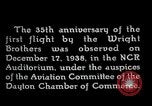
Edward Andrew Deeds, Henry Ford, Orville Wright and Charles F Kettering present at first flight commemoration event
The 35th Anniversary celebration of the first Wright airplane flight in the United States. Seats occupied in a NCR auditorium. U.S. Army Colonel Edward Andrew Deeds, Founder of Ford Motor company Henry Ford, Aviator Orville Wright, and Inventor Charles Franklin Kettering seen sitting on stage. Still photograph of Orville Wright and Wilbur Wright.
CRITICALPAST.COM: About Us | Contact Us | FAQs - How to Order | License Agreement | My Account | My Lightboxes | Shopping Cart | Advanced Search | Featured Collections | Website Terms & Conditions | Privacy Policy ©2026 CriticalPast LLC.
License Agreement |
Terms & Conditions |
Privacy Policy
©2026 CriticalPast LLC.