


 Francais
 Deutsch
 Italiano

Refine Your Search
Nevada United States 1936 stock footage and images
- Showing 20773 to 20778 of 35682 results more
 Hide
Color Sound
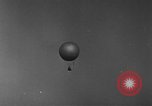
Stages of history of flight from balloons to successful heavier than air manned flight by Wright Brothers
Various stages of manned flight are seen during history of flight. First a balloon with a passenger basket suspended below. Then a man is seen making a long flight in a glider from a high hillside. Men maneuver a Wright flyer on the ground. It is a 1910 model B, displaying number NR 14333 on its wing. Men turn the propellers to start the engine. Closeup of the engine. The first occupant is already seated in the airplane as the second walks around the right wing checking things. Closeup of Orville Wright. A Wright flyer taking off. The distance of the first successful flight by the Wright Brothers is illustrated by an animated representation of it over the wing of a 1950 era B-36 bomber.
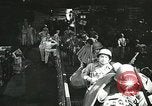
Views of London, England, when it is filled with Allied military personnel during World War II. Various organizations supporting the Allied military in the city.
American troops are seen boarding a transport ship in the opening scene, heading for the war front in Europe during World War 2. Closeup of the ship leaving the dock in the United States. Closeup of soldiers on deck looking back as they depart. Glimpse of upper deck of the ship completely filled with soldier passengers. Soldiers in their multi-bunk rooms aboard ship. Soldiers on ship's deck wearing life preservers. An impromptu band of soldier musicians entertains the troops. Others pass the time in card games,and sharing letters from home. Next, soldiers are seen watching as the troop ship arrives in Liverpool, England. A British army band plays to welcome them. View from the ship of American soldiers descending a gangplank to the Liverpool dock, where U.S. army trucks and an ambulance awaited them. Sailors, and a Women's Army Corp (WAC) Sergeant, feed pigeons on dock. One sailor poses with a small English girl. Film shifts to scenes of wartime London which occupy the remainder of the film. Several U.S. Army officers walk along a London sidewalk A British woman army sergeant and a local policeman. An English Bobbie (police officer with tall helmet) poses for the camera with several sailors and an American WAC Sergeant. U.S. soldiers and Military police (MPs) posing in front of a shop with U.S. Marine Corps logo on the window. Street scene with U.S. soldier walking past a sign reading: "USA cars, No Entry." More street scenes showing various British military and police in the city. A sign reading, "American Red Cross Services for Women." Another sign reading, "A uniformed Red Cross woman. Sign identifying the "Yugoslav Relief Society" headquarters. Canadian soldiers near the headquarters of the "RCAF Overseas." A Norwegian sailor with cap reading,"Norske Marine." Street sign pointing toward :"Canadian Red Cross and Maple Leaf Club." Headquarters of the "Newfoundland Caribou Club." Uniformed women from a Canadian province. Three Canadian soldiers lighting cigarettes. A local park in the background. Sign above "Merchant Navy Comforts Club." Sign reading: "St. Columbia Catholic Services Club." An Australian soldier walking on the sidewalk. Two uniformed women consulting a guide book with two American MPs. A Scottish soldier wearing a kilt accompanying a woman. Brief glimpses of various Allied soldiers from the British Commonwealth. British soldier wearing a busby hat. "Lion Services Club" sign with lion image. "Armoured Royal Corps Club" sign. "New Zealand Forces Club.""United Nations' Forces' Club."

Men rig pontoon during salvaging activities for USS Squalus off the coast of Isles of Shoals near Portsmouth,New Hampshire.
Salvaging activities for the U.S. Navy submarine Squalus (SS-192)off the coast of Isles of Shoals near Portsmouth,New Hampshire. Men prepare to rig pontoon and they attach hoses. Men unrig the "flowerpot". Lowering line is attached to "flowerpot" and depth measuring line to pontoon. Temporary mooring line is cast off from pontoon. Men tighten up hose connections. They unrig "flowerpot" and attach cable clamp to tails of sling. They close the vents. Pontoon raises up from water. Pontoon is blown dry and made ready to leave the U.S. Navy ship Falcon (ASR-2) submarine rescue vessel. Diagrammatic representation of the U.S. Navy submarine Squalus (SS-192) raised by the slings and pontoons.

Men work on air manifold on deck of USS Falcon (ASR -2) off the coast of Isles of Shoals near Portsmouth,New Hampshire.
Salvaging activities for the U.S. Navy submarine Squalus (SS-192) off the coast of Isles of Shoals near Portsmouth,New Hampshire. Rescue vessel underway. U.S. Navy Submarine Sculpin (SS-191) with bow line attached. Men work on the air manifold on deck of USS Falcon (ASR -2). Animated view of U.S. Navy Submarine Squalus (SS-192) after being lifted by cables. Disturbance caused by the air bubbles. Pontoons pop to surface during salvage operations. Air hoses and pontoons seen on surface. Small boats seen in area. Men move in and climb aboard pontoons to secure them. Men return to boats.
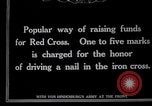
Jane Addams, of Chicago, U.S.A. watches Berliners raising funds for the Red Cross in Germany during World War I
A large wooden replica of the Iron Cross medal is set up outdoors, where persons may drive nails into it, to mark their contributions of from one to five marks to the Red Cross, during World War 1. An older man in military uniform taps several nails into the top of the cross. Visiting American, Jane Addams, co-founder of Hull House, in Chicago, and President of the newly formed Women's International League for Peace and Freedom (WILPF) stands nearby observing, as the man sets a nail into position at the center of the cross. He then lifts a small boy up, so he can finish hammering it in.

U.S.Navy student pilot makes first solo flight in N3N seaplane, at Pensacola, Florida
A Cadet and an instructor get into the seats of an N3N seaplane in Pensacola, Florida, and take off under the control of the cadet who flies the whole flight while being monitored by the instructor. After landing, the instructor gets out, and the officer-in-charge of operations signals the cadet and he takes off again and completes his first solo flight. The cadet gets out of the plane after he arrives at the pier, where other student flyers meet him and throw him into the water in celebration of his signal accomplishment.
CRITICALPAST.COM: About Us | Contact Us | FAQs - How to Order | License Agreement | My Account | My Lightboxes | Shopping Cart | Advanced Search | Featured Collections | Website Terms & Conditions | Privacy Policy ©2026 CriticalPast LLC.
License Agreement |
Terms & Conditions |
Privacy Policy
©2026 CriticalPast LLC.