


 Francais
 Deutsch
 Italiano
Refine Your Search
Nevada United States 1936 stock footage and images
- Showing 20875 to 20880 of 27248 results more
more Hide
Hide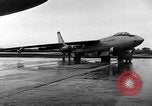
Pre inspection of a B-47 Stratojet by Col. Kunkle and Colonel Greer before it takes off from Brize-Norton Air Force Base.
Activities at Brize-Norton Air Force Base in the United Kingdom. A U.S. Air Force B-47 Stratojet aircraft stationary at an air strip. The engine starts. Operations being performed on the aircraft. An auxiliary power unit in front of the aircraft. Ground crewmen perform preflight inspection of the B-47 before starting the engines. Colonel Kunkle, crew member of the B-47 writes information on a flight plan form. Colonel Greer peers into a section of the engine. Preflight inspection. Col. Kunkle makes a visual check of the wings and all components parts of the aircraft. A ground crew operates the auxiliary power unit control panel for starting the engine of the B-47. He checks the rocket assist unit. Airmen make adjustments on the release nozzle of the rocket assist unit. The colonel reads information on a check sheet. A ground crewmen holds hands over the auxiliary power unit. A staff car drives up a taxi strip. Water covers the taxi strip. Heavy rainfall and no aircraft visible. Col. Kunkle, Colonel Greer and Major Richards get off from the car and walk. The crew donning flight equipment stands near the nose of the B-47 prior to boarding it. The Col. and the crew converse before boarding the aircraft. Men check each other's personal equipment. The B-47 stationary at the air strip. The engine starting unit with the auxiliary power unit in the nose. The B-47 taxis over the water covered runway. A jet blast blows a spray behind the aircraft. A ground crewman gives signal to the aircraft taxiing in the parking area. A ground radio control unit in a half ton truck. The operator of the truck talks over a radio phone. The rocket unit is set in. Rocket assisted takes off.

Places in New Mexico, familiar to Ernie Pyle
Views of Ernie Pyle’s familiar places in New Mexico. Opening shot shows a man stepping from the porch of Ernie Pyle’s house, with great expanse of desert landscape in the background. A car driving along a quiet mountain road. People picnicking at a roadside table. Views of mountains and sky and a man leading a horse walking slowly up a sandy hillside. Horse-drawn wagon in the Pueblo of Isleta. A farmer plowing a field with a team of horses. Pueblo women placing rugs on a line and baking bread in an ancient clay outdoor oven. Pueblo residents celebrating Corpus Christi Day. They walk slowly carrying banners and flags. The local Priest says prayers for American soldiers away in World War 2. Inside the church, a Pueblo mother lights candles for her son, overseas, against a backdrop of stars representing each local man away in the war. Car is seen driving across a low bridge over the Rio Grande River. It drives slowly into the town of Sandoval, where a man leads a cow across the road in front of the car. Farmers cultivating rows of crops by hand. A woman sings accompanied by a guitar. A sheep ranch where shepherds on horseback move a flock. Sheep being herded into pens. View of sheep being sheared by team of men. Wool being piled into a truck. Mailman delivering mail to a country mailbox on a street in Albuquerque, New Mexico. Two girls in jeans walking in town. A girl comes out of a building and embraces a young soldier in uniform, who was waiting for her. Pedestrians on the sidewalks in the commercial district. Women with cut roses; playing cards; baking a cake; and cutting a lawn with a manual reel mower. A wedding party walking along the sidewalk. Two girls reading. People in various settings reading the Albuquerque Tribune (or the Journal) newspaper. Movie houses that show films in Spanish and English. Students walking on the grounds of the New Mexico State University in Las Cruces. More views of ordinary people in towns including people of Hispanic descent or Mexican Americans. Sheriff Harold Hubbell of Bernalillo County, who served with the 200 Coast Artillery on Bataan, in 1942, is seen mailing a letter. Former Governor, Clyde Tingley, now Mayor of Albuquerque, comes down steps of a building. A Navajo indian reading a newspaper. A rancher rolling his own cigarette. A young Spanish American boy (Muchacho). Girl (Muchacha) rides a bicycle. A Navajo man followed by his family. Sign reading “Bataan Relief” announcing a talk by a Bataan veteran of World War 2. View of the speaker, in uniform, speaking to a group of mostly women. (Narrator states they lost a whole National Guard Regiment to the Japanese after the Pearl Harbor attack in 1941.) Another glimpse of students at the State University. Another repeat glimpse of Pueblo women baking bread in outdoor oven. Views of girls and women. Various Views of Ernie Pyle with American troops overseas during the war.
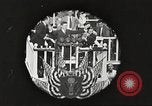
Scenes of the 1924 Democratic National Convention held in Madison Square Garden, New York City
1924 Democratic National Convention, at Madison Square Garden in New York City from June 24 to July 9, 1924. The alphabetical process of nominating candidates begins with Alabama and Forney is seen Johnston, putting Senator Oscar Underwood's name into consideration. View of men at the podium. Bernard Baruch, a supporter of William McAdoo, is seen standing in background. View of the crowded Madison Square Garden, filled with delegates. Some carry a banner reading: "Wilson 1916 for McAdoo 1924." The various State delegations are identified by signs with their State names on them. Kentucky, Massachusetts, and Hawaii (U.S. territory) are seen. As the camera pans the gathering, many more State signs are seen. Outside , in Madison Square Park, a loudspeaker is set up on a truck and a crowd is gathered to listen to events. Back inside Franklin D. Roosevelt, Al Smith's campaign manager, is seen giving a speech nominating Smith for President. Supporters hold up Posters displaying Smith's picture. Closeups of some of the banners. Ticker tape being thrown to celebrate the end of the convention, which ended on July 9th after the 103rd vote finally carried for compromise candidate, John W. Davis of West Virginia. Governor Charles W. Bryan of Nebraska was selected as the vice-presidential nominee.
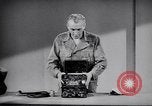
Signal Corps Radio 694 radio set receiver including hand generator and vibrator power supply control system explained.
Operating receiver unit of SCR 694 radio set shown. Receiver unit is detached from case of SCR 694 radio set by radio engineer. Control system is shown. View of engineer working with hand generator and vibrator power supply unit. Insulator is attached to the case by engineer. View of vertical antenna of SCR 694 radio set in a moving vehicle and a horizontal antenna in fields.
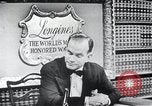
Senator J William Fulbright discusses trading with Russia and denounces Senator Joseph McCarthy.
A Television Journal titled 'Longines Chronoscope'. Co-editors of the program ask Senator Fulbright about trading with Russia. Fulbright says that there would be no trading with red China i.e. Communist China. Fulbright talks about Senator McCarthy of Wisconsin and the McCarthy subcommittee and the Army-McCarthy hearings. Fulbright says that Senator Joseph McCarthy is "a menace to our system of government. I think he's much more dangerous than most people believe that he is. I think that he is confronting this country with the greatest test that it has had since the war between the states. His approach to the problems of government is quite similar to that of the fascists or communists, if you like. His actions in the present hearings remind me very much of the actions of the communists in the old hearings...in other words it's to obstruct, to take advantage of every technicality to destroy the hearings. And that's what he's intending to do. He's done it in every hearing." He further states, "if this country cannot destroy this senator's influence I see no real future for it because it will undermine the very moral basis for our kind of government." If McCarthy, as a result, is removed from his committe or expelled from the senate, Fulbright says, "then I think there might be a rebirth, I might say, of the enthusiasm of the people for self government in this country." He continues, "I think given the opportunity I think the people of this country will recognize a demagogue such as he is -- well, that's only faith -- I have nothing to base it on other than on a faith in the discrimination of the people of the country."

U.S. Navy training film about escape from ditched modern jet fighters that sink faster than the old propeller airplanes
An F6F Hellcat ditches in the sea. It floats long enough to allow pilot to abandon it before sinking. Next an A-4 Skyhawk ditches. Narrator remarks about the short time for escape from such aircraft on the surface of the water. Views of tests conducted by the U.S. Navy to test the sink rates of jet aircraft from various heights and attitudes. A dummy is placed in the cockpit of a derelict F9F Panther, which is lifted by a crane and is dropped into water from a low height. It is seen floating. (Narrator states that even with no structural damage, it sinks in less than a minute.) Next an FJ-2 Fury is dropped from about 55 feet. Due to structural damage, narrator states such an aircraft may sink in a few seconds, and generally between zero to 55 seconds. View of crane operator and then of an airplane sinking rapidly. Scene shifts to James F. Roth of U.S. Navy Attack Squadron 42,(VA-42) the "Green Pawns," in the closed cockpit of a Navy jet airplane. Next, an F-4 phantom jet is seen being catapulted from an aircraft carrier. Animation shows that the airplane falling into the sea right after takeoff will sink ballistically and can descend as deep as 100 feet in 10 seconds.
CRITICALPAST.COM: About Us | Contact Us | FAQs - How to Order | License Agreement | My Account | My Lightboxes | Shopping Cart | Advanced Search | Featured Collections | Website Terms & Conditions | Privacy Policy ©2026 CriticalPast LLC.
License Agreement |
Terms & Conditions |
Privacy Policy
©2026 CriticalPast LLC.