


 Francais
 Deutsch
 Italiano
Refine Your Search
Nevada United States 1936 stock footage and images
- Showing 20905 to 20910 of 27248 results more
more Hide
Hide
U.S. Army 1st Cavalry Division and 82nd Field Artillery (Horse) return to base camp at Alamito, Texas, after maneuvers.
U.S. Army First Cavalry Division soldiers at their base camp at Alamito, after military exercises. Dust is raised, in the distance, by units returning from maneuvers. Elements of the 7th and 8th Cavalry Regiments mounted in formations. Sweeping views of the Base Camp show many tents, some motor vehicles, and several more permanent structures. Transport military trucks near the camp. Units of the 82nd Field Artillery (Horse) Battalion on a dusty path leading to the Base Camp. Their teams of horses haul field artillery pieces and caissons. Numerous horse-drawn ambulances are seen flying red cross flags. A motorized ambulance and a staff car are also seen. Numerous horse-drawn supply wagons bring up the rear.
The first take off of Ercoupe airplane with auxiliary jet propulsion at March Field in California.
Flight tests of Ercoupe airplane without and with auxiliary jet propulsion at March Field in California. Four jet units are installed. The Ercoupe airplane taxis and takes off with the auxiliary jet propulsion for the first time. It is piloted by Captain Homer A. Boushey Jr. The airplane lands and taxis in to park. The pilot in the cockpit and crew stands near the airplane after its first flight with the auxiliary jet propulsion. The Ercoupe airplane in flight with the auxiliary jet propulsion and 6 units installed.
Highlights of Senior Bowl football game between College all stars from North and South at Mobile, Alabama, in 1967.
Several highlights from the 1967 Senior Bowl football game. A crowd fills the sold-out Ladd Peebles Stadium, in Mobile Alabama, for the Senior Bowl game, matching all star football players from the North and the South. Oregon State's Bob Grim is seen running the ball to pick up 25 yards. North's Quarterback hits Iowa State's Eppie Barney for a touchdown, with 1:13 remaining in the 3rd period. South quarterback Terry Southal, of Baylor, passes to Louisiana State's Dick Redding for a touchdown at the 13:12 mark of the 4th quarter. North's Bob Grim takes handoff and runs from the 40 yard line until pushed out of bounds at the South's 15 yard line. Nebraska's Harry Wilson runs the ball for a touchdown in the 4th Quarter. North beats the South 35 to 15. (Note:The final North tally came at the very end of the game with a pass from BYU's Virgil Carter to Nebraska's Pete Tatman. Bubba Smith of Mich. State was a monster on Defense and won the MVP award.)
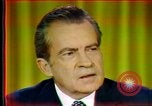
U.S. President Nixon talks about one of his goal during his speech on the Watergate issue in Washington DC.
U.S. President Richard Nixon discusses his future goals regarding politics during a speech on the Watergate scandal in Washington DC. The President states that he has been in public life for more than 25 years. Politics, like any other calling, has both good and bad people. He mentions that majority of people in the Congress, the Federal Government and the state government are good. He believes that easy for people to fall in to shady tactics under the intense pressure of campaign. Both great parties are also guilty of these tactics in the past. He states that America, in its political campaign, must not fall again in such shady tactics. He urges both political party leaders and citizens to work upon new roles and procedures to ensure that the future elections would be free of such abuse. He states that this is his goal but he wants to make it America's goal.
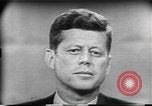
John F Kennedy talks about the importance of welfare programs during a presidential election debate in Chicago, Illinois.
The first Kennedy-Nixon Presidential Debate in Chicago, Illinois. Stuart Novins from CBS News asks Democratic candidate Senator John F Kennedy about welfare programs for education system, medical care and reduction in the federal debt. Kennedy argues that he has not mentioned about the federal debt reduction in his speeches. He states the advantages of his program for providing medical care for the aged and an effective education system. He tells that the development of natural resources will generate revenues to finance new projects. He states about the importance of a balanced budget. Republican candidate U.S. Vice President Richard M. Nixon presents his views and states that the reduction of federal debt was mentioned on the Democratic platform and not in Kennedy's speech. He presents his views on Senator Kennedy's proposal for medical care for the aged and the development of the natural resources. He states that Kennedy's proposals will result in rise in taxes and unbalancing of the budget which will lead to inflation. He favors the aid for school construction.
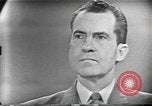
Richard Nixon argues against federal government control over education during a presidential election debate in Chicago.
The first Kennedy-Nixon Presidential Debate in Chicago, Illinois. Charles Warren from Mutual News asks Republican candidate U.S. Vice President Richard M. Nixon about the raising of education standards and the reason for his refusal to vote in favor of increase in salary of teachers in the Senate. Nixon answers and objects the potential cost in controls and states his views against federal government control over education. He talks about the role of the state and local communities towards the education system. Democratic candidate Senator John F Kennedy presents his views on the matter and states that the issue before the Senate was the money given to the state which would then decide whether to spend it for school construction or on teachers' salaries. He objects to the federal government paying teachers' salaries directly. He disagrees with the statement made by Nixon regarding unbalancing of budgets by execution of programs.
CRITICALPAST.COM: About Us | Contact Us | FAQs - How to Order | License Agreement | My Account | My Lightboxes | Shopping Cart | Advanced Search | Featured Collections | Website Terms & Conditions | Privacy Policy ©2026 CriticalPast LLC.
License Agreement |
Terms & Conditions |
Privacy Policy
©2026 CriticalPast LLC.