


 Francais
 Deutsch
 Italiano
Refine Your Search
Nevada United States 1936 stock footage and images
- Showing 21187 to 21192 of 27248 results more
more Hide
Hide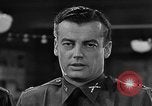
An officer questions Sergeants about different situations during battle formation (WW2)
The advantages of battle formations during World War II. A U.S. Army Rifle Squad officer talks about imagination and alertness during battle. The Sergeants seated around a desk. A model on the desk. The officer asks the Sergeants questions about the conditions they will adopt during different situations, and they explain it with the help of the model. Question for the interior unit is about the exact route to be followed to reach the road. The other situation is where the Squad Leader asks them to take their squad through a bridge and cover his crossing. The next situation is where the platoon moves forward, an officer gives a signal, the squad deploys, and when he returns, they are moving in different directions. Next, the Platoon moves into a thick wooded area and command a left squad, you are under orders not to change your formation without the permission of the platoon leader. The last situation is where the platoon leader has become irresponsible, you are the leader, and the troops advance and artillery is fired. How would you cross this field and what action's will you take. The sergeants answer one by one and take the help of the model.
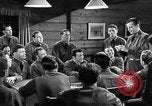
An officer highlights the basic and important points that can be used during different formations (WW2)
The advantages of the different Platoon formations during World War II. The Sergeant seated on a desk. A Rifle Squad officer stands in the center sums up with the highlights that were done in the lesson. He focuses on few big points during the formations they are provide good control, allow and use cover, get forward faster. Deploy skirmishes only when you are forced too. Always adopt a formation that will provide you with support squad. Maintain contact on the units to the right and left. To take up Echelon formation if the platoon leader has an open flank. The Sergeants listen to him.
U.S. troops show their ingenuity by designing new improvised gadgets (WW2)
A World War II documentary titled ' Yankee Noodle' depicts improvised devices and techniques used by U.S. troops to save time. Aircraft parked in a line at an aircraft industry. A man operates washing machine. Men at work on a granite launcher. A man operates a grappling wire used to trip mine. A man holds a cable binder used to put a line. Men on an elephant and put a wire. A man uses oxygen tank and a copper tube being coiled inside an oil drum for making a still for distill water. The water comes out from the tank and used for the battery. Men put the water in the battery. A U.S. aircraft lands. A man works on a gadget that takes only 20 minutes to change the tire of an aircraft. A tire loaded in a trolley and being pulled by a jeep. Three men load tire. Men hold a winch designed to tighten nuts and bolts. Mobile service and repair unit mounted on a truck. Instrument panel mounted behind the driver seat. Men at work on 110 volt generator. A work light, electric grill. A parachute used as an emergency brake for an airplane.
Men spread chlorinated lime over a road bed to stop troops from entering the area so as to decontaminate it (WW2)
A documentary titled 'Decontamination Procedure' depicts methods of decontamination in World War II. Men clean a road. A skin blistering chemical being sprayed by firing an artillery. The chemical on the leaves. The men wear a special clothing to protect themselves from mustard gas. A man wear cotton gloves. All equipment being loaded in a trailer. The equipment includes shovels, buckets, sprays, axes and other necessary materials. The unit gas officer inspects the area. He marks all contaminated areas on a map. The officer returns to the leader with the details. They look at the area on the map and advance. The truck stops and men put on gas masks. They get in the truck and move in the contaminated area. Animation depicts a shell and artillery covering the contaminated area. A man places the sign which reads 'Danger War Gas'. He writes the name of the gas and the date on the sign. Men stand in a line and the leader of the men gives them instructions. Shell holes on the ground. They start their work. Chlorinated lime is spread over a road bed and contaminated brush is burned. The road is then covered with the brush.
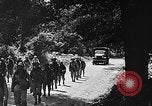
Soldiers exposed to the gas attack apply anti-gas ointment and wash their clothing with hot water (WW2)
A World War II documentary depicts the methods of decontamination after a gas attack during a war. Troops walk on a contaminated area. An aircraft in flight and sprays gas. They put the gas mask and necessary clothing. The troops advance. Troops that have been exposed to gas attack being inspected. A mustard stain on the sleeves of a troop. Clothing being removed and sterilized and anti-gas ointment being applied to the skin areas. A stiff brush being used to remove the chlorinated lime from the shoes. The unit moves on. They clean their clothing and equipment. Hot water in the buckets. They take a bath. The clothes re hanged on a string. The clothing being soaked in a water. A man rinses the clothes and hangs it to dry. The troops then advance.
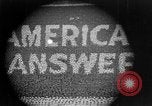
American soldiers and sailors assemble in spectacular formation and march during World War One
Huge numbers of American World War I soldiers and sailors stand in a formation that spells out 'America's Answer'. Soldiers comprise the background and sailors, in white uniforms, spell out the message. The troops disassemble and then march over the field, en masse, A Military band plays in the midst of the marching soldiers. In a separate scene, the soldiers, now shouldering rifles, march with an American flag and a unit flag.
CRITICALPAST.COM: About Us | Contact Us | FAQs - How to Order | License Agreement | My Account | My Lightboxes | Shopping Cart | Advanced Search | Featured Collections | Website Terms & Conditions | Privacy Policy ©2026 CriticalPast LLC.
License Agreement |
Terms & Conditions |
Privacy Policy
©2026 CriticalPast LLC.