


 Francais
 Deutsch
 Italiano

Refine Your Search
Nevada United States 1936 stock footage and images
- Showing 21259 to 21264 of 35682 results more
 Hide
Color Sound
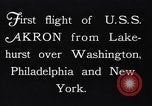
Dirigible USS Akron during its first flight from Lakehurst, New Jersey to Washington DC.
First flight of the dirigible USS Akron from Lakehurst, New Jersey to Washington DC. Airship floats in air, U.S. navy symbol and Akron written on it. The cabin at the bottom of Akron. Buildings and Potomac River shoreline seen from it. Views as it flies over the National Mall, the White House, the Washington National Monument, Lincoln Memorial, Main Navy and Munitions Buildings, and several Potomac River Bridges including the Memorial Bridge. Empty land seen at Gravelly Point where National Airport was later built. Passengers in the dirigible looking out the windows at the sights below. Control room, navigation captain and crew members talk, including good views of the ship's captain, Lieutenant Commander Charles E. Rosendahl, U.S. Navy. A cook checks on roasts cooking in an oven. Airship flies directly over Washington Monument. Views of Union Station from the airship, and then views from directly over the U.S. Capitol. Many views of the airship in flight taken from an adjacent airship or plane. Views of another U.S. city on the east coast, and then views of the airship flying over Manhattan Island. New York City skyscrapers and skyline seen from the airship.
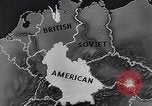
Military and German Police try to stop gun runners and black marketing and conduct free elections in Germany after World War 2
A map shows the United States, British and Soviet occupied zones in Germany after World War II. American and French police checks papers and belongings of Germans entering their zone. They chase and capture a gun runner car and remove a weapon from the back seat. Scene in a building depicts young Nazi die hard followers in a "werewolf gang" meeting in secret to plot how to continue Nazi Germany. German civilians gathered exchanging items in black market activity. U.S. occupation soldiers sell cigarettes in black market to German civilians. German police raid a black market exchange area and arrest many German citizens, rounding them up and loading them onto a truck. A captured German woman cyring. German de-nazification trials at a court in session. At a news conference, U.S. Army General Lucius D. Clay speaks about measures to build democratic processes in Germany, starting with local elections. A leader speaks at a political party meeting. German civilians vote at first free elections after World War II. A German man acts with servility before a U.S. officer and looks vindictively in direction of officer after leaving his room. Narrator describes German people post-war as egotistical people.
Sentries at buildings, bridges and children enter school warships patrol in Honolulu, Hawaii following Japanese attack.
United States armed sentry at guard post outside military building. Another armed soldier on the roof. Sentry checks soldier entering in a jeep. Numerous school children in an orderly line, entering their school building. Workers using hoes cultivate a pineapple field. Woman placing cloth on barbed wire fence. A formation of U.S. aircraft flying overhead. A building surrounded by barbed wire. Workers loading crates of pineapples onto a truck. Women weaving cloth strips into camouflage netting.Views of mountains and clouds. Hawaiian civilian workers stretching chicken wire over vertical poles. Workers cultivating pineapple plants with hoes. View from vehicle driving toward, and over a bridge guarded by armed sentry. Road signs indicate intersection of U.S. Route 1 and local Route 130. Sign on building reads: "Haleiwa." U.S. Navy sailors walk at Honolulu Harbor past the "Aloha Tower" covered in camouflage paint. (World War II period).
World tensions after World War II. The Baruch Plan. The Berlin Airlift. The Korean War. The Cold War. The Atomic age. Ballistic Missiles
Speaking before United Nations Atomic Energy Commission (UNAEC) in its first meeting in June 1946, Bernard Baruch proposes international control of all atomic energy -- the so-called Baruch Plan. Low level aerial view of ruined post World War 2 European city. Goods including heavy equipment, locomotives, being loaded aboard ships to aid in the postwar recovery of Europe (The Marshall Plan). Workers in Western Europe making use of Marshall Plan materials to rebuild their national infrastructures. West European farmers restoring agriculture. View from overflying light airplane of parts of postwar Berlin in 1948. Blocked roads and empty railroad tracks leading from East Germany to West Germany, blocked by the Soviet Union. Barge traffic at standstill due to Soviet actions. U.S. C-54 transport aircraft flying supplies into West Berlin (The Berlin Airlift) during the Soviet blockade of that city. West Berlin citizens watching U.S. transport aircraft bringing fuel, food and other essentials into the isolated city. A C-54 flying low over empty railroad lines, as it prepares to land in West Berlin. Supplies offloaded from a DC-3 ( AKA C-47 or British Dakota) equipped with unusual set of rear cargo doors. Supplies being moved on Tegel Airport with many C-54 aircraft in the background. Numerous C-47 aircraft operating at Tempelhof airport. An East German official opening a barricade as Soviet blockade of West Berlin ends on May 12, 1949, and supply trucks begin to move over roads again. Flags of Western nations flying on high flagpoles. Glimpse of Allied warships underway during the Cold War. Formation of P-38 Lightning aircraft in flight overhead. NATO troops marching and NATO armor on parade. Flashes of heavy artillery firing at night. Korean refugees moving South in 1950 with the outbreak of the Korean War. View of UN Security Council meeting in the absence of Soviet representative. U.S. tanks firing guns and American infantrymen in conflict with North Korea in Korean War. American wounded on stretchers.Delegates of both North and South Korea signing the Korean Armistice Agreement in P'anmunjŏm, on July 27, 1953. A rocket is launched. Images of earth from inside a space craft in orbit. Narrator mentions the first satellite to circle the earth, the soviet Sputnik 1 in 1957. View of Soviet pilots in low pressure altitude chamber. A test subject in an aircraft making a maneuver that allows him to experience "weightlessness." Objects in his cockpit float about. A military rocket launch monitored by arrays of radar. An object being retrieved from space by means of a parachute. A nuclear powered submarine. Rockets on display during a military parade in Red Square, Moscow, the Soviet Union. A U.S. Air Force B-52 bomber taxiing. More views of rockets seen during a Soviet military parade in Red Square, Moscow.
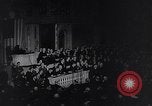
President Franklin D. Roosevelt asks Congress to declare war, after Japanese attack on Pearl Harbor (WW2)
On December 8, 1941, U.S. President Franklin D. Roosevelt, addresses the Congress, calling for a declaration of War against Japan in World War II. He calls December 7, 1941 "a date which will live in infamy." Roosevelt notes the United States was at peace and in conversation with Japan's government and Emperor Hirohito, about maintaining peace in the Pacific. Japanese ambassador and statesmen are seen visiting State Department offices to meet with the U.S. Secretary of State. Photographers take pictures of the visiting Japanese statesmen. President Roosevelt asks Congress to affirm that a state of War exists between the United States and the Japanese Empire.

The USS George Washington carrying President Wilson to Brest, France, at end of World War I
President and Mrs. Woodrow Wilson, on the deck of the USS George Washington, nearing France, en route to the Paris Peace Conference, at the end of World War 1. The President looks through binoculars, briefly. A U.S. battleshipis seen steaming ahead to port. The President motions with his hand towards another battleship,while speaking to Mrs. Wilson. (U.S. battleships and destroyers deployed in European waters joined the Presidential convoy as it approached Brest, France.) The camera pans across U.S. warships in the convoy. A dirigible is seen several hundred feet above the convoy. Closeup of the battleship, USS Oklahoma (BB-37). Camera shows French coast and flotilla moving toward Brest. President Wilson, dressed in overcoat and top hat, is seen on deck of the USS George Washington. He stands with Naval officers looking at the flotilla of U.S. warships.
CRITICALPAST.COM: About Us | Contact Us | FAQs - How to Order | License Agreement | My Account | My Lightboxes | Shopping Cart | Advanced Search | Featured Collections | Website Terms & Conditions | Privacy Policy ©2026 CriticalPast LLC.
License Agreement |
Terms & Conditions |
Privacy Policy
©2026 CriticalPast LLC.