


 Francais
 Deutsch
 Italiano

Refine Your Search
Nevada United States 1936 stock footage and images
- Showing 21331 to 21336 of 35682 results more
 Hide
Color Sound

Officers speak to African American soldiers and Dwight D. Eisenhower with senators enters a car in Weimar, Germany.
A United States Congressional group arrive at the Buchenwald concentration camp in Weimar, Germany during World War II. African American soldiers talk with a group of senators. United States Army General Omar Nelson Bradley speaks with the senators. The senatorial group is met by United States Army Lieutenant General Walter Bedell Smith at an airfield. United States Army General Dwight David Eisenhower and the senators come out of building. Officers enter a car.
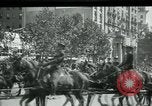
Memorial ceremony in Baltimore Maryland, for those lost in the sinking of the RMS Lusitania, in 1915
Film opens showing mounted U.S. soldiers riding teams of horses pulling empty caissons signifying those lost in the sinking of the RMS Lusitania in 1915. They ride along a major thoroughfare in the City of Baltimore. Buildings along the street are decorated with patriotic bunting. Scene shifts to view from a pier, of a U.S. Navy single-funnel gun boat is seen making way, slowly In Baltimore harbor. Closeup of Group of women, dressed in white, aboard the boat, ares seen holding a large memorial wreath over side of the boat. Next, the camera shows a U.S. Aeromarine AS-2 Float Plane landing in the water. As it taxis in, the scene shifts back to the women on the boat, holding the memorial wreath. They are seen from behind, as they hold it high over their heads, and cast it over the side into the water. View of the women clustered in the bow of the boat as it moves slowly in the water. Other persons are present on deck, including at least one soldier and photographers and reporters. The U.S. navy ensign of stars flies from the bow. Closeup of the women in the bow, who now throw flowers into the water. Closeup of a woman (possibly Lusitania survivor). She stands next to the gun boat (now docked) holding a bouquet of flowers and wearing a sash reading “Lusitania.” Next, the camera focuses on Lusitania survivor, British actress, Rita Jolivet, who stands on a pier with a building and automobile behind her. Scene shifts, again, to the ladies in white aboard the docked gun boat. Among those seen with them are two British Royal Navy officers in uniform. Final scene is of large public gathering at an outdoor pavilion. A military band is at the front of the gathering. Public figures are assembled on the stage. A color guard carrying American flags is moving through the crowd, toward the stage.
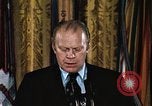
President Ford addresses gathering and awards Medal of Honor to Louis R. Rocco and Jon R. Cavaiani in Washington DC.
President of the United States Gerald R. Ford, Jr awards medals to soldiers of Vietnam War during a ceremony in White House in Washington DC. President of the United States Gerald Rudolph Ford, Jr speaks about American support to peace and about honoring the officers of Vietnam war. United States Secretary of the Army, Howard Hollis Callaway reads the citation while President Ford decorates the heroes of Vietnam War. President Ford pins medals of Honor to United States Army soldiers Louis R. Rocco and Jon R. Cavaiani. He greets the family members of the soldiers.

President Gerald Ford awards Medal of Honor to Louis R. Rocco and Jon R. Cavaiani during a ceremony in Washington DC.
President of the United States Gerald R. Ford, Jr awards medals to soldiers of Vietnam War during a ceremony in White House in Washington DC. Officers and their families enter a hall. President of the United States Gerald Ford, Jr walks up to the platform to the podium. President Gerald Rudolph Ford, Jr addresses the gathering. United States Secretary of the Army Howard Hollis Callaway reads the citation while the President awards the officers of Vietnam War. President Ford pins medals of Honor to United States Army soldiers Louis R. Rocco and Jon R. Cavaiani. He greets the family members of the soldiers. The two officers greet each other.
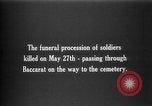
American Expeditionary Forces(A.E.F.) 42nd (Rainbow Division) bury their fallen at Baccarat, France, in World War I
A cortege of U.S. Army trucks, covered with American flags and laden with flag-covered coffins of American soldiers,who fell in combat on May 27th, 1918,proceeds through the streets of Baccarat, France, in World War 1. U.S. soldiers of the 42nd Infantry Division march as escorts, beside the trucks. Local citizens observe from the sides of the road. Scene shifts to Memorial Day (May 30, 1918), when U.S. Army Major General Charles T. Menoher and U.S. Army Colonel Douglas MacArthur,of the 42nd Infantry Division, are joined by French Generals Dupont and Penet, in decorating the graves of fallen American soldiers, during a ceremony at a rugged battlefield cemetery containing new graves marked by wooden crosses. A little French girl places a bouquet (reportedly made by Major General Menoher) upon the grave of an American soldier.She is accompanied by other French children who also place bouquets on the graves. An honor guard of American soldiers fires a salute. Scene shifts to a gathering of American soldiers at their base in Baccarat, where they surround a small outdoor stage, to watch a Miss Hart, of the YMCA theatrical Corps dance the Higland Fling. She is dressed in traditional costume of Scotland and accompanied by a violinist. A group of Army musicians, seated close to the stage, watch the performance along with the rest of the troops.
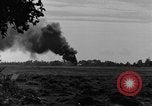
Wrecked CG-4 Haig glider, Horsa glider, Martin B-26 Marauder aircraft and other aircraft on a field in France.
Wrecked gliders and aircraft on a field in France during World War II. Smoke comes out from a burning U.S. Army Air Force Martin B-26 Marauder aircraft in the background. The B-26 burns and thick smoke rises. A U.S. soldier near a 50 caliber anti aircraft gun at an emplacement in the foreground. The wrecked gliders. The invasion marks on the gliders. A wrecked Horsa glider and invasion markings on it. The name on one glider reads 'Spook' . U.S. soldiers at an gun emplacement and wrecked gliders in a field. Many glider obstacles. A wrecked CG-4 Haig glider and invasion markings on it. Trees in the background. Wrecked gliders in the foreground. An abandoned German tank. Glider obstacles near a tree. A crushed silver U.S. Army Air Force Lockheed P-38 Lightning. Personnel examine the P-38. Trees in the background. Wrecked gliders Horsa and CG-4 on the field. Invasion markings on the gliders.
CRITICALPAST.COM: About Us | Contact Us | FAQs - How to Order | License Agreement | My Account | My Lightboxes | Shopping Cart | Advanced Search | Featured Collections | Website Terms & Conditions | Privacy Policy ©2026 CriticalPast LLC.
License Agreement |
Terms & Conditions |
Privacy Policy
©2026 CriticalPast LLC.