


 Francais
 Deutsch
 Italiano

Refine Your Search
Nevada United States 1936 stock footage and images
- Showing 21367 to 21372 of 35676 results more
 Hide
Color Sound
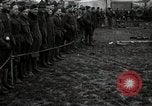
Newton Baker, Gen. Pershing and Benjamin Foulois arrive at USAAC Third Aviation Instruction Center in Issoudun, France.
U.S. Army Air Corps ( USAAC ) Third Aviation Instruction Center in Issoudun, France during World War I. Students standing behind a roped off area. Other students standing near an airplane. 'Field' written on a small board. They work on the airplane. United States Secretary of War Newton Diehl Baker, U.S. Army General John Joseph Pershing and U.S. Army Major General Benjamin Delahauf Foulois standing outside a building. They inspect the base. Airplanes parked on an airfield. Some of the airplanes taxiing on the airfield. The airplanes in flight overhead and performing aerial aerobatics.
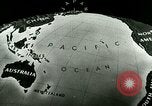
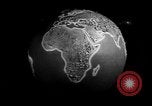
African American soldiers engaged on all fronts in World War 2
Film opens with map of the world showing the various theaters of operation in World War II. Narrator refers to Allies liberating town after town, as they advance. View of American troops being welcomed in a European town during an advance (probably Italy in 1944). Next, African American troops are seen boarding troop transport ships. A huge convoy of ships is seen from the air. Huge piles of war materiel on a dock. Ammunition being delivered by landing craft from the transport ship USS Hunter Liggett (APA-14) to American troops at a beachhead in the Pacific. An African American sailors directs the lowering of a piece of artillery from a ship into a landing craft. Construction equipment being used to clear the way for a new landing field. Docks, roads, and bridges being built as the Allies advance. American troops in the swamps of the South Pacific. American Army engineers clearing trees to build the Alaska Highway (ALCAN Highway) in 1942. Corps of Engineers building the Ledo Road (from India to China) during the war. African American soldiers building a bridge across a river in Europe. A U.S. Army truck under fire, driving along a dirt road in Europe as shells burst all around it. U.S. troops firing various kinds of field artillery and tank guns. U.S. infantryman using a flame thrower. Closeup of African American soldier using a bayonet and others firing small arms. A tank being blown up by artillery fire. A Japanese Mitsubishi A6M3 Zero aircraft maneuvers overhead in the Pacific theater. An African American soldier runs to man his Browning .50-caliber, water-cooled antiaircraft machine gun, and begins firing as the Zero fighter plane strafes his position. Closeup of Japanese pilot in his cockpit and his machine guns firing from leading edges of his plane. His rounds strike all around the U.S. gunner, who turns and follows him with more fire. His tracers show behind the plane. Closeup of the African American gunner as he continues firing. View of the Japanese airplane rolling over and diving. Next the Japanese plane, aflame, crashes on a tropical island and explodes. (Note: It is apparent that some of these combat scenes have been made up of clips from other sources, edited into this film.) (World War II; WW II; World War 2; World War Two)
Surrender of Japan after atomic bombings of Hiroshima and Nagasaki, Japan.
Surrender of Japanese Imperial forces leads to end of World War II. V-J Day (Victory over Japan) celebrations in August 1945. Americans celebrate as newspaper headlines announce V-J Day. Close up view of man holding Boston Post with headline "War Is Over." Teeming crowds in New York City's Times Square celebrating the news. Crowd of citizens, soldiers, and sailors in uniform surrounds a newspaper with headline "U.S. Announces Jap Surrender." Happy crowds of people waving, jumping, and smiling in jubilation. People show V signs. U.S. warships underway at sea. U.S. soldiers aboard ship. Japanese troops parading in Japan. Japanese aircraft lined up in flight line ready for take off to defend the Japanese mainland. Japanese amphibian tanks lined up ready for use against a possible allied invasion. Aerial view of actual atomic bomb explosion over Hiroshima as seen from second B-29 aircraft accompanying the Enola Gay on the bombing run on August 6, 1945. Ruins of twisted metal and debris in Hiroshima and Nagasaki and civilians walking among the devastation. Japanese civilians along road. Japanese Generals deplaning and meeting U.S. General MacArthur on an airfield. Troops of 11th Airborne Division land in Japan. Marines reach Japanese shores at Yokosuka Naval Base in Landing crafts. American soldier raises American flag in Japan. American troops aboard Japanese battleship Nagato after Japanese surrender. View of the Nagato (later used as a target ship during Operation Crossroads).
The Cold War. Montage of scenes showing American industry, and military, in contrast to Soviet Union.
The Cold War from perspective of U.S. military. Industry in the United States. Exterior of a factory shows stacks belching smoke. Scenes of heavy manufacturing.Steel furnace; flywheel; moving parts; machinists using drill press and lathe. Milling machine in operation. Steel fabrication; ingots; forging operations;gear cutting. Steel Bridge construction. Man rides girders suspended by cables. Concrete building construction. Electric transmission lines and facilities. Capitol building in Washington DC. The Kremlin in Soviet Union and Soviet military parade in Red Square. U.S. C-130 aircraft takes off. Helicopters fly in formation. Artillery is fired. Paratroops drop from C-130 aircraft in formation. Aircraft catapulted from carrier's deck. Rockets launched from ships. Polaris missile fired from submarine breaks surface of ocean. B-52 taking off. Formation of F-105s in flight. F-102s in flight. Troops in amphibious assault on beach. Helicopters in formation. Various missiles launched. U.S. surveyors working in an Asian country. President Lyndon B Johnson speaks at mike.
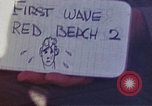
Amphibious assault on Red Beach 2 during battle of Okinawa in World War II
U.S. amphibious landings on Red Beach 2 in Okinawa during World War 2. U.S. Navy Destroyer USS Metcalf (DD-595) fires guns toward shore. Behind her is the Cruiser, USS Baltimore (CA-68) also firing her guns. Closeup of the USS Metcalf as first waves of Company "A", 4th U.S. Marine Regiment, in amphibious landing craft head toward Red Beach 2. They pass in front of the USS Metcalf and USS Baltimore, as both ships continue firing at the shore. Views from a landing craft of others in the first landing wave. Brief closeup of U.S. Marines crowded in their landing craft.

General Simon Bolivar Buckner, Admiral Mitscher and Admiral Richmond K Turner plan an invasion of Okinawa.
Invasion of Okinawa. U.S. Army and Navy headquarters in Guam, Pacific Ocean. Army and Navy officers walk along path in exteriors of building. Officer arrives to his flagship at fleet's starting point. U.S. convoy underway at sea. General Simon Bolivar Buckner, Admiral Mitscher and Admiral Richmond K Turner in conference examine map. Map shows Kerama Islands near Okinawa. U.S. convoy underway and naval bombardment. Landing crafts advance toward island in Kerama group. Amphibious landings on islands in the Kerama group by 77th Division and the 305th Regimental Combat Team. Troops advance and fight enemy. Dead Japanese soldiers. U.S. soldiers question Japanese prisoners and natives. (World War II period).
CRITICALPAST.COM: About Us | Contact Us | FAQs - How to Order | License Agreement | My Account | My Lightboxes | Shopping Cart | Advanced Search | Featured Collections | Website Terms & Conditions | Privacy Policy ©2026 CriticalPast LLC.
License Agreement |
Terms & Conditions |
Privacy Policy
©2026 CriticalPast LLC.