


 Francais
 Deutsch
 Italiano
Refine Your Search
Nevada United States 1936 stock footage and images
- Showing 21577 to 21582 of 27248 results more
more Hide
Hide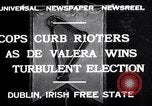
Cops curb rioters in Dublin after Eamon de Valera wins election.
Post election condition during 1932 in Dublin, Irish free State. A huge gathering outside a government building in Ireland. Eamon de-Valera is seen. William T. Cosgrave with another official comes out of the building. Police work through crowd in a line and control rioters and agitators.
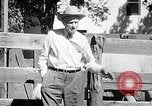
Farmers explain how they suffered the drought and dust bowl storms in Dalhart, Texas, during 1934.
Farmers of Dalhart, Texas describe the terrible sand storms they suffered in the region during 1930s. In 1960 interview, farmer Harold Hogue describes a severe dust storm he experienced in 1934. Scene change to mid 1930s footage showing dust bowl views of desolated farms, drought stricken lands and houses and farm equipment all piled high and buried in dust and dirt. A 1960s' farmer on his tractor describes how the dust storms destroyed his wheat crops and left sand and dust on everything. He states that they experienced 110 dust storms in the Spring of 1934.
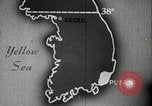
UN landings at Inchon and reoccupation of the capital, Seoul, by UN forces during the first year of the Korean war.
Animated map shows South Korea, from 38th parallel, South, and highlights Pusan, and the advances being made by UN forces after being reinforced. Next, the UN amphibious landings at Inchon (or Incheon) are shown on the map. Flashes of naval gunfire are seen in the blackness of night. Next, a Landing Craft Tank (Rocket), LCT(R), is seen firing barrages of rockets toward shore, at Inchon. On September 15, 1950, U.S. troops are seen landing at Incheon, from boats of the attack transport ship, USS Noble (APA-218). Return to the animated map shows advance of UN forces from Inchon joining with those advancing from Pusan, until they occupy most of the area south of the 38th parallel. UN infantry are seen engaged in urban combat in the city of Seoul, accompanied by M26 Pershing tanks and M46 Patton tanks. Building burning in the city. UN soldiers firing rifles inside damaged building. American soldiers, under fire, carrying wounded on litter. Medical corpsmen tending to casualties, including wounded Korean civilians. Republic of Korea (ROK) infantry following four of their soldiers carrying their flag, stretched out horizonally, between them. (Narrator states they are carrying it back to the liberated capital of Seoul.) ROK troops escorting large number of prisoners of war, marching with hands on heads. UN forces distributing rice and clothing to the Korean inhabitants of Seoul. Soldiers helping little Korean children don clothing. Bodies of men, women, and children who were slain by retreating enemy troops, are laid out on the ground, attended by Grieving relatives. Large quantities of captured North Korean weapons are piled up, including those made in the Soviet Union.
Early Bell Laboratory technology in computer art and computer animation for communication, advertising, motion pictures.
Computer screen showing animation of a silhouette of a man running. Narrator states that the first such image was generated at Bell Telephone Laboratories in New Jersey in the early 1960s. More views of the so called "Olympic Runner" graphic design generated by the Bell Laboratories newest digital computer. Colors like pink, blue and red are used in the early, historic computer art and animation technology. Men seated in a control room, interacting with the digital computer and other animation and recording hardware. Views of computer monitor screens and discussion by narrator about various visual forms created by computers. Various computer generated images are shown on the screen. Engineer stands in front of video tape machine where the images are being recorded. More computer and animation hardware is shown including an Animation Aid. Narrator describes process of photographing analog computer art work onto motion picture film and then enhancing it with color choices. Engineer is seen operating camera, and then a close up view of motion picture film running on machines and on reels. Animation and color consultant in discussion as they stand over some frames of the film that they have isolated. Sample work of early computer artists is shown, with moving animated art seen on screen, combining color and motion in new ways that were not possible before the digital computer. Another view of the video tape machine operating. Narrator discusses use of the computer also in development of computer generated music that accompanies the visual images. Animated clock is seen. Different kinds of animations are seen.
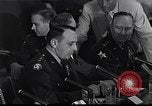
Public Hearing, Senate permanent subcommittee on Investigations. Army-McCarthy hearing April 22, 1954.
April 22, 1954. First open session of Senate permanent subcommittee on investigations in response to charges filed by the U.S. Army on April 13, 1954, concerning improper actions by Senator McCarthy and staff to obtain special treatment for Private G. David Schine, U.S. Army. Seen before start of session are Army Generals Lucius Clay and Alfred Gruenther. Senator Karl Mundt presiding, calls the session to order. Among those seen are Senator Edward Dirksen, second person to the Chairman's right, and Senator Charles E. Potter to Dirksen's right. Senator John L. McClelland sits to Chairman Mundt's left. Senator Joseph McCarthy and his counsel, Roy Cohn, are at the end of the table. At end of clip McCarthy states for the record that "there is no contest between Senator McCarthy and the Department of the Army, and that all that Senator McCarthy has been trying to do is to expose the Communists who have infiltrated the Department of the Army -- a very small percentage."
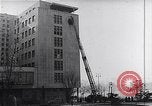
Scenes of Hungarian Revolution, 1956.
Hungarian revolution. Hiding the communist seal of the state with a national flag on the office building of the members of the parliament, while onlookers watching from the Elisabeth bridge. Trucks carrying humanitarian aid on road. Men and women on the streets. Various views during the Hungarian revolution.
CRITICALPAST.COM: About Us | Contact Us | FAQs - How to Order | License Agreement | My Account | My Lightboxes | Shopping Cart | Advanced Search | Featured Collections | Website Terms & Conditions | Privacy Policy ©2026 CriticalPast LLC.
License Agreement |
Terms & Conditions |
Privacy Policy
©2026 CriticalPast LLC.