


 Francais
 Deutsch
 Italiano

Refine Your Search
Nevada United States 1936 stock footage and images
- Showing 21625 to 21630 of 35675 results more
 Hide
Color Sound

Researchers test household equipment like washing machines, electrical ovens and home freezers.
Research work by the Bureau of Human Nutrition and Home Economics Service (United States Department of Agriculture). Chief of the Bureau Dr. Hazel K Stiebeling talks about domestic science research in the field of household equipment. A researcher put clothes into a washing machine. Another woman takes notes. Fabric sample are uniformly soiled, cut and sown onto muslin. The researcher records temperature while putting the clothes in. A woman checks the amount of dirt removed by measuring the reflected light before and after the laundry. Cooking: A woman researcher develops a standardized cake recipe to test baking performance of an electric oven. She lays the batter in pans into the oven. Judges measure the upper and lower limits of browning compared to a reference cake. Engineering test of home freezers in a laboratory. The researchers load freezer with filled cartons. Some have thermocouples inserted. A researcher checks meters and time clocks for current, energy consumption and freezer motor measurements. Researchers compare the amount of two fuels used to cook a farm family meal. (Some scenes with camera closeups have the look of 1940s and 1950s era "housewife" or homemaker scenes)
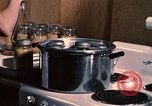
Space requirement tests and approval of housing plans as a part of the housing research.
Research work by the Bureau of Human Nutrition and Home Economics Service (United States Department of Agriculture). Chief of the Bureau Dr. Hazel K Stiebeling talks about housing research. Domestic science tests on space requirements for kitchen work in the experimental housing laboratory. A researcher checks for the amount of space required to do an efficient job of home canning. An architect completes the perspective drawing for a farm house. The Regional Committee selects a group of plans. Architects and draftsmen prepare the working drawings. Architects and housing specialists check the drawings for functionality.

Jill presents 'GI Jive', a jive music section on the 'By Request' program for the American soldiers abroad (WW2)
A female WAAC (Women's Army Auxiliary Corps) presents 'By Request' for the Army Navy Screen Magazine' in the United States during World War II. She reads out a request for music from Ameriacn soldiers in the Pacific Theater. The 'GI Jive' section presented by Jill. She talks to the GIs, plays a jive tune for them and asks them to keep writing in. Pictures, sketches, letters, photographs and other memorabilia sent by GIs from various war fronts. Jive tune plays in the background.

Humorists including Jimmy Durante, Andy Devine and Robert Benchley perform 'Down by the Old Mill Stream' for American GIs.
A woman GI presents 'By Request' for the Army Navy Screen Magazine in the United States. An American soldier in China requests an old song. Character actors, humorists and comedians perform song "Down by the Old Mill Stream" on stage. Performers include Jimmy Durante, Allen Jenkins, Sterling Holloway, Hugh Herbert, William Gargan, Edward Brophy, Andy Devine, Allan Hale, Robert Benchley, and Arthur Treacher. The audience breaks into laughter during the performance. The female GI winds up the show after the performance. She states the program address and asks the soldiers to keep writing in. (World War II period).

Space research about the ionosphere from the ground by the National Bureau of Standards.
Film entitled 'Scatter Radar', from The National Bureau of Standards, United States Department of Commerce. Depicts space research from the ground. The globe rotating. A satellite antenna moves into position. Radio instruments. Red optical instruments used to study the sun. Clouds in the upper atmosphere. Animation: Ionosphere reflects radio waves to the planet. A smoke of cloud rises during the launching of a rocket. An artists' conception of the Van Allen Radiation Belt above the Earth's ionosphere discovered by Explorer I and Pioneer III. A satellite orbits the globe. Men watch as a rocket is erected and fired. A scientist at the National Bureau of Standards works on a formula. A man at the controls of a scatter radar fro space research. Animation: Ionized and neutral particles as well as free electrons that permit long distance communication. free electrons reflect radio energy. Radio waves penetrate the ionosphere. A scientist at the Ionosonde model C4 to measure electron density variations. Electron density model on the monitor. Two Oxygen atoms. An electron detaches and becomes a free electron. Radio waves pass by, the electron and waves oscillate and scatter energy. Animation: Need to excite electrons sufficiently so that their energy radiated can be detected from the ground. The process requires a powerful transmitter, large antenna, and a sensitive receiver.

Communication waves and the relation between power transmitted and received in Space Communications
United States Air Force training film about Space Communications and the related problems and developments. Animation: Planets, remotely controlled unmanned space research vehicles in space. Space communication links between the vehicles and Earth. Radio waves are reflected, refracted and absorbed. An antenna radiates waves that are dispersed. Communication and light waves on the frequency spectrum. Groundwave and Skywave transmission explained. Skywave transmission reflected back to Earth by the ionized layers in the Earth's upper atmosphere. Bouncing of signal in optimal conditions. Spacewave travels from transmitting to receiving antenna, and travels unaffected through the ionosphere into outer planetary space. Depicts laws that govern Line of Sight transmission: Relation between power transmitted and power received, and ideal and regular conditions. Explains the factors involved in the relation between the power transmitted and received. Comparison of communication and light waves. Inverse Square Law explained. The law applied to Space Communication: Signal generated from point source, energy dispersed in shape of sphere, energy spreads over expanding spherical area. Outlines a practical approach to strengthen received power: Directing the radiating energy, and enlarging area of the receiving antenna.
CRITICALPAST.COM: About Us | Contact Us | FAQs - How to Order | License Agreement | My Account | My Lightboxes | Shopping Cart | Advanced Search | Featured Collections | Website Terms & Conditions | Privacy Policy ©2026 CriticalPast LLC.
License Agreement |
Terms & Conditions |
Privacy Policy
©2026 CriticalPast LLC.