


 Francais
 Deutsch
 Italiano
Refine Your Search
Nevada United States 1936 stock footage and images
- Showing 21691 to 21696 of 27294 results more
more Hide
Hide
Cardinal Mindszenty in Hungary. In New York: American Legionnaires Parade. Communists parade. Catholics protest against Russia
Views of St. Stephen’s Cathedral, Budapest, Hungary. Cardinal József Mindszenty and retinue enter St. Stephen's Cathedral (Budapest, Szent István tér 1, 1051 Hungary). Dark interior of cathedral. Cardinal Mindszenty, priests, and sacristans leaving the cathedral. Cardinal in procession during festival. Cardinal Mindszenty blesses the crowd outside St. Stephen’s Cathedral. Several graves in woods, marked with wooden crosses. Hungarian Communist Leader Mathius Rakosi speaks. Photograph of Cardinal during his trial in Hungary. Comparison of Cardinal Mindszenty's signatures made in 1947 with that ostensibly signed to his confession in 1949. Massed American flags carried by members of the American Legion, in May Day loyalty Parade passing Central Park, in New York City. Small parade of Communists Sympathizers in New York. People carry banners reading: "Against KKK; Against War Bases in Africa; Against Universal Military Training; The Soviet Union Wants Peace; Return to Roosevelt's Peace Policy." One man carries a sign "Hail the State of Israel." Roman Catholic priests lead 'Procession of protests' against Communist Russia at the New York Polo grounds.
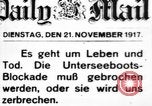
German U-Boat stops the Spanish steamer " Asuarca," at sea in World War I
Slate mimics The British Daily Mail newspaper, Tuesday, November 21, 1917, declaring that England must break the German U-boat blockade or be broken by it. Another slate alludes a statement by British MP Gibson Bowles to the effect that Britain's food supply is being controlled by the German submarine. Crew of a surfaced German submarine is seen on deck taking advantage of good weather to perform maintenance on their deck gun, during World War 1. Officers in Conning tower scan horizon with binoculars. The neutral Spanish Steamer, "Asuarca," is sighted from the conning tower, where the Imperial German Navy war ensign is displayed along with a nautical pennant bearing a white cross on red background, indicating the numeral "4." The crew is also raising a bicolor nautical flag for the letter "H." (A slate states that the U-boat is signalling for the ship to send a boat.) View of the single-stack Spanish steamer. A boat from the Asuarca, sits alongside the U-boat after bringing an officer carrying her papers. The officer is seen leaving the submarine and boarding the ships dinghy, to return to the Asuarca. A Slate indicates she carried no contraband and was therefore allowed to proceed unhindered. (World War i; World War 1; WWI; WW1)
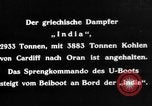
German U-Boat sinks Greek ship "India" in 1917 during World War I. U-Boat crew captures and examines sea turtles, in 1915.
Opening scene shows a tramp steamer listing to starboard.during World War 1. She displays "India, Greece" in large letters on her side. Slate indicates that an explosives technician from a U-Boat had climbed aboard and set charges on the Greek Steamer, "India" as she is stopped in the Atlantic during World War 1. The India is carrying a cargo of coal from Cardiff Wales, to Oran. The ship is seen listing. Smoke still rises from her stack. Slate states that the cross on the hull of the sinking "India" is the Greek national emblem. The ship sinks lower and finally slides out of sight, with smoke rising above the water from her exploding boilers. (Note: This German U-boat is the SM U-35, which was operating in the western approaches to the Straits of Gibraltar after leaving the Mediterranean on 11-12 April. It carried a professional cinematographer on board. Two years earlier, on June 12, 1915 , the U-35 also sank the British ship, "Crown of India." ) The next sequence shows an image of the German Daily Express newspaper for Monday May 10, 1915. Dead! it reports in bold print: The world has a duty to conduct a Hunt for turtles. Scene shifts to deck of surfaced German U-boat, showing a dinghy arriving alongside, from which several giant sea turtles are unloaded. Crew members examine the turtles on the deck of the submarine. At least one appears to be dead. Next scene shows lookouts on conning tower of the U-Boat, as they see smoke on the horizon. (The Imperial German Naval war flag is displayed on the conning tower.) The Captain calls for full speed ahead on both engines, and the controls show that being selected. (World War i; World War 1; WWI; WW1)
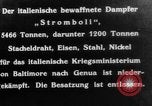
German U-Boat sinks Italian armed freighter, "Stromboli," by means of explosives and gunfire during World War I
Slate describes the Italian armed steamer, "Stromboli" carrying bulk cargoes of iron, steel, and nickel for the Italian war ministry, from Baltimore, U.S.A. to Genoa, Italy. It states that the ship was sunk and her crew released. View from deck of German U-Boat,U-49, under command of Captain Hans von Mellanthin. Several crew seen in conning tower. The single stack ship "Stromboli," stopped in the background. The U-49 approaches portside of the Stromboli, where a 7.6 cm deck gun is seen astern. An explosives technician, is dispatched by dinghy from the U-Boat, and boards the Stromboli. The U-Boat crew members obtain fresh water from the STromboli, before setting explosives to sink her. The German explosives technician is seen lighting fuses on deck of the Stromboli. The charges explode at her waterline. The U-Boat then fires its deck gun to hasten sinking of the Stromboli. View from the submarine as the Stromboli settles lower in the water and finally sinks stern-first. The location is off Capo Mele, (43.57N, 08.12E) in the Mediterranean Sea. Scene shifts to view from the U-49 deck during sunrise at Algiers.
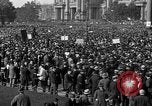
Paul von Hindenburg leads ceremonies in Deutsches Stadion, Berlin, Germany, in World War I
A crowd of German civilians is seen gathered in the Lustgarten. But the scene shifts suddenly to the Berlin Deutsches Stadion (Deutsches Stadion, Olympischer Platz 3, 14053 Berlin) in the Grunewald Racecourse. Men in old-fashioned traditional military uniforms march into the stadium, carrying flags of the various German States. They parade around the perimeter of the stadium. Flag of the German Weimar Republic flies over the principal building in the stands. The flag bearers on the field lower their flags, in salute. Next, Field Marshal Paul von Hindenburg and his deputy, General Erich Ludendorff, enter the field, leading several military officers, together with a civilian, carrying a sign reading: "I.G.I.D." They are followed by a long line of civilians. Spectators are on their feet in the stands where some men wave their hats and some women wave handkerchiefs. (World War I; World War 1; WWI; WW1)
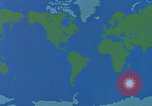
Map of oceans showing "rings of fire" where tectonic plates are active. Arctic operations on Glomar Challenger
Animated map of worlds oceans, showing "rings of fire" where tectonic plates are in various states of relative motion. Scene shifts to drilling rig on the research vessel, Glomar Challenger. Scene of arctic conditions, with heavy coatings of ice seen on the vessel. Drilling crew continues work on the Glomar Challenger, in spite of the weather. Crew member's feet sliding across the deck. Crew continues "roughneck" work of drilling and use Acetylene Torch and hammer to keep equipment free and moving. Crew with core sections, retrieved from deep ocean floor. they cut them with hacksaw and bind them. Views of deck in harsh weather. Radar antenna in motion.
CRITICALPAST.COM: About Us | Contact Us | FAQs - How to Order | License Agreement | My Account | My Lightboxes | Shopping Cart | Advanced Search | Featured Collections | Website Terms & Conditions | Privacy Policy ©2026 CriticalPast LLC.
License Agreement |
Terms & Conditions |
Privacy Policy
©2026 CriticalPast LLC.