


 Francais
 Deutsch
 Italiano
Refine Your Search
Nevada United States 1936 stock footage and images
- Showing 21823 to 21828 of 27294 results more
more Hide
Hide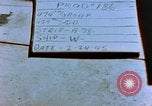
Two soldiers arrest suspected Nazis and a woman takes firewood out of debris in Germany during World War II.
Activities of civilians in Germany during World War II. Two U.S. Army soldiers arrest two suspected Nazis. They stand and interact at the entrance gate of a building that is under guard by American forces. Scene changes to a bomb damaged Atlas relief carving on a destroyed building. Next scene is a wide view of a totally destroyed area from bombing, with the same portion of broken wall with the Atlas carving seen at center. A German woman walks through rubble and debris from bombing, carrying two stacks of broken wooden timber pieces for firewood. (Location is possibly Nuremberg. Despite film slate stating 2-24-1945, these shots appear to be more likely April or May 1945.)

A crane loads engines built by the Baldwin Locomotive Company on a freighter in Eddystone, Pennsylvania.
Engines are loaded on a freighter in Eddystone, Pennsylvania. Seven huge engines built by the Baldwin Locomotive Company for the Chilean State Railway. A crane loads the engines on a specially designed freighter. A man on a deck instructs the loading of engines.
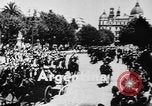
Stanton Griffis, newly appointed U.S. ambassador to Argentina, presents his credentials to President Juan Peron in Buenos Aires.
Stanton Griffis, the newly appointed U.S. Ambassador to Argentina, presents his credentials to President Juan Peron in Buenos Aires. Griffis arrives to Casa Rosada (Balcarce 78, C1064 CABA, Argentina), the Argentine presidential palace in horse wagons. He reviews guard of honor and then meets President Peron and other leaders in an official ceremony. He also presents a gold coin to the Argentine Head of State.
Several scenes of public demonstrations by Russian citizens in Petrograd during World War I
Scenes of unrest in Russia during World War 1. Crowds of Russians, disappointed with the war, their government and the general state of affairs, demonstrate in Petrograd, during the so-called February Revolution immediately preceding the beginning of the Russian Revolution. Some carry banners reading "Freedom and Equality, and similar slogans. (This event triggered the abdication of Tsar Nicholas II and formation of a Provisional Government.) In another sequence, a huge mass of Russians, mostly women, move through a street in Petrograd on International Women's Day, May 8th, during a period of labor strife and unrest. In final sequence, Russians are seen packed together on a warm day, possibly listening to a speaker. (These may be brief scenes from the July Days uprising, in Petrograd, When a peaceful demonstration by half a million people, was put down by armed troops resulting in some 700 deaths.) (World War I; World War 1; WWI; WW1)
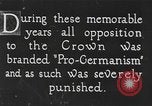
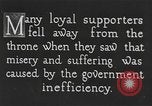
Russians mistreated by government prior to abdication of Tsar Nicholas II. Latvian soldiers executed by German firing squad
Shows government suppression of Bolsheviks around time of Russian Revolution, and before the 1917 abdication of Tsar Nicholas II, in Russia, and by German forces in post-war Latvia, in 1919. Imperial Russian troops intrude on a gathering of persons ostensibly opposed to Tsarist policies. Slate states such persons are accused of "Pro-Germanism." View of a damaged prison building and high guard tower. View of women and children in a large common cell of the prison. View of prison wall from outside, with barred windows evident. Women walking about inside the prison, as an Imperial Russian guard walks past the cell. View through a barred window. The final short sequence was filmed near Riga, on May 26, 1919, by American Army cameraman, Lieutenant Johnson, who was in Latvia as part of a U.S. post-war relief effort. It shows three Latvian Bolshevik soldiers facing a German firing squad. Boots of the condemned (which were valuable) have been removed. The firing squad executes the Latvian soldiers. Next, the bodies of the victims are seen in a ditch where they had fallen. (Note: This entire film includes a mix of staged theatrical and documentary scenes from various sources, times, and places.)
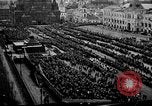
Lines of marchers in a peaceful demonstration at Red Square, Moscow, Russia, in World War I
View from a high point overlooking a peaceful demonstration at Red Square in Moscow during World War 1. The State Museum in the background. The square filled with several parallel lines of marching people. Others sit in grandstands watching. Some marchers carry banners.
CRITICALPAST.COM: About Us | Contact Us | FAQs - How to Order | License Agreement | My Account | My Lightboxes | Shopping Cart | Advanced Search | Featured Collections | Website Terms & Conditions | Privacy Policy ©2026 CriticalPast LLC.
License Agreement |
Terms & Conditions |
Privacy Policy
©2026 CriticalPast LLC.