


 Francais
 Deutsch
 Italiano
Refine Your Search
Nevada United States 1936 stock footage and images
- Showing 21877 to 21882 of 27294 results more
more Hide
Hide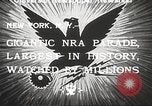
An NRA (National Recovery Act) parade passes in review before an NRA official in New York City.
An NRA (National Recovery Act) parade in New York during the Great Depression. American men, women and children including bank presidents and office boys parade on the Fifth Avenue. A crowd passes in review before NRA official Hugh S. Johnson, Governors of three states and other notables in a huge demonstration to pledge their support to U.S. President Franklin Roosevelt's National Recovery Act.
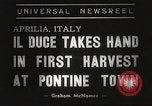
Italian Prime Minister Benito Mussolini takes a hand during the first harvest in Aprilia, Italy.
Italian Prime Minister Benito Mussolini helps during the first harvest in Aprilia, Italy. Mussolini strips to waist and helps to harvest grain grown on the Pontine Marshes which he reclaimed from a swamp and dedicated to his totalitarian state.

Francisco Franco triumphantly enters Madrid. Dolores Ibárruri ("La Pasionaria") in France, on her way to Russia
The city of Madrid in Spain after the Spanish Civil War comes to an end. Views of bomb damaged and ruined buildings in Madrid. Captured rifles piled up. Two women carry away bricks in a basket during clean-up work. Civilians having their food. Spanish Head of State, Regent of the Kingdom Francisco Franco waves to crowd. Scene changes completely to Dolores Ibárruri , known more famously as "La Pasionaria" (passion flower) arriving in France,on her way to Russia. She walks with companions after arriving at a train station. Photographers take pictures of her and her companions. They exit the station to the street, where she and some of her companions enter an automobile.
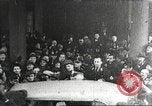
Adolf Hitler is named Chancellor of Germany
Crowds in Berlin, Germany, celebrate their new chancellor and Government, on January 30, 1933. Crowd of German people surround a car carrying Adolf Hitler in front of the Hotel Kaiserhof in Berlin. Citizens gather around the statue of General Leopold I, in Wilhelm Platz. Scene shifts to newly appointed Chancellor Hitler with his cabinet. He is seen conversing with former Chancellor, Franz von Papen, at his left and Hermann Göring, at his right. Standing behind Papen is Alfred Hugenberg, head of the German National People's Party (DNVP). Next, a slate appears stating that In the evening, the National Youth honor the aged German president (Hindenburg) and their new chancellor by a torchlight parade. View of Hitler watching from a window in the Chancellery. (Note: The torchlight parade was made up mostly of Nazi storm troopers, aka Sturmabteilung -SA, and SS troopers, with some organized youth participating.)
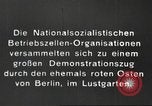
National Socialist Factory Cell organizations (NSBO) gathered in the Berlin. Hermann Goering reviews Sturmabteilung (SA)
The National Socialist Factory Cell organizations (NSBO) gathered in the Berlin Lustgarten, for a large protest march through the formerly Marxist areas east of Berlin. Men carry banners for various worker groups, including some German Government workers from the Defense Ministry. Many carry signs showing affilitation with the NSBO. Uniformed Berlin policemen are seen in the crowd. At start of the next sequence, a slate states that the day before the election, the entire Berlin Sturmabteilung (SA) Stormtroopers marched by Hermann Goring, Prussian Minister of the Interior. They are seen marching past Goering, who reviews them from a balcony.
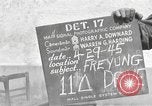
Hungarian schoolboys are interviewed by American soldiers of U.S. 11th Armored Division at Freyung, Germany in World War II
American soldiers interviewing prisoners at the U.S. 11th Armored Division Prisoner of War enclosure in Freyung, Germany near the end of World War 2. An American Army Sergeant questions a young man with help of another Sergeant, interpreter, who speaks to him in German. The boy identifies himself as being Hungarian from the Royal Hungarian High School. The boy tells them he learned marching drill, but had no weapons training. He had been enrolled four years, and had never been engaged in combat with Americans. He states his age as 14 years. Scene shifts to another interview with a younger boy soldier. The interpreter asks if he speaks German. The boy says no, he is Hungarian. Nevertheless, with some difficulty, they determine that he too is from the Hungarian military school. When asked about his military training, the boy answers by demonstrating, standing at attention, saluting, and simple close order drill actions. They determine that he is in the third year of school. The film director calls for a cut at this point. They resume asking if he ever fought against Americans. He has difficulty understanding but eventually says no. The boy is 12 years old.
CRITICALPAST.COM: About Us | Contact Us | FAQs - How to Order | License Agreement | My Account | My Lightboxes | Shopping Cart | Advanced Search | Featured Collections | Website Terms & Conditions | Privacy Policy ©2026 CriticalPast LLC.
License Agreement |
Terms & Conditions |
Privacy Policy
©2026 CriticalPast LLC.