


 Francais
 Deutsch
 Italiano
Refine Your Search
Nevada United States 1936 stock footage and images
- Showing 22645 to 22650 of 27293 results more
more Hide
Hide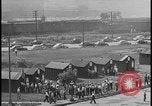
Members of UAW Ford Local 600 voting on the first Union contract with Ford Motor Company
Opening scene shows a virtual tent city set up to facilitate voting by numerous elements of Ford United Auto Workers Union 600. Camera pans over the scene where buses are transporting members. It shows the headquarters building with sign reading: "Ford Local No. 600." Men are lined up to vote at tents marked according to Ward and District. They are voting on the question of ratifying the first UAW contract with Ford Motor Company that was signed June 20, 1941. A bus pulls up to a curb. It contains signs reading "Ride Free" and "Vote Yes."
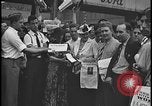
UAW workers gather outside Ford River Rouge plant to celebrate victory against Ford leadership.
Women surrounded by UAW workers at the Ford River Rouge plant. They are gathered at the overpass to the plant, clutching the Ford Edition of the "United Automobile Worker" newspaper. Headlines on the newspapers read, "Dearborn Police Face Riot Trial" and "Prepare Smashing Ford Drive." This is possibly in the aftermath of the Battle of the Overpass, in which UAW protesters were injured by police and Ford security men. A motion picture camera pointed at one of the women as she speaks. A man smoking a cigarette with his arm in a sling views photos with another man, perhaps copies of Scotty Kilpatrick’s photos of the attack on UAW workers. Cars and taxis lined up outside the Ford River Rouge complex. Men distribute newspapers outside the plant. A La Salle Cab Co. taxi pulls onto the roadway. A woman holds a newspaper above her head in victory. Onlookers gather on the overpass while a police man on horseback rides through. View from overpass of UAW workers holding papers. Streetcar next to overpass. Men climb stairs onto overpass. A UAW worker distributes papers to men exiting a streetcar. Woman with a feathered hat smiles while looking at a newspaper.
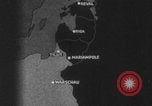
Evacuation of German forces from the Baltics in World War II
Film begins showing map of the Baltic sea and cities of Reval (Tallinn), Riga, Tilsit, Mariompole (Marienburg) ,Warschau (Warsaw) and Krakau. German naval warships and troop carriers are seen in a convoy evacuating German forces from the Baltics in World War 2. The German Navy ships fire their guns. View of the German Cruiser, Admiral Scheer. Troop ships and barges arrive with German soldiers at a dock in Germany. Field Marshal Ferdinand Schörner (wearing Knights Cross of Iron Cross with oak leaves, crosses and diamonds) is the first to step ashore. He is Commander of Heeresgruppe Nord which is a unit being evacuated. He is greeted by a German General. They converse and shake hands. Closeups of Marshal Schoerner interacting with German soldiers. Some troops manually move an artillery piece along the dock. Views of German soldiers eating snacks and seeming quite happy. Marshal Schörner decorates some German soldiers on the spot. Later, he is seen shaking hands with two newly decorated soldiers at a ceremony in an open field. Closeup of one soldier and an iron cross award pinned on a German uniform.
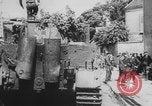
German SS troops prepared to defend positions in Southern Normandy after Allied D-day invasion in World War II
Film starts showing a camouflaged German Stug IV assault gun parked in front of a sidewalk and building in Southern France during World War 2. German soldiers are congregated on the sidewalk. Closeup of German SS (Schutzstaffel) officers huddled together looking at a map held by one of them. They all display the Death Head (totenkopf) insignia on their caps. Closeup of seated SS officers consulting a map. One wears insignia of SS-Storm Unit Leader (Sturmbannfuhrer). Scene shifts to German soldiers moving rapidly out of a village in a camouflaged Leopard I tanks and camouflaged (with foliage) "Kübelwagens." A camouflaged half track carrying supplies and towing an artillery piece is accompanied by several walking troops. Scene shifts to a soldier with surveying scope on tripod giving hand signals to assistant (unseen). German soldiers remove a rocket launcher (Nebelwerfer) hidden in trees at the edge of a field. View of several such launchers lined up in a battery at edge of forest. View of German infantry moving under cover and of a soldier crawling under a tank for protection. Change of scene shows several soldiers relaxing inside a dugout. Four soldiers share a single dish meal. A small hog is shown as a pet in a camp. Troops pet it. A soldier on a bicycle carries treats to one in a defensive position. Soldier with binoculars looks out on Normandy terrain comprised of mixed woodland and pasture (Bocage: also called Hedgerows by Americans in World War 2.) German soldier slogging through mud. A soldier calls to another who peers out from his well established dugout. Soldiers dressed in camouflage consult a map. German patrol sets out. One of the soldiers climbs a tree. Closeup of him climbing. Another soldier seen comfortably perched a tree with his weapon. Two patrolling German soldiers advance running from cover of a tree, and make their way across a grassy plain. Officer looking through binoculars. Soldiers in grassy field stay down as explosions sound and smoke rises from shells striking in distance. Closeups of Several soldiers helping each other as they go through hip deep water in swampy part of grassy field. German artillery firing from established positions near a river. Several soldiers make their way from across the grassy field to join others in well established camouflaged defensive positions.
The first American orbital spaceflight carrying astronaut John Glenn, "Friendship 7", before launching to space from Cape Canaveral
NASA logo. A message scrolls from a sign saying, “Glenn ready for orbital flight”. A message scrolls through the black screen “Friendship 7”. View of Times Square across the Hotel Claridge and the iconic “Camel Man” billboard. View of London, United Kingdom across the Big Ben Tower of London. View of Paris, France. Italian vegetable market vendor peels an artichoke and talks about the American astronaut, John Glenn, and his impending take off from Cape Canaveral as the first American to orbit earth. An Arab vendor sells children’s jackets. View of Hong Kong. View of Japanese neon signs in Tokyo- a Japanese kanji character meaning “East”, and “Toshiba”. A Mexican mariachi walks in a park carrying a guitar case. Views of television sets showing news about the launch of Friendship 7- the spaceship carrying John Glenn. Close-up views of various consumer vintage black and white television sets with television screens all showing scenes about Friendship 7 preparing to launch. McDonnell engineers work in Cape Canaveral to prepare Friendship 7 for launch. Engineers jot down notes. A NASA engineer pushed some buttons. An “Astronautics” scientist observes the status of the Friendship 7.
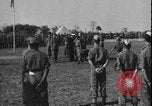
Lord Louis Mountbatten presents medals to Indian and British soldiers of the 5th Indian Division, Indian bagpipe band plays during ceremony in Assam India during WW2
Lord Louis Mountbatten, the Supreme Allied Commander of South East Asia, presents medals to 5th Indian Division soldiers at their camp in Assam, India during World War 2. Lord Louis Mountbatten presents medal to Indian, Sikh and British soldiers individually. 5th Indian Division soldiers stand in formation. Lord Louis Mountbatten addresses British soldier standing in formation. British soldiers in formation, wearing the British Army Jungle Slouch hats. Lord Louis Mountbatten addresses Indian soldiers standing in formation. Lord Louis Mountbatten presents medal to British soldier wearing a Jungle Slouch hat. Soldier takes his turn after his comrade has been presented with a medal. Bagpipe band composed of Indian soldiers plays at the ceremony. Indian soldiers standing in formation, holding their guns, as Lord Louis Mountbatten inspects the army. Flag of the United Kingdom. 5th Indian Division soldiers in formation.
CRITICALPAST.COM: About Us | Contact Us | FAQs - How to Order | License Agreement | My Account | My Lightboxes | Shopping Cart | Advanced Search | Featured Collections | Website Terms & Conditions | Privacy Policy ©2026 CriticalPast LLC.
License Agreement |
Terms & Conditions |
Privacy Policy
©2026 CriticalPast LLC.