


 Francais
 Deutsch
 Italiano
Refine Your Search
Nevada United States 1936 stock footage and images
- Showing 23047 to 23052 of 27294 results more
more Hide
Hide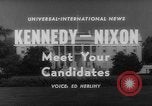
Kennedy and Nixon campaign for the Presidential election of 1960 and give reasons to elect them as President.
Presidential election of 1960. Candidates for Presidential election race, John F. Kennedy and Richard Nixon. Kennedy being welcomed during his campaign. Confetti being poured as people cheer the Kennedy couple (then Senator John F. Kennedy and Jacqueline Kennedy) in a parade in New York City on October 19, 1960 during the Presidential campaign. Voters putting on Kennedy campaign buttons and showing Kennedy signs. Kennedy at the Democratic Convention in Los Angles along with his sister and mother after being declared the Presidential candidate. Kennedy as Senator as he attends Senate committee meetings, including one with Robert Kennedy speaking by his side. Kennedy with his running mate for Vice President, Lyndon B. Johnson. Democratic Party's election campaign in Berlin, West Germany. Kennedy with wife Jacqueline Kennedy and daughter Caroline Kennedy, seated on a couch together. Republican party candidate Richard Nixon at Republican convention after being declared the party's Presidential candidate. Nixon with his running mate Henry Cabot Lodge, with both men talking to President Dwight Eisenhower. Nixon being welcomed in Poland by cheering crowds and he visits the Warsaw ghetto. He is seen climbing in and out of a window of the ghetto. Vice President Richard Nixon with Russian premier Khrushchev preparing for the so-called Kitchen Debates. View of the kitchen debate set. Nixon campaigns extensively and receive enthusiastic crowds in various cities. Both the candidates sum up giving reasons for choosing them as the next President. Kennedy says that he aims at making America a stronger country. Whereas Nixon speaks about the experience gained by him under President Eisenhower. He emphasizes maintaining peace without surrendering. Nixon and Kennedy after giving the reasons for their election. They shake hands as photographers take pictures.
Role of the Jeep in U.S. military operations during World War II.
A U.S. Army Air Forces (USAAF) Waco CG-4A-WO glider is seen descending and landing in a grass field. Upon touchdown, its front pops open and and an army jeep drives out. USAAF C-47 aircraft are seen next, offloading jeeps pulling small artillery pieces, and infantry who move rapidly from the parked aircraft. Jeeps traversing a high hump in a dirt road. A jeep towing an M-3 Antitank Gun 37mm, and others driving through underbrush and bouncing over rough road while towing 37mm guns and trailers. Soldiers stepping from jeeps to set up machine guns. American soldiers playing a game of horse and rider, during a break in duties. Soldiers setting up mortars. Jeeps driving through bodies of water. Two M4A1 (76)W Sherman tanks, with cast steel hulls, drive into a stream. Troops setting up several 37mm guns on a river bank. Two soldiers in a communications jeep. Army officers perusing a map laid out on the hood of a jeep. U.S. field artillerymen using periscopic binoculars on tripods, to spot and direct gunfire. Military vehicles, including jeeps, moving across desert terrain. Artillery crews firing M59 (M2 Long Tom) 155mm guns. A Douglas A-26 Invader aircraft flying overhead. Jeeps in various roles, bouncing along in the desert and laying smoke screens. Jeeps equipped with M3 anti-aircraft guns and others with stretchers for wounded affixed to their sides. U.S. Army Ford GPA "Seep" amphibious jeeps plunging into water and continuing on as boats. A jeep production and assembly line in a U.S. factory showing stages of assembly and finished jeeps driving out of the plant into yards containing hundreds of them. A convoy of jeeps driving over a bridge, and others carrying a U.S. military brass band in a parade in England. A Hollywood actress (Gloria Swanson?) being lifted into a jeep by several men. Glimpse of an unidentified actress with an American soldier, in a jeep. Hollywood stars, Stan Laurel and Oliver Hardy clowning in the front seat of a jeep with Desi Arnaz and two women riding in the back. Several jeeps carrying these and other Hollywood personalities during a war bond parade in Washington DC. The Capitol looming in the background as the jeeps move away from it toward the camera. Jeeps being prepared for transport to overseas destinations. Jeeps being partially disassembled and loaded into wooden crates and placed on rail cars for transport. Jeeps being hauled by cranes and placed aboard ships. Landing crafts mechanized (LCMs) transporting infantry and vehicles, including jeeps. An M4A1 Sherman tank driving out of a landing craft into surf. A jeep being driven onto beach at Adak,in the Aleutians,from a landing craft of the USS J.Franklin Bell (AP-34), in 1942. In 1943, this transport ship was reclassified as APA-16.) American troops with jeep on a South Pacific island in World War 2. A soldier on motorcycle, skids in mud on road in North Africa, and jeeps drive past him. American soldiers ride camels and some drive in a jeep near the Great pyramid and Sphinx in Egypt. Jeeps seen in China, with Generals Joseph Stilwell and Claire Chennault. One parked next to a Flying Tiger P-40 airplane. Soldiers in a jeep in Alaska, next to a tent and sign pointing to "Tokyo." Local tribesmen literally carrying a jeep, on long poles, across a river in Timor. General Douglas MacArthur, accompanied by staff officers, being driven in a jeep along a jungle road in New Guinea, past a line of local tribesmen. Wendell Wilkie, serving as Ambassador-at-large, during the war, speaks to U.S. officers in a jeep. Britain's King George VI in a jeep followed by another carrying Queen Elizabeth. President Franklin D. Roosevelt riding in a jeep to review troops. He removes his hat as they pass the American flag. Sign on a building in North Africa reads "Bizerte." General George S. Patton, standing in a jeep during a victory parade in North Africa. Soldiers at an outdoor religious service during the war with the hood of a jeep serving as a make shift altar.Various views of jeeps driving with soldiers in them.
Assorted scenes of World War I, as America enters in 1917
An Allied ship in final stage of sinking by German U-Boat during World War 1. The ship's boilers explode as she goes under. U.S. President Woodrow Wilson looking out a window in his office in the White House. Officers and crew crowd conning tower of German submarine U-35 as it approaches a steamer it has stopped in Mediterranean Sea. View of shells from the U-Boat's deck gun, striking at the ship's waterline. View from the U-Boat U-35 deck as the attacked ship is sinking. She disappears, bow-first, beneath the water. Black smoke issues from her stack. President Wilson signing papers at his desk. American flag flying in front of the nation's capitol. President Wilson addressing the Congress and obtaining a declaration of war against Germany, on April 6, 1917. A banner reading: "War is declared." New recruits marching into an Army Post, in civilian clothes, carrying personal baggage. Regular U.S. soldiers beginning the basic training of recruits. Recruits learning the manual of arms, with wooden substitute weapons. Recruits engaged in Calisthenics outdoors at an army base. Contingents of uniformed and trained American soldiers marching along a road. Soldiers practicing live fire with machine guns, and engaged in bayonet training. Troops in formation double-time marching. American troops marching to trains at a railroad station, as spectators cheer them from the train station platforms. They board railway train and wave as it pulls out of the station.
American soldiers enjoy recreation, sponsored by charitable organizations during World War I.
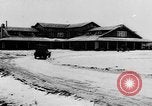
American soldiers enjoying recreation during World War I. Cars pull up outside a recreation building, in snow. A church-sponsored facility for soldiers, seen from outside in snow, with several persons at entrance. American soldiers read books at Salvation Army library. Soldiers read with an American flag in the background. Soldiers leaving a Knights of Columbus Hall. Soldiers wave from the balcony of a Masonic Hall. Soldier plays piano as another sings, at a recreational facility. Older persons visiting with them. Soldier converses with two young women on veranda of recreation facility. Inside, volunteers visit with the soldiers. Older woman invites soldier to sit and chat awhile. Young woman and soldier come into room from the veranda.
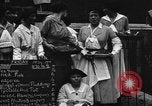
Women run a food kitchen in Britain, during World War I
A Group of women pose, holding trays and dishes, next to a slate chalk board, containing a menu and pricing for food items on Friday, May 17th, 1918. The items are priced in British pennies. In a change of scene, women customers are seen leaving the building with food purchases.(one has a small dog on a leash.) Several stand and chat while they sip cups of tea. Back inside the building, three women smile as they hold food and empty dishes.

Animation shows the launch of Soviet satellite Sputnik 1.
Animation shows the first Soviet satellite Sputnik being launched into space early in the "space race." Animated cartoon shows Sputnik 1 being launched by a rocket booster. Rocket takes off and detaches later on. Satellite being placed in the earth's orbit. Narrator refers to the satellite as a "new moon". Satellite orbiting the earth. Technician in front of IBM computers receives telemetry.
CRITICALPAST.COM: About Us | Contact Us | FAQs - How to Order | License Agreement | My Account | My Lightboxes | Shopping Cart | Advanced Search | Featured Collections | Website Terms & Conditions | Privacy Policy ©2026 CriticalPast LLC.
License Agreement |
Terms & Conditions |
Privacy Policy
©2026 CriticalPast LLC.