


 Francais
 Deutsch
 Italiano
Refine Your Search
Nevada United States 1936 stock footage and images
- Showing 23167 to 23172 of 27294 results more
more Hide
Hide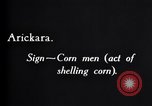
Indian sign language by General Hugh L. Scott, who shows sign for shelling corn
General Hugh L. Scott seated on a chair demonstrates Indian sign language. General demonstrate sign for Arichara, act of shelling corn.
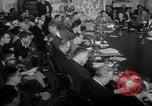
Meeting of Senate Subcommittee on Investigations chaired by Senator Karl Mundt
Senate Subcommittee on Investigations conducts so-called Army-McCarthy hearings, chaired by Senator Karl Earl Mundt. Scenes include Senator Joseph McCarthy with his chief counsel, Roy Cohn. Among Senators seen are Stuart Symington and Everett Dirksen.
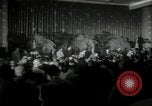
Large dinner attended by many dignitaries including Winston Churchill, Cordell Hull, John Foster Dulles
Major dinner attended by many dignitaries, including Winston Churchill, Cordell Hull, and John Foster Dulles.
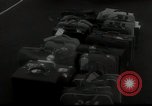
President Eisenhower and well-wishers see Vice President and Mrs. Nixon off on their trip to Asia.
Vice President Richard Nixon and his wife, Pat, mingle with officials seeing them off from Washington National Airport, Washington DC, on a trip to Asia. Luggage at the airport. 'Dick Nixon Special' sign on the airplane. Well-wishers with posters and banners stand on the observation deck balcony. One sign reads: "We Love Pat." President Dwight D Eisenhower is personally seeing them off. Mrs. Nixon carries a bouquet of flowers. The Nixons wave goodbye as they board the waiting aircraft.
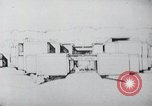
Volunteers at the Seaside Regional Center help mentally disabled children to prepare for community life.
A map of Connecticut, on which Director Bert Schnikel points regional centers such as Hartford, New Haven and the Seaside Regional Center Waterford, on the Long Island Sound. Mr Fred F Finn, Director of Seaside Center points out the importance of family in a mentally disabled person's life. Volunteers take care of children. A volunteer helps a girl to take medicine. The volunteer strokes the face of the child. And the child makes faces. Children play outside on a tractor ride. People get into a car and the car drives away. Mentally disabled children from Mansfield and Southbury come to "Seaside Regional Center for the Mentally Retarded" to prepare for community life. A boy puts on a television and sits down to watch it. A woman hands things to a girl. Volunteers help children to walk. A mentally disabled girl holds a book in her hands. A postcard sent by a normal sibling of a mentally disabled boy. Children play in snow. A boy sits on a seat while a man bends. A mentally disabled boy plays with his brothers. A couple talks about their mentally disabled child while he sits nearby.
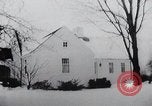
Mothers of mentally disabled children explain the importance of rehabilitation programs run by various institutes.
Families of mentally disabled children tell how their children have profited from rehabilitation programs. Snow covered land. A woman tells how her mentally disabled child has benefited after going to Mansfield School. A family in a room. The mother tells about the change in the facilities and attitude for the mentally disabled as awareness about mental disability increases. A mentally disabled boy reads from a book.
CRITICALPAST.COM: About Us | Contact Us | FAQs - How to Order | License Agreement | My Account | My Lightboxes | Shopping Cart | Advanced Search | Featured Collections | Website Terms & Conditions | Privacy Policy ©2026 CriticalPast LLC.
License Agreement |
Terms & Conditions |
Privacy Policy
©2026 CriticalPast LLC.