


 Francais
 Deutsch
 Italiano
Refine Your Search
Nevada United States 1936 stock footage and images
- Showing 23305 to 23310 of 27294 results more
more Hide
Hide
Review of remote controlled weapons of the U.S. Army Air Force such as High Angle Controllable Bombs in Azimuth only (Azon Bomb)
A review of remote controlled weapons of the U.S. Army Air Force such as High Angle Controllable Bombs in Azimuth only, called the Azon Bomb. An Azon Bomb after being dropped from a bomber aircraft from a height of approximately 15000 feet. The bomb glides through air and moves speedily towards its target on ground. The glide is controlled by fins on its tail. (World War II period).
Glow Stabilizers and Radio Controllers attached to the tail section of a bomb to control the bomb during its glide.
A review of remote controlled weapons of the U.S. Army Air Force. A pointer marks deviations from the ideal of a bomb, gliding towards its target. Workers take out tail section of a glide bomb from a case and place it on a test bench. Assembling components such as Gyro-Stabilizers, which maintain vertical position of the Rudders of the tail. Release of bomb with rudders at a 45 degree angle. Radio Controllers attached with tail section . Worker operates control lever to control the movement of tail. (World War II period).
Tail section and smoke flares attached to a glide bomb and operators observe its glide towards its target on ground.
A review of remote controlled weapons of the U.S. Army Air Force. A worker replaces cap of a bomb by a tail section. Smoke flares attached with this tail section. Bomb is placed on a cart and dragged towards a B-25 bomber aircraft of the U.S. Army Air Force. Operators work on instruments to observe the glide of the bomb through a lower gun turret well. Bomb dropped traverses towards its target on ground (World War II period).

U.S. Army training film depicting people involved in unfair means of making money like gamblers, bar girls and bookies, in the US
U.S. Army training film titled 'Don't be a Sucker'. Two wrestlers fight at wrestling match. One of the wrestlers dominates and defeats the other one. Two men in spectators, one of them looses the bet money. Gamblers playing a card game. The winner among them gets the money. A bar girl kisses the victorious man and he walks out with her. The man who lost the game strikes the winner from behind. As he falls and faints on street, the girl and other man take off his money. (World War II period).
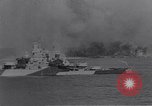
American forces in combat on land and sea, in Europe and the Pacific during World War II
American naval triple guns firing, in World War 2. The battleship, USS West Virginia, modernized and in camouflage, firing guns at a Pacific island. U.S.troops firing weapons from a beachhead. American soldiers manning a 155mm howitzer under camouflage netting. Another gun crew firing at zero elevation from heavily sandbagged position near buildings. Black flak clouds filling the air as American aircraft carrier fights off Japaneae Kanikase attack. The Kamikase plane appearing to by hit by flak. Cluster of Doouglas Dauntless planes on the carrier deck. Closeup of sailors firing double Bofors 40mm anti-aircraft guns from the carrier. Downed aircraft plunging into the sea. American troops riding a landing vehicle tracked (LVT) during amphibious assault. Landing craft stacking up along beach and subject to intense enemy fire during amphibious assault. One is hit and blows up. Flame thrower being usee to drive Japanese defenders from fortified positions. One runs out aflame. U.S. soldier throwing a grenade. American troops quick time entering an occupied town in Europe. Explosions and U.S. infantry passing destroyed buildings. Soldier firing a mortar. U.S. soldiers carrying a wounded on stretcher under fire.
Discover- E program by National Society of Professional Engineers to guide students about a career in Engineering.
Program to promote Career in Engineering. Engineers working on designing a Printed Circuit Board (PCB) in a laboratory. Other Engineers observe meter readings and operate computerized control systems. Young students at Julius West School and Laurel High school. Conference about the careers in various streams of Engineering by National Society of Professional Engineers under the program, Discover- E. Engineering professionals from Westinghouse Electronic System Group address a class of young students. Monitory aid provided, magazines and journals introduced to promote school students opting for a Career in Engineering.
CRITICALPAST.COM: About Us | Contact Us | FAQs - How to Order | License Agreement | My Account | My Lightboxes | Shopping Cart | Advanced Search | Featured Collections | Website Terms & Conditions | Privacy Policy ©2026 CriticalPast LLC.
License Agreement |
Terms & Conditions |
Privacy Policy
©2026 CriticalPast LLC.