


 Francais
 Deutsch
 Italiano
Refine Your Search
Nevada United States 1936 stock footage and images
- Showing 23665 to 23670 of 27246 results more
more Hide
Hide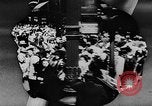
Montage of images reflecting life in 20th century America up to World War II
Streets of Manhattan New York City crowded with pedestrians prior to World War II. Views of Americans at work: miners; farmers; factory workers; office workers. A drafting room. Montage of inventions in America: lightning rod atop roof; cotton gin in operation; telegrapher using a key; anesthetists in operating theater; rotary newspaper printing press; a telephone; an arc welder; early incandescent lamp; early submarines; steam turbine; 4-engine high wing airliner; early X-ray tube; gyroscope compass; singer sewing machine; early television; farmer hooks cows to mechanical milking machine, cat expresses dismay at not getting milk; architectural draftsmen at work; rows of apartment buildings; automobiles crowding roads; sanitation street sweeper truck at work; eggs and dairy products in refrigerated case; Surgical team in an operating theater; Scenes in a modern U.S. hospital; children being cared for, and in schools and colleges; Soldiers marching during World War I; U.S. soldiers marching in World War II; people relaxing on crowded beach; recreational hunting and fishing activity; A football game in progress; a baseball game; horseracing; track & field events; a rodeo; a basketball game; golfing; Ten pin bowling; boys play marbles; frog jumping contest; skiing; springboard diving; motorboat racing; water skiing;ice skaters with sails; Joe Louis boxing with Max Schmeling in 1938; auto racing with cars crashing; Railroad timetables in a rack; Henry Dreyfuss Commodore Vanderbilt New York Central locomotive and interior of dining car; 1935 Chevrolet sedan pulling a trailer; Road sign "Arizona welcomes you"; Motorcycle policeman pulls driver over; roadside motor hotel; girl serving at drive-in diner; signs for hot dogs, beer, cheesburgers; workers preparing sandwiches, pancakes,bacon and eggs, coffee and coca cola, using some machinery; Customers eating at a lunch counter; Welcome sign at Van Nuys California with symbols for Kiwanis, American Legion, Rotary; a Delta Sigma Phi fraternity building. Scene of a person's hand signing a membership certificate document for the Calibou Lake Mountain Club.
Montage of images reflecting aspects of 20th Century life in America before World War II
Brief views of ordinary American people and their music and reading activities, including: Scenes of many different radios in all locations, and hands on dials of radios, including console radios, portable radios in many rooms of the house, car radios, and hand-carried (vintage boom box) radio. A jukebox and a bobby soxer (bobby socks fashion), dancing; Crowd dancing to a swing band at a jazz night club; Older people doing country dances; Xavier Cugat conducting his orchestra; Tchaikovsky's 5th symphony being played in the Hollywood Bowl; African American jazz musician playing trumpet; a school marching band; newspaper being printed on a printing press; a news stand filled with papers and magazines; numerous city newspapers; a library filled with books; a Dick Tracy comic strip.
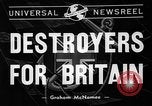
U.S. Destroyers, including some being readied for transfer to Britain, under the Destroyers for Bases Agreement of 1940.
A line of U. S. Destroyers tied up in a port. In the line of ships are seen DD-121 ( USS Montgomery), and DD-122 (USS Breese), both Wickes Class Destroyers that saw action with the U.S. Navy in World War II. Workers, including welders and such, are seen repairing and otherwise preparing 4-stacker destroyers for transfer to Britain in the so-called "Destroyers for Bases Agreement" of September 2, 1940.The USS Hale (DD-133) a 4-stacker Town Class Destroyer, later commissioned as HMS Caldwell (I-20), is seen underway in a channel. Lines of ships underway are seen in an aerial view.
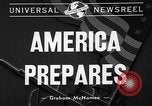
President Franklin Roosevelt signs the Selective Training and Service Act of 1940. U.S. soldiers march and drill in a camp.
America prepares for World War II. U.S. President Franklin D. Roosevelt signs the Selective Training and Service Act of 1940 (codified as 54 Stat. 885). He signs and dates September 16, 1940. A blindfolded man reaches into a large glass container and draws out the number of the first young man to be drafted under the new law. He gives the selected number to President Roosevelt. American soldiers march past a line of tents at an Army Camp. They drill on the parade field.
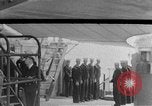
British Prime Minister Winston Churchill and top ranking British officials board USS Augusta to meet U.S. President Roosevelt
U.S. President Franklin Roosevelt and British Prime Minister Winston Churchill meet for the Atlantic Conference in World War 2 aboard USS Augusta in Placentia Bay, Argentia, Newfoundland. U.S. General George C. Marshall, Vice Admiral Ernest J. King, and Admiral Harold R. Stark, descend steps to main deck of U.S. Heavy Cruiser, USS Augusta, where they greet top ranking members of the British military establishment as they arrive for the Atlantic Conference. U.S. General Marshall is seen greeting British Field Marshall Sir John Dill. President Roosevelt is assisted by his son, Franklin, Jr. who helps him obtain a handhold on a fixture of the ship. (This is a rare shot of President Roosevelt where he is seen walking a few steps with his cane, assisted, as his disability was typically not captured on film to be shown to the public.) President Roosevelt greets British Admiral Sir Dudley Pound, Admiral of the Fleet, First Sea Lord and Chief of the Naval Staff. He also greets British Field Marshal Sir John Dill, Chief of the Imperial General Staff. British Prime Minister Winston Churchill arrives, salutes the President, and walks past. Franklin Roosevelt, Jr. steps forward and guides Churchill back to stand with President Roosevelt, for the camera.
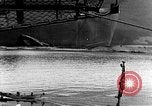
Atlantic Conference. A gangway is set between HMS Prince of Wales and USS Augusta. Roosevelt and Churchill converse.
In preparation for the World War 2 Atlantic Conference, crews of the British Battleship, HMS Prince of Wales and the U.S. Heavy Cruiser, USS Augusta, prepare a gangway connecting the two ships. British Prime Minister Winston S. Churchill is seen pacing the deck of the Prince of Wales, as the crews are at work. A cat is seen on deck. Several individuals pass over the gangplank. Later, President Roosevelt and Prime Minister Churchill are seen seated on deck of the USS Augusta, as members of their respective parties mingle and converse. Sailors from the USS Augusta mingle with British sailors aboard HMS Prince of Wales.
CRITICALPAST.COM: About Us | Contact Us | FAQs - How to Order | License Agreement | My Account | My Lightboxes | Shopping Cart | Advanced Search | Featured Collections | Website Terms & Conditions | Privacy Policy ©2026 CriticalPast LLC.
License Agreement |
Terms & Conditions |
Privacy Policy
©2026 CriticalPast LLC.